

You've tried cutting gluten. Maybe you went dairy-free for a month. You feel a little better, then a little worse, and you still can't figure out what the hell is actually going on in your body. Your joints ache in the morning, your skin does something weird, your digestion is unpredictable, and your energy is just... gone. Doctors say your labs are fine. But you know something is off.
This program is for that person. The one who needs a real answer, not just a hunch.
The 28-Day Autoimmune Reset is the most structured protocol I offer. It's strict on purpose, and it's temporary by design. Four full weeks with the most common inflammatory food groups removed, so your system gets a genuine rest. Then a careful, staged reintroduction so you can find out exactly what you're reacting to and what you're not. No guessing. No blaming everything and fixing nothing.
- A full 28-day elimination window with clear guidance on what comes out and what stays in
- A paired 5-day AIP meal plan to get you started without staring at your kitchen in a panic
- Six daily trackers (joint comfort, energy, skin, digestion, mental clarity, and sleep) so you build an actual record, not a memory
- A five-group reintroduction ladder run in clinical order over 15 additional days
By the end of 43 days, you will know things about your own body that no lab panel has ever told you. That's the whole point.
Why your body needs all four weeks to respond
A lot of elimination approaches run 21 days. I went with 28 because most people spend the first week just getting the food figured out. By week two the novelty has worn off and the fatigue of the protocol hits. Week three is when your body is actually doing the deeper work. Week four is when you start to see what baseline really feels like for you, maybe for the first time in years.
Twenty-eight days gives the gut lining a fighting chance to quiet down. It gives your immune system time to stop reacting to the absence of something it had been constantly exposed to. Two weeks is often just long enough to feel like you did something without actually learning anything useful.
This protocol runs 43 days total: 28 of elimination, 15 of staged reintroduction. Block it out on your calendar before you start. Knowing the end date makes the hard middle easier to get through.
Every food group removed and what fills the plate
The elimination phase removes grains (all of them, including rice and oats), dairy (all forms), eggs, nuts, seeds and seed-based spices, nightshades (tomatoes, peppers, potatoes, eggplant, paprika), legumes, alcohol, refined sugar, and industrial seed oils. That sounds like everything. It isn't.
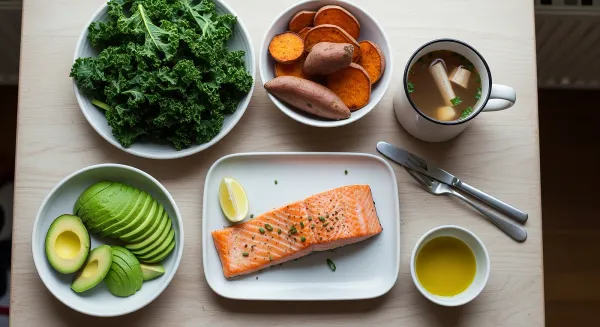
What you have left is generous: all meat and fish, all vegetables that aren't nightshades, fruit, coconut in every form, olive oil, avocado, avocado oil, lard, tallow, fresh herbs, sea salt, and non-seed spices like turmeric, ginger, cinnamon, and garlic. This is real food. It's flavorful. It takes some adjustment, but people consistently eat well on this phase once they stop staring at what they can't have and start cooking with what they can.
The 5-day AIP meal plan is paired with this program for exactly this reason. Use it for the first week while you find your footing, then riff from there.
Days one through five and the fatigue of weeks two and three
Days one through five are the adjustment. You might get a headache. You might feel cranky and tired and wonder why you signed up for this. That's normal. Your body is recalibrating. Keep your electrolytes up, eat enough fat, and don't let yourself get hungry. Hungry people on an elimination diet make desperate choices.
Days six through fourteen, most people start to feel a shift. Sleep often improves first. Then digestion. The joint stuff and the skin stuff tend to take longer.
Days fifteen through twenty-one are usually the clearest stretch. This is where people start saying things like "I didn't realize how foggy I was until I wasn't anymore." Hold that feeling. Write it down. It's your new reference point.
Days twenty-two through twenty-eight are about cementing your baseline. Don't rush into reintroduction early. The data you collect in this final stretch is what makes the next phase meaningful.
The three-day reintroduction window explained
The whole value of this protocol lives in the reintroduction. If you do it sloppily, you lose the information you spent 28 days earning.
Each group gets three days. On day one of each group, eat a normal portion of the test food, two or three times that day. Then stop eating it. Eat clean elimination-phase food for the remaining two days and watch closely. Reactions can show up immediately, a few hours later, or sometimes 48 hours out. This is why the three-day window matters.
A reaction doesn't have to be dramatic. Some people get a rash. Some get a headache. Some notice their joints stiffen overnight, or their digestion gets loud, or they sleep poorly, or their mood tanks. Watch your six trackers every single day and rate them honestly. If something shifts after a test food, you have your answer. If nothing shifts, that food is likely fine for you. Move to the next group.
Do not test more than one group at a time. If you sneak in something from a later group during an earlier test window, you can't trust what you're seeing. Three days per group, clean in between, in order.
Egg yolks first and the clinical order that follows
The five groups reintroduce in this order, and there's a reason for the sequence.
Group 1: Egg yolks (days 29 to 31). Yolks only, no whites. The white is the more reactive part, so we start here to see if eggs are even in the picture for you before we go further. Many people tolerate yolks beautifully. If you do, that's useful information.
Group 2: Seeds and seed-based spices (days 32 to 34). This means things like sunflower seeds, pumpkin seeds, cumin, coriander, mustard, and sesame. Seeds are a broad category and they add a lot of variety back in. Testing them before nuts makes sense because the two groups have different protein profiles, and separating them gives you cleaner data.
Group 3: Nuts (days 35 to 37). Start with one type, something mild like macadamias or almonds, rather than going straight for the heavy hitters. Tree nut sensitivity is pretty common in people with autoimmune patterns, so go slowly here and pay attention.
Group 4: Nightshades (days 38 to 40). Tomatoes, peppers, potatoes, eggplant. This group matters a lot for people with joint issues, because the alkaloids in nightshades seem to bother certain people more than others. Some people are genuinely fine with them. Others add them back and immediately feel it in their knees. The tracker data here is invaluable.
Group 5: Ghee and butter (days 41 to 43). These come last because they're dairy-derived, but they're also the dairy forms least likely to cause problems for most people. Casein and lactose are largely removed in the clarification process. If you react to ghee, that tells you something about your dairy sensitivity. If you don't, ghee and butter may well be a permanent part of your life again.
Why a daily symptom log beats memory
You rate six things every day: joint comfort, energy, skin, digestion, mental clarity, and sleep. Each one on a simple scale.
Here's why this matters. Human memory is genuinely bad at tracking slow, gradual changes in how we feel. We adapt to our normal, whatever our normal is. By the time something shifts, we've already forgotten how we felt two weeks ago. The trackers give you a paper trail (a digital one, in this case) that your memory cannot fake or soften.
When you hit day 35 and you're testing nuts, you want to be able to look back at your baseline scores from weeks three and four and compare them honestly. That comparison is the whole point. Don't skip the trackers on the easy days. The easy days are the most important ones to document.
Label traps, low calories, and other protocol killers
Reading labels wrong. "Spices" on an ingredient list can hide nightshades or seed-based spices depending on the product. If you can't verify what's in it, skip it during the elimination phase.
Going too low calorie. This protocol removes a lot of foods, and some people unconsciously under-eat. You should be eating satisfying meals. Add an extra half an avocado, pour a more generous hand of olive oil, eat a proper portion of protein. Feeling miserable and food-deprived is not the goal and it's not going to give you clean data either.
Reintroducing too early because they feel great. This one is frustrating to watch. Feeling great is not a sign you can skip the elimination window. It's a sign the protocol is working. Finish it.
Testing more than one group at a time. I said it above and I'll say it again, because this is the one that kills the data. One group. Three days. In order.
Giving up after a reaction. A reaction to a food is not a failure. It's information. That's the whole reason you did this. Note it, grieve it if you need to, and move to the next group.
Medical and personal history to consider before starting
If you have a diagnosed autoimmune condition, are pregnant or nursing, or have any history of disordered eating, please talk with your doctor or a registered dietitian before you start. This program is structured and intentional, but it's not a substitute for personalized medical care, and there's no version of this where your specific health history doesn't matter.
What the evidence actually says
The autoimmune protocol has been studied directly in inflammatory bowel disease. A prospective study of an elimination phase followed by maintenance reported improvement in patient-reported and clinical measures, and a companion analysis reported changes in intestinal RNA expression.
These were small studies without a control group, and the authors say plainly that randomized trials are still needed. That is the honest framing: promising and specific, not settled.
These are the sources behind this program. They are worth reading yourself; none of them were written to sell you anything.
Sources
- PubMed: Efficacy of the Autoimmune Protocol Diet for Inflammatory Bowel Disease
- PMC: The Autoimmune Protocol Diet Modifies Intestinal RNA Expression in Inflammatory Bowel Disease
- Harvard T.H. Chan Nutrition Source: Diet Review: Anti-Inflammatory Diet
- Cleveland Clinic: What Is Your Gut Microbiome?