

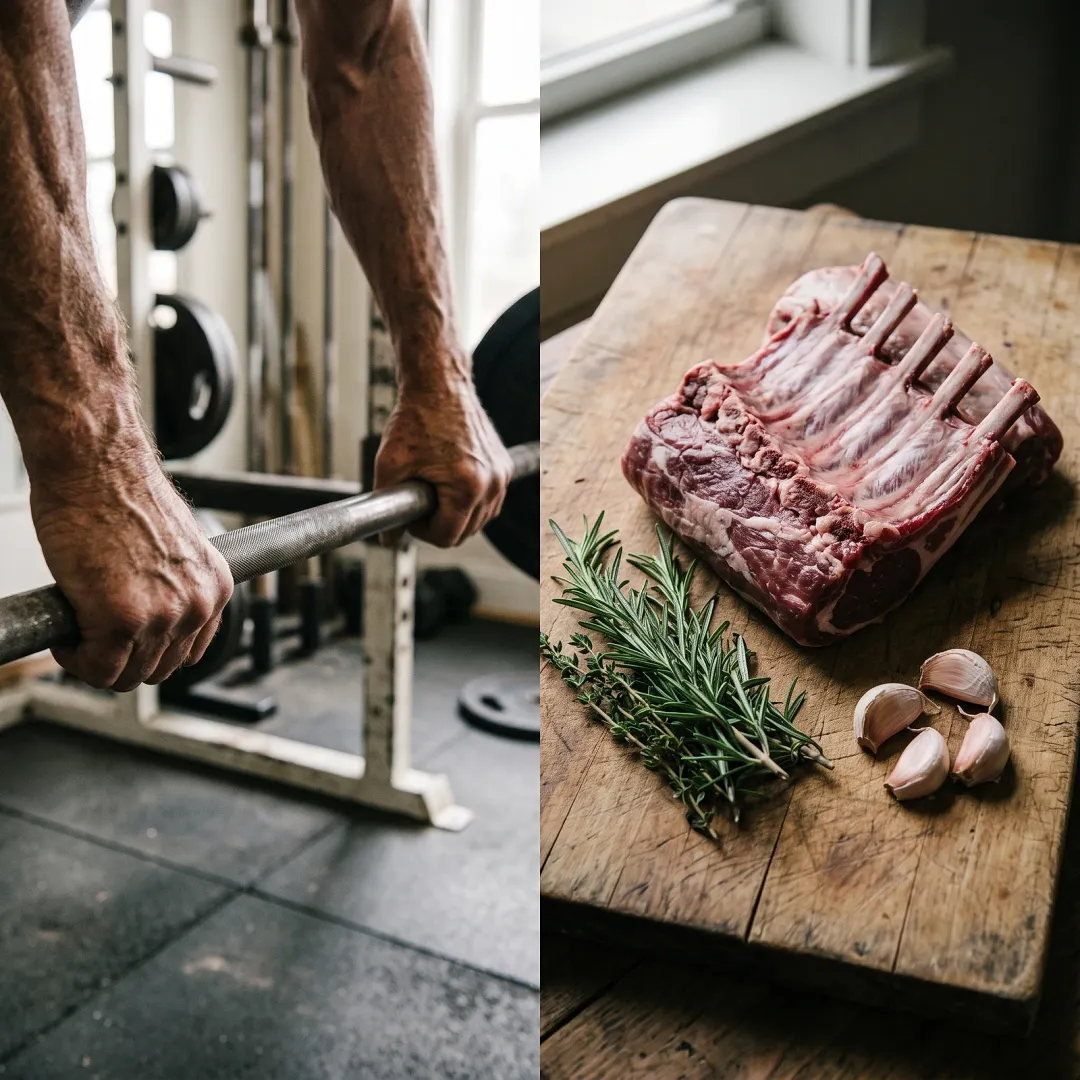

Your muscles are running a cleanup system right now, scrapping damaged proteins and rebuilding tissue, and at some point in your thirties that system starts quietly breaking down. Not because you stopped caring. Because a gene nobody told you about started going haywire. Scientists just figured out why, and the answer changes how I think about every single workout.
What DEAF1 Is and Why You Should Care
Researchers recently published findings showing that a gene called DEAF1 becomes overactive as muscles age, and when it does, it throws a wrench into one of the most important biological processes your body runs: autophagy. That's the cellular cleanup crew, the system that identifies damaged, misfolded, or worn-out proteins and hauls them out so your muscles can actually rebuild.
According to the ScienceDaily report on the study, exercise can help restore this balance, giving DEAF1 activity a nudge back toward normal and allowing older muscles to regain the ability to repair and strengthen. The caveat is right there in the research: the results are promising, but scientists are still working out the full picture.
This is not a minor footnote. This is the kind of finding that reframes the whole conversation about aging and muscle loss, and it deserves more than a trending-science headline.
The Timeline: How Long We Have Known the Pieces
This discovery did not come out of nowhere. The science behind it has been building for decades, piece by piece. Here is what the published record actually shows.
The 1990s: Autophagy gets named and characterized. Japanese cell biologist Yoshinori Ohsumi began mapping the genes responsible for autophagy in yeast in the early 1990s. His team's work, published through the decade, established the core molecular machinery of cellular self-cleaning. He won the Nobel Prize in Physiology or Medicine in 2016 for this body of work. At the time of his earliest publications, no one was talking about DEAF1. They were just trying to understand how cells eat themselves in a controlled, useful way.
2007: Research begins linking impaired autophagy to muscle wasting. A study published in Autophagy showed that disrupting autophagic flux in skeletal muscle led to progressive myopathy, the kind of muscle wasting that looks, on the surface, a lot like what we call "normal aging." That paper was published in 2007. We are now nearly twenty years on from that finding.
2012 to 2018: Exercise and autophagy science converges. Researchers started confirming that exercise, specifically resistance and endurance training, actually stimulates autophagy in muscle tissue. A 2012 paper in Nature showed that exercise-induced autophagy is required for the metabolic benefits of physical activity in mice. A 2018 review in Aging Research Reviews gathered the evidence that aging specifically impairs autophagic function in skeletal muscle, and that this impairment is linked to the accumulation of damaged proteins and the loss of muscle mass known as sarcopenia. The science was accumulating. The gap between what researchers knew and what the general public heard about it was already widening.
2026: DEAF1 enters the picture. The new finding, covered by ScienceDaily, identifies DEAF1 as a previously overlooked regulator that becomes overactive with age and actively interferes with autophagy in muscle tissue. This is the "why" that the earlier research was pointing toward without being able to name. Exercise was already showing up in the data as a corrective. Now there is a specific gene-level mechanism attached to that effect.
That is roughly three decades of converging science. The mechanism was being assembled in plain sight, in peer-reviewed journals, by researchers who were not hiding it. It just was not landing in your doctor's office or on your gym trainer's handout.
Why This Never Made It Into Your Doctor's Office
This is where I have to say something blunt. The gap between "we published this" and "your doctor mentioned it" in the context of muscle aging is enormous, and it is not a mystery why.
Sarcopenia, the progressive loss of muscle mass and strength as we age, is a recognized clinical condition. The National Institutes of Health has documented it as a major driver of frailty, falls, and loss of independence in older adults. The standard response from the medical establishment? Adequate protein and "some resistance training." Which is right, by the way. It is just grossly incomplete now that we have a molecular explanation sitting in the literature.
The DEAF1 finding matters because it gives us a target. If this gene's overactivation is suppressible through specific types and volumes of exercise, that is not just a lifestyle suggestion, it is a biological intervention. But that kind of finding does not come with a prescription pad. It does not generate a revenue stream for a pharmaceutical company. Nobody owns the patent on squats.
I am not saying there is a coordinated conspiracy to hide the autophagy-exercise research. What I am saying is that the incentives in our healthcare system are not pointed toward "exercise restores a gene you have never heard of and your muscles can clean themselves again." That does not have a billing code.
What the Autophagy Gap Actually Means for Your Body
Think about autophagy this way. Your muscle cells are constantly building and breaking down proteins. When everything is working, damaged proteins get flagged, collected, and dismantled so the raw materials can be reused. DEAF1 overactivation, according to the new research, disrupts that flagging and collection process. Damaged proteins pile up. The muscle cannot rebuild efficiently. Strength declines. Recovery slows.
This is happening to most people over forty at a cellular level that no amount of good intentions fixes without movement.
A 2019 review in the Journal of Physiology confirmed that resistance exercise specifically upregulates the autophagy pathway in human skeletal muscle, meaning the same type of training that builds strength also appears to support the cleanup system those muscles depend on. The two processes are not separate. They are intertwined.
The research also makes a case for adequate dietary protein as a necessary partner. Your muscles need the raw material. When you eat real, whole-food protein, you give the rebuilding process something to work with. A braised lamb shoulder, a lamb stew made from bone-in pieces, a simple rack of lamb roasted with herbs: lamb is one of the densest sources of leucine and other branched-chain amino acids that directly signal muscle protein synthesis. A 2017 paper in the American Journal of Clinical Nutrition showed that leucine in particular is a key trigger for the mTOR pathway, the anabolic signal that tells your muscles to build. That signal works better when the autophagic cleanup is also functioning, which is exactly what the DEAF1 research is pointing toward.
So no, this is not me saying "eat lamb and all your problems are solved." It is me saying that the protein your grandmother told you to eat and the exercise your body was designed for are now being confirmed at the gene-expression level to do exactly what they were always doing.
The Documented Record, Piece by Piece
I want to lay this out as clearly as I can, because "scientists discovered" headlines flatten the timeline into a single moment, and the reality is that each of these findings was available to anyone paying attention.
- 1993: Ohsumi's lab publishes foundational autophagy gene research. Available. Peer-reviewed. Ignored outside cell biology.
- 2007: Autophagy impairment directly linked to muscle wasting in a published study, as noted above. Clinical awareness: minimal.
- 2012: Exercise-induced autophagy confirmed in Nature as required for metabolic benefit. Published. Still not in mainstream gym or medical culture.
- 2016: Nobel Prize awarded for the autophagy work, briefly a trending science story. Then forgotten by general media within weeks.
- 2018: Aging specifically confirmed to impair autophagic function in skeletal muscle. Sarcopenia mechanistically explained. Primary care awareness: still limited.
- 2026: DEAF1 named as the overactive gene that is doing the disrupting. The "why" finally attached to the "what."
Thirty years. No conspiracy. Just the slow, underfunded, clinically underleveraged march of real science through a system that does not particularly reward it when it points toward movement and food.
What You Can Actually Do With This
The research is still developing. The DEAF1 findings have not yet been fully replicated in humans at a clinical scale. That matters, and I am not going to pretend the science is more settled than it is. What it does give us is a plausible, mechanistic reason to take the exercise-for-muscle-longevity case seriously beyond "it builds strength."
Here is what the evidence supports, without overclaiming:
Resistance training, consistently. The 2018 Aging Research Reviews paper found that exercise is one of the most reliable ways to support autophagic function in aging muscle. That does not mean you need to deadlift three hundred pounds. It means progressive overload, meaning you are consistently asking your muscles to do a little more than they did last time, appears to be doing something real at the cellular level.
Adequate protein from whole-food sources. Research consistently links protein intake, particularly from leucine-rich sources, to muscle protein synthesis. Lamb, grass-fed beef, pastured pork, wild-caught fish: these are the proteins your muscles were designed to use. The amino acid profile matters. Ultra-processed protein powders full of additives are not the same thing as a properly raised lamb chop.
Not waiting until you feel weak. Sarcopenia tends to be invisible until it is not. The cellular decline documented in the literature begins well before most people notice strength loss. This is a case where the evidence strongly suggests starting, or maintaining, earlier is better than reacting later.
Talk to your doctor. If you are managing a condition that affects how you exercise or how you absorb protein, this is a conversation for a qualified healthcare professional. I am a functional medicine health coach. I can help you understand the research and think about your choices. I am not your physician.
God designed these bodies to move, and He designed food to feed them. The DEAF1 story is, at its core, a confirmation of something ancient: that sitting still and eating poorly is not how we were built to live. The science is just finally catching up with the common sense.
Key Takeaways
- A gene called DEAF1 becomes overactive with age and disrupts autophagy, the cellular cleanup process muscles depend on for repair and rebuilding.
- The science connecting autophagy, muscle aging, and exercise has been building in peer-reviewed literature for roughly three decades, from Ohsumi's 1990s work to the 2026 DEAF1 findings.
- Exercise, particularly resistance training, has been shown in multiple studies to support autophagic function in aging muscle tissue.
- Leucine-rich whole-food proteins like lamb may support the muscle protein synthesis that depends on a functioning cellular repair system.
- The gap between what is published and what reaches clinical practice is not a mystery: findings that point to movement and food do not generate pharmaceutical revenue.
- This article is for general informational purposes only and is not medical advice. Always consult a qualified healthcare professional before making changes to your diet or health routine.
Sources
- ScienceDaily: Scientists discover how exercise reverses muscle aging
- Nobel Prize: Nobel Prize in Physiology or Medicine 2016, Yoshinori Ohsumi
- PubMed / Autophagy: Impairment of autophagy in skeletal muscle leads to progressive myopathy (2007)
- Nature: Exercise-induced autophagy is required for metabolic benefit (2012)
- PubMed / Aging Research Reviews: Aging-related impairment of autophagic function in skeletal muscle (2018)
- PubMed / Journal of Physiology: Resistance exercise upregulates autophagy pathway in human skeletal muscle (2019)
- PubMed / American Journal of Clinical Nutrition: Leucine as a key trigger for mTOR and muscle protein synthesis (2017)
- National Institute on Aging: Sarcopenia: Age-Related Muscle Loss
This article is for general informational purposes only and is not medical advice. Always consult a qualified healthcare professional before making changes to your diet or health routine.




Join the conversation
What do you think?
Free members can comment, reply and like. It takes ten seconds.