
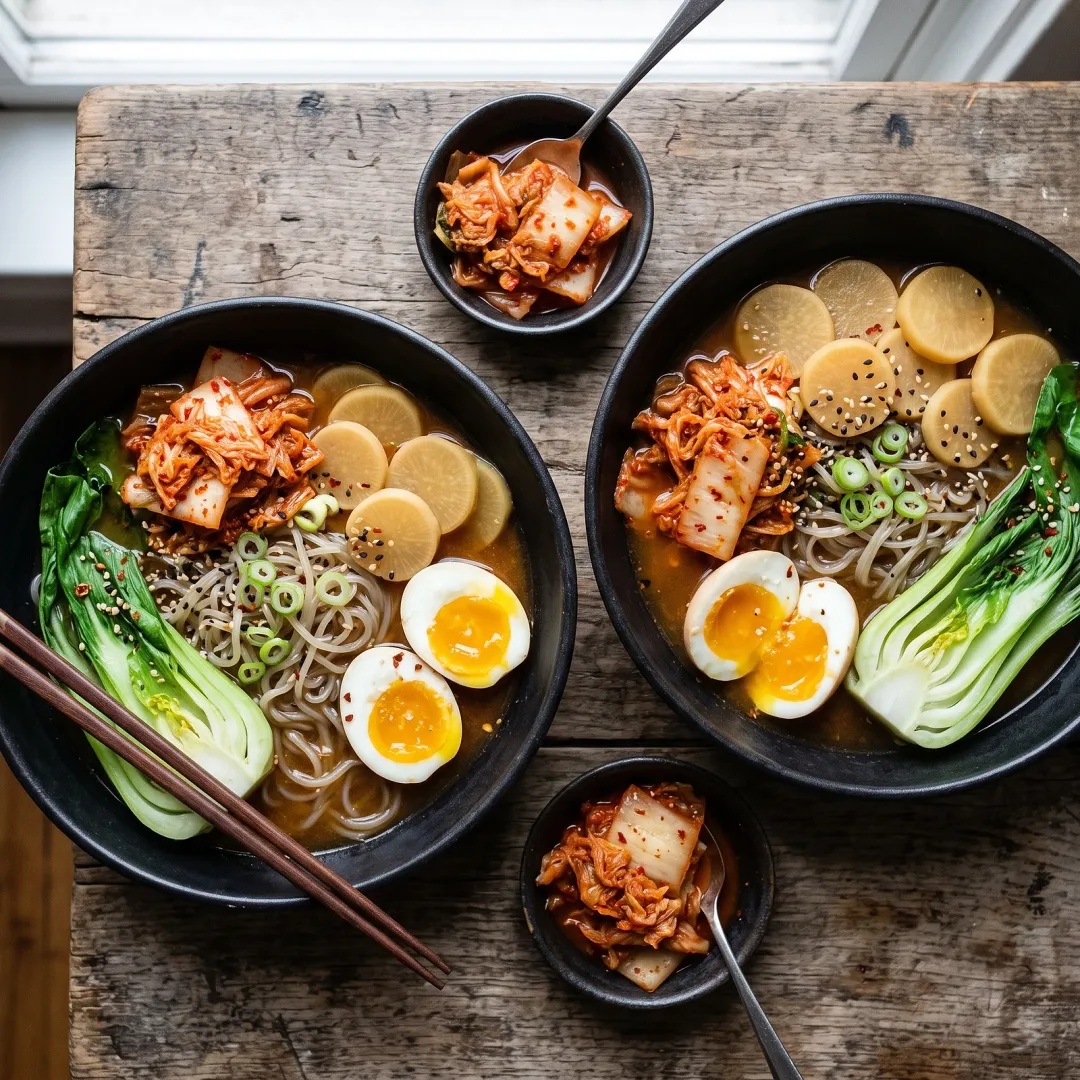

There is something about a warm broth bowl at lunch that fixes things. Not in a dramatic way, just in a quiet, steady way that makes the afternoon feel manageable. This one has been in my rotation for a while now, and it hits differently from most. The base is a sesame-spiked bone broth, deeply savory and just a little spicy. The noodles are kelp, which means zero grains and a satisfying, slightly chewy texture that holds up in broth better than you'd expect. And then the fermented vegetables go in cold on top, a big scoopful of kimchi and tangy fermented daikon, because you do not want heat killing off the cultures you are eating them for in the first place. The whole thing comes together in 30 minutes. It looks like something you'd order at a good spot and pay too much for. But it's sitting on your own counter, and you made it from real food.
Nutritional Benefits
Why Fermented Vegetables Belong in Your Lunch
- Fermented vegetables like kimchi and fermented daikon are rich in live probiotic cultures. Research published in the journal Cell (2021, Wastyk et al.) found that a diet high in fermented foods was associated with increased microbiome diversity and markers of immune function compared to a high-fiber diet alone.
- Traditional lacto-fermentation produces lactic acid, which acts as a natural preservative and may support the gut lining environment over time, according to research reviewed in Nutrients (2020).
- Fermented napa cabbage is also a source of vitamins C and K, and the fermentation process can increase the bioavailability of certain nutrients compared to raw cabbage.
Kelp Noodles: A Grain-Free Noodle Worth Knowing
- Kelp noodles are made from seaweed and are naturally very low in carbohydrates and calories, making them a solid grain-free, gluten-free base for a filling bowl.
- Kelp (seaweed) is one of the richest natural food sources of iodine, a mineral that plays a key role in thyroid hormone production, according to the National Institutes of Health Office of Dietary Supplements.
- Because they have almost no flavor on their own, kelp noodles absorb broth beautifully, which means you are not sacrificing taste when you skip the grain-based pasta.
Bone Broth as a Functional Lunch Base
- Bone broth provides collagen-derived amino acids including glycine and proline. Glycine has been studied for its role in gut barrier integrity, with research in the journal Nutrients (2017, Zhong et al.) suggesting it may help maintain tight junction function in the intestinal wall.
- Using broth as a soup base rather than a cream or oil base keeps the dish dairy-free and lighter without sacrificing that sense of deep, satisfying savoriness.
- A warm liquid base at lunch may also support hydration, particularly for people who do not drink enough water through the day.
Ginger and Garlic: More Than Flavor
- Fresh ginger contains bioactive compounds including gingerols and shogaols. A review in the British Journal of Nutrition (2015, Mozaffari-Khosravi et al.) noted that ginger may have a modest effect on markers of inflammation when consumed regularly.
- Garlic is a prebiotic food, meaning it contains inulin-type fructans that serve as fuel for beneficial gut bacteria, according to research in the journal Molecules (2019).
- Both ingredients show up in traditional fermented vegetable preparations across Korean, Japanese, and Eastern European food cultures, which is not a coincidence.
FAQs
Does the broth have to be hot when I add the fermented vegetables?
No, and actually you want to avoid that. Add the kimchi and fermented daikon directly to the assembled bowl at room temperature or cold, right before serving. Heating fermented vegetables kills the live probiotic cultures, which is the whole point of including them. The warm broth will bring the temperature up a little naturally, and that is fine.
Where do I find paleo-friendly kimchi?
Most grocery stores carry kimchi now, even regular ones. Read the label carefully. You want to see napa cabbage, radish, garlic, ginger, chili, and salt. Skip anything with added sugar, corn syrup, or additives you cannot identify. Many Korean-made brands in the refrigerated section are clean. If you want to be 100% sure of what is in it, making your own lacto-fermented kimchi at home takes about 20 minutes of hands-on time and a few days of patient waiting.
Can I make this without eggs?
Absolutely. The soft-boiled egg adds protein and richness but the bowl is completely satisfying without it. If you want to keep the protein up, add a few slices of grilled chicken or some cooked shrimp on top instead.
Is miso paleo?
Strictly speaking, no. Miso is made from fermented soybeans, which puts it outside strict paleo guidelines. That is why the ingredient is labeled with a swap. The coconut aminos plus a small splash of rice vinegar gets you very close to that umami, savory depth. If you are not strict paleo and you tolerate fermented soy well, white miso is a reasonable whole food choice, but I always flag it so you can decide for yourself.
Can I meal prep this bowl?
Yes, with one note. Keep the components separate until you are ready to eat. Store the broth, the noodles, and the bok choy together in one container, and the fermented vegetables in a separate container. When you are ready for lunch, reheat the broth and noodles gently, then pile the cold fermented vegetables on top. The texture of kelp noodles holds up well for a couple of days in broth.
If you made this bowl, I genuinely want to hear about it. Leave a comment below or tag me over on Instagram. And if you have a fermented vegetable you swear by that I did not put in this bowl, tell me. I am always looking for an excuse to add more living food to a recipe.
Fermented Veggie and Grain-Free Noodle Lunch Bowl with Sesame Miso Broth
A deeply savory, gut-nourishing lunch bowl built on kelp noodles, a warm sesame-spiked broth, and a generous pile of live-culture fermented vegetables. This is real food doing real work.
Ingredients
- 1 package (12 oz) kelp noodles, rinsed and soaked in warm water for 10 minutes
- 1 cup paleo-friendly kimchi (check label: no fish sauce with additives, no sugar, fermented napa cabbage, radish, ginger, garlic, and chili flakes is ideal)
- 1/2 cup fermented daikon radish, sliced (homemade or store-bought with no added sugar or vinegar)
- 3 cups good-quality chicken bone broth (or vegetable broth)
- 1 tablespoon white miso paste, not strictly paleo; use 1 tablespoon coconut aminos + 1/2 teaspoon rice vinegar as a swap
- 1 tablespoon toasted sesame oil
- 1 tablespoon coconut aminos
- 1 teaspoon fresh ginger, finely grated
- 2 garlic cloves, minced
- 1 teaspoon apple cider vinegar
- 1/2 teaspoon crushed red pepper flakes (adjust to taste)
- 2 heads baby bok choy, halved lengthwise
- 2 soft-boiled eggs, halved (omit for egg-free)
- 1 tablespoon sesame seeds, for garnish
- 2 scallions, thinly sliced, for garnish
- 1 teaspoon avocado oil (for sauteing)
- Sea salt, to taste
Instructions
- Soak the kelp noodles in a large bowl of warm water for 10 minutes. Drain, rinse well, and use kitchen scissors to cut them into shorter, more manageable lengths. Set aside.
- Bring a small pot of water to a gentle boil. Lower 2 eggs in carefully and cook for exactly 7 minutes for a jammy, slightly soft center. Transfer immediately to an ice bath and peel when cool.
- Heat the avocado oil in a medium saucepan over medium heat. Add the garlic and grated ginger and cook for 60 to 90 seconds, stirring constantly, until fragrant but not browned.
- Pour in the bone broth and bring to a gentle simmer. Whisk in the miso paste (or the coconut aminos plus rice vinegar swap), coconut aminos, sesame oil, apple cider vinegar, and crushed red pepper flakes. Taste and adjust salt.
- Add the halved baby bok choy to the simmering broth. Cook for 2 to 3 minutes until just tender and bright green. Remove the bok choy and set aside.
- Add the drained kelp noodles directly to the broth. Simmer for 2 minutes to warm through and let them absorb some of the flavor.
- Divide the noodles and broth between two deep bowls. Arrange the bok choy, kimchi, and fermented daikon on top. Place the halved soft-boiled egg in each bowl.
- Finish with a scatter of sesame seeds and sliced scallions. Serve immediately. The fermented vegetables go in cold or at room temperature, do not cook them, or you will lose the live cultures.
Nutrition per serving
- Calories: 340
- Total Fat: 21g
- Carbohydrates: 22g
- Protein: 16g
- Dietary Fiber: 5g
- Sugar: 6g
 That Paleo Chick
Real food that heals
RecipeLunchGluten-FreeDairy-Free

Fits these needs
Checked ingredient by ingredient. Tap one to see every recipe that fits.
Ingredients
Instructions
Nutrition Facts Amount per serving
Estimated from the ingredients. Values vary with brands and portions.

Join the conversation
Made it? Tell us how it went.
Free members can comment, reply and like. It takes ten seconds.