
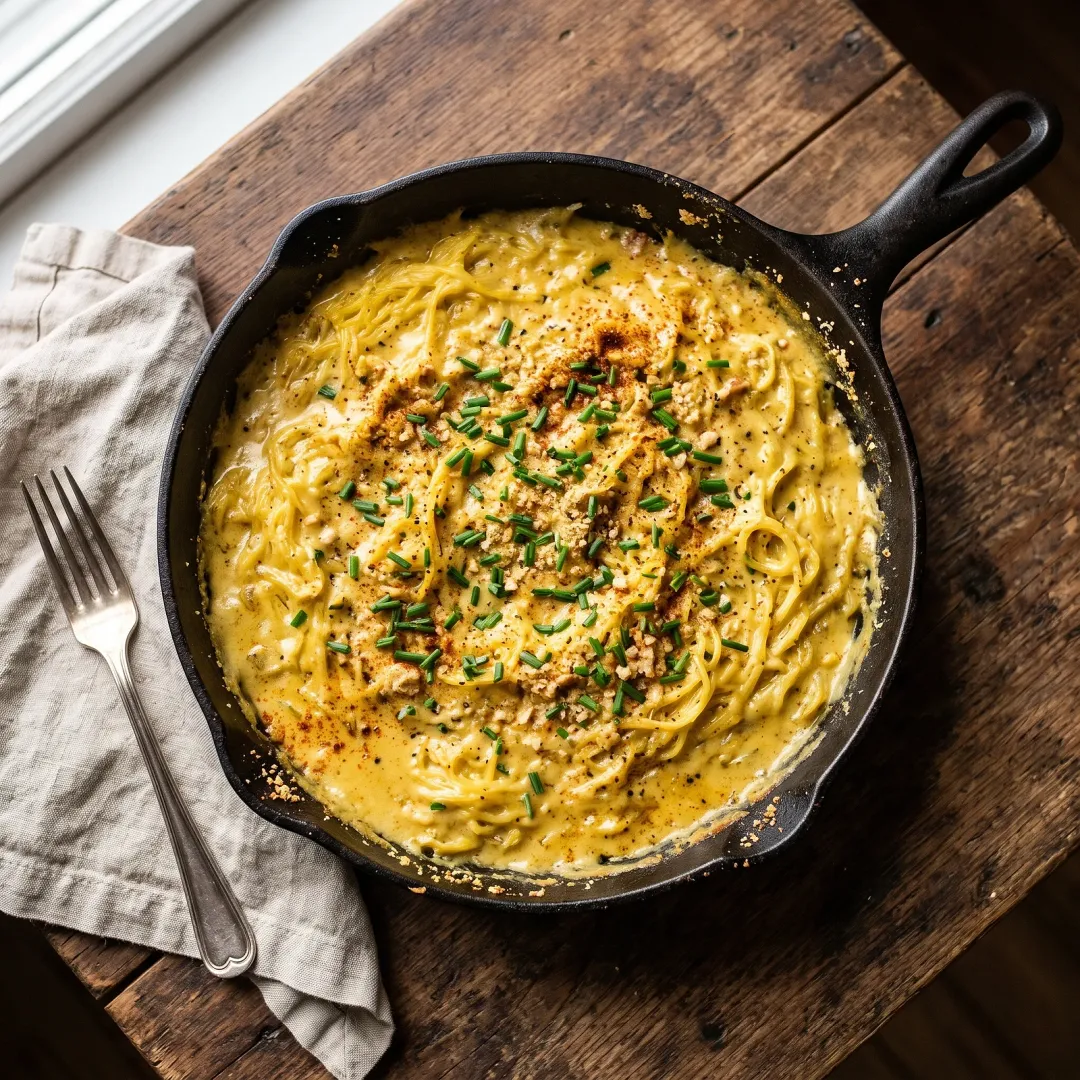

Spaghetti squash is the swap that actually earns its place here. When you drag a fork through a roasted spaghetti squash, you get these tender, slightly toothsome strands that hold a thick sauce almost exactly the way elbow pasta does. That texture is the whole game with mac and cheese, and this delivers it. The sauce is where I put the real work. Raw cashews blended smooth with coconut milk, nutritional yeast, smoked paprika, mustard, and a shot of apple cider vinegar produce a sauce that is thick, rich, and tangy in all the right ways. The nutritional yeast is doing the heavy lifting on that savory, almost sharp cheese note, while the vinegar and lemon give it the brightness real cheese sauce naturally has. No dairy. No grains. No settling. This is the mac and cheese you can bring to any table and people will go back for seconds before they notice anything is different.
Nutritional Benefits
Spaghetti Squash: Lower-Carb Comfort
- Spaghetti squash provides roughly 10 grams of carbohydrates per cooked cup, compared to about 43 grams in a cup of cooked elbow pasta, according to USDA FoodData Central.
- It's a source of vitamin C, vitamin B6, and manganese, contributing to your daily micronutrient needs with almost no effort.
- The natural fiber in spaghetti squash (about 2 grams per cup) may support healthy digestion and steadier blood sugar responses after meals, according to research published in the journal Nutrients (2022).
Cashews: More Than Just a Sauce Base
- Cashews are one of the better plant sources of copper, a mineral involved in energy production and iron metabolism, per the National Institutes of Health Office of Dietary Supplements.
- They provide heart-healthy monounsaturated fats similar to those found in olive oil, and research published in the American Journal of Clinical Nutrition (2017) suggests that replacing saturated fats with unsaturated fats is linked to improved cardiovascular markers.
- Cashews also contribute magnesium, which plays a role in muscle function, nerve signaling, and over 300 enzymatic reactions in the body, according to the NIH.
Nutritional Yeast: The Dairy-Free Cheese Workhorse
- Nutritional yeast is a complete protein, meaning it contains all nine essential amino acids, making it an efficient protein source for a plant-leaning dish.
- Many commercial nutritional yeasts are fortified with B12, a vitamin that can be harder to get from a paleo or mostly plant-based diet. Check your label and look for fortified varieties.
- It delivers that savory, umami depth that makes this sauce taste like something far more indulgent than it actually is.
FAQs
Can I make this Whole30?
Yes, with one check. Nutritional yeast is technically Whole30 compliant as of the current program rules, but always verify your broth label has no added sugar or non-compliant ingredients. Everything else in this recipe is straightforwardly Whole30.
Do I really have to soak the cashews?
If you have a high-powered blender like a Vitamix, you can get away with soaking for just 30 minutes in boiling water. For a regular blender, the full 4-hour soak in cold water is worth it. Under-soaked cashews give you a gritty sauce, and gritty sauce ruins the whole illusion.
My sauce looks thin coming out of the blender. Did I do something wrong?
Nope. The sauce thickens as it heats in the skillet. Give it those 3 to 4 minutes over medium-low, stirring constantly, and it will come together. If it still feels loose, let it cook another minute or two.
Can I prep any part of this ahead?
Absolutely. You can roast the spaghetti squash up to 2 days ahead and refrigerate the scraped strands in an airtight container. The cashew cream sauce keeps in the fridge for up to 4 days. When you're ready to serve, warm the sauce in the skillet, add the squash, toss, and go.
Can I bake this for a bubbly, browned top?
Yes. Transfer the sauced squash to a baking dish, sprinkle with a little extra smoked paprika and a handful of crushed almond flour crackers if you want a breadcrumb vibe, and bake at 375 degrees F for about 15 minutes until the top is set and lightly golden.
Will kids eat this?
In my experience the answer depends entirely on whether you call it 'mac and cheese' with full confidence or start explaining what spaghetti squash is. Plate it, say it's mac and cheese, and let them try it. The sauce is rich and mild enough that most kids take to it.
If you made this, drop a comment and tell me how it went. Did people notice? Did they care? That is always my favorite thing to find out. And if you photographed it, tag me so I can see your bowl. Save this one, share it, pin it. Someone in your life needs a mac and cheese that loves them back.
Paleo Mac and Cheese with Spaghetti Squash and Roasted Cashew Cream
Spaghetti squash stands in for pasta, and a roasted cashew cream sauce nails that thick, cheesy pull. This paleo mac and cheese is the real deal, no dairy and no guilt required.
Ingredients
- 1 medium spaghetti squash (about 3 lbs), halved lengthwise and seeded
- 1 tbsp avocado oil
- 1/2 tsp fine sea salt, divided, plus more to taste
- 1/4 tsp black pepper
- 1 1/2 cups raw cashews, soaked in water for at least 4 hours, then drained
- 3/4 cup unsweetened full-fat coconut milk (from a can)
- 1/2 cup low-sodium chicken or vegetable broth (no sugar or additives)
- 3 tbsp nutritional yeast
- 1 tbsp fresh lemon juice
- 1 tsp apple cider vinegar
- 1/2 tsp onion powder
- 1/2 tsp garlic powder
- 1/2 tsp smoked paprika, plus a pinch for topping
- 1/4 tsp ground mustard
- 1/4 tsp turmeric
- 2 tbsp avocado oil, for the sauce
- 2 cloves garlic, minced
- 2 tbsp fresh chives or flat-leaf parsley, finely chopped, for serving
Instructions
- Preheat your oven to 400 degrees F. Line a large baking sheet with parchment paper.
- Brush the cut sides of the spaghetti squash with 1 tbsp avocado oil and season with 1/4 tsp salt and the black pepper. Place cut-side down on the prepared baking sheet. Roast for 35 to 40 minutes, until the skin gives easily when pressed and a fork slides through the flesh without resistance. Remove from the oven and let cool for 10 minutes.
- While the squash roasts, drain and rinse your soaked cashews. Add them to a high-powered blender along with the coconut milk, broth, nutritional yeast, lemon juice, apple cider vinegar, onion powder, garlic powder, smoked paprika, ground mustard, turmeric, and remaining 1/4 tsp salt. Blend on high for about 60 to 90 seconds until completely smooth and creamy. Scrape down the sides as needed. Taste and adjust salt or lemon to your liking.
- Heat 2 tbsp avocado oil in a large oven-safe skillet over medium heat. Add the minced garlic and cook, stirring frequently, for about 60 seconds until fragrant but not browned.
- Pour the cashew cream into the skillet with the garlic. Reduce heat to medium-low and stir continuously for 3 to 4 minutes, until the sauce thickens slightly and is hot throughout. Remove from heat.
- Use a fork to scrape the spaghetti squash flesh into strands directly into the skillet with the sauce. Toss well until every strand is coated.
- Sprinkle the top with a pinch of smoked paprika. Serve straight from the skillet, topped with fresh chives or parsley.
Nutrition per serving
- Calories: 340
- Total Fat: 23g
- Carbohydrates: 28g
- Protein: 9g
- Dietary Fiber: 4g
- Sugar: 7g
 That Paleo Chick
Real food that heals
RecipePaleoSide DishGluten-Free

Fits these needs
Checked ingredient by ingredient. Tap one to see every recipe that fits.
Ingredients
Instructions
Nutrition Facts Amount per serving
Estimated from the ingredients. Values vary with brands and portions.

Join the conversation
Made it? Tell us how it went.
Free members can comment, reply and like. It takes ten seconds.