
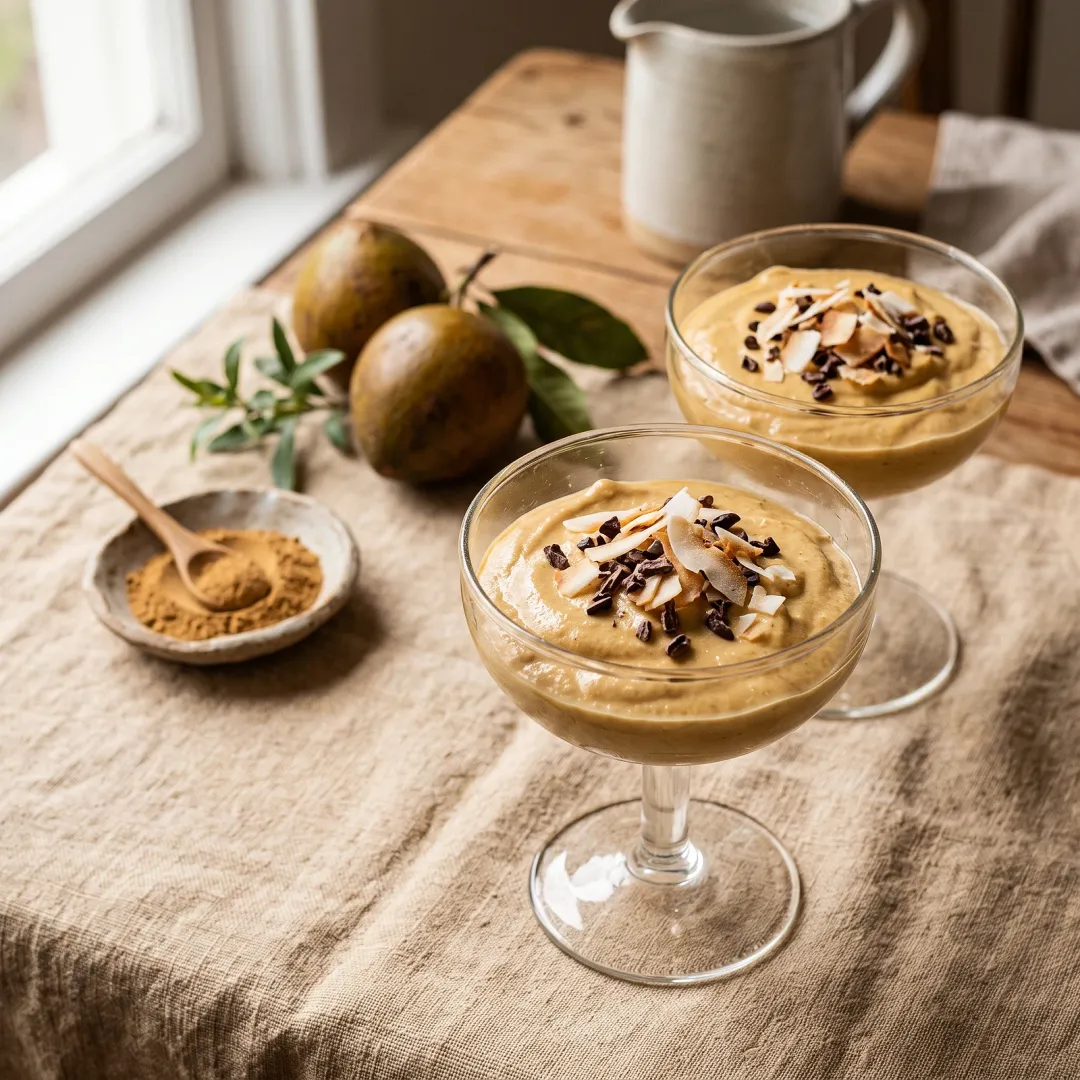

Lucuma is what Peru has been quietly keeping to itself for centuries, and once you taste it, you will understand why. It has this deep, almost maple-meets-sweet-potato flavor that is completely unlike anything else. I found lucuma powder at a natural food store years ago, grabbed it on a whim, and then just stared at the bag for two weeks not knowing what to do with it. Then it hit me: mousse. A custard-based mousse the way the Peruvians know dessert, built around coconut cream instead of dairy and sweetened with honey instead of a cup of white sugar. The result is one of those desserts that makes people put their fork down and say, 'Wait. What IS that?' Exactly.
Nutritional Benefits
Lucuma Powder
- Lucuma is a Peruvian fruit dried and ground into a powder. It has been used for thousands of years as a natural sweetener with a lower glycemic impact than refined sugar.
- It provides beta-carotene, iron, zinc, and B vitamins, making it one of the more nutrient-dense sweet additions you can use in a paleo dessert.
- The fiber content in lucuma helps slow sugar absorption, so you get sweetness without the same spike-and-crash that comes from conventional desserts.
Egg Yolks
- Egg yolks are one of the most nutrient-dense foods on the planet. They are packed with fat-soluble vitamins A, D, E, and K2, plus choline, which most people are chronically low in.
- The healthy fats in egg yolks actually help you absorb all those fat-soluble nutrients. Eating the whole yolk matters.
- Pasture-raised egg yolks specifically have a much better omega-3 to omega-6 ratio than conventional eggs. Worth sourcing well.
Full-Fat Coconut Cream
- Full-fat coconut cream provides medium-chain triglycerides (MCTs), which the body uses quickly for energy rather than storing as fat.
- It is naturally dairy-free, making this mousse accessible for anyone with a casein or lactose sensitivity.
- The fat in coconut cream also helps stabilize blood sugar when paired with natural sweeteners like honey and lucuma.
Raw Honey
- Raw honey contains trace enzymes, antioxidants, and minerals that are stripped out in processed honey. It is still sugar, but it is a whole-food form of it.
- Used in small amounts alongside lucuma, raw honey adds sweetness without the inflammatory load that refined cane sugar carries.
- A small amount of honey goes a long way here because of the naturally sweet flavor of lucuma.
FAQs
Where do I find lucuma powder?
Most natural grocery stores carry it in the supplement or superfood aisle, and it is easy to order online. Brands like Navitas Organics and Anthony's are reliable. If you genuinely cannot find it, raw cashew butter blended with a touch of maple gives a very different but still delicious result. The mousse will be nuttier, not the same, but still great.
Can I make this ahead of time?
Yes, and honestly it is better that way. You can make this up to 48 hours ahead and keep it covered in the fridge. The texture actually improves overnight as everything firms up and the flavors deepen. Just add the toppings right before serving.
My custard base got lumpy. What happened?
That happens when the heat is too high or the mixture is not stirred constantly. Keep the heat on medium-low and do not walk away. If you do end up with lumps, strain the custard through a fine mesh sieve before chilling it. It will smooth right out.
Is lucuma Whole30 compliant?
Lucuma itself is a fruit powder, but the honey in this recipe makes it not Whole30 compliant. If you want to push it toward Whole30, you could try a small amount of pitted Medjool dates blended into the custard base instead of honey, though technically most Whole30 guidance cautions against desserts that recreate sweet treats, so use your own judgment there.
My coconut cream did not whip up fluffy. What went wrong?
Coconut cream absolutely must be refrigerated overnight, and your bowl and beaters should be cold too. If the cream is even slightly warm, it will not hold peaks. Some brands are more reliable than others. Trader Joe's Coconut Cream and Native Forest both whip really well. Avoid any cans that contain guar gum-free formulas if you are having trouble, though guar gum-free actually whips better in some cases. The main thing is cold, cold, cold.
Can I use fresh lucuma instead of powder?
If you happen to live somewhere fresh lucuma is available, absolutely. You would want to scoop out the flesh, blend it smooth, and strain it, then fold it into the mousse. The flavor will be even more vivid. For most of us in the US, the powder is just the practical option.
If you make this, I want to see it. Tag me and show me your glasses of mousse. I promise it is going to look as gorgeous as it tastes, and your people are going to be asking what lucuma is for weeks. That is the whole point.
Peruvian Lucuma Custard Mousse
A silky, cloud-light Peruvian-inspired custard mousse made with lucuma, coconut cream, and egg yolks. No dairy, no refined sugar, totally paleo, and unlike anything else in your dessert rotation.
Ingredients
- 1 (13.5 oz) can full-fat coconut cream, refrigerated overnight
- 4 large egg yolks, room temperature
- 1/3 cup lucuma powder
- 3 tablespoons raw honey
- 1 teaspoon pure vanilla extract
- 1/4 teaspoon fine sea salt
- 1/4 teaspoon cinnamon
- 1 tablespoon tapioca starch (for custard base thickening)
- Toasted coconut flakes, for serving (optional)
- Cacao nibs, for serving (optional)
Instructions
- Open the refrigerated can of coconut cream and scoop the thick, solidified cream into a large chilled bowl. Set the liquid whey aside, you will use some of it in the custard base. Place the bowl of solid coconut cream back in the refrigerator while you prepare the custard.
- In a small, heavy-bottomed saucepan, whisk together the egg yolks, lucuma powder, honey, tapioca starch, sea salt, and cinnamon until smooth. Slowly whisk in 1/2 cup of the reserved coconut liquid until the mixture is fully combined with no lumps.
- Set the saucepan over medium-low heat. Cook, stirring constantly with a silicone spatula or wooden spoon, for 7 to 10 minutes until the custard thickens enough to coat the back of a spoon. Do not let it boil. Remove from heat immediately and stir in the vanilla extract.
- Transfer the custard to a shallow bowl or baking dish. Press a piece of plastic wrap directly onto the surface of the custard to prevent a skin from forming. Refrigerate for at least 45 minutes, until the custard is completely cool and set.
- Remove the bowl of solidified coconut cream from the refrigerator. Using a hand mixer or stand mixer with a whisk attachment, beat the coconut cream on high speed for 2 to 3 minutes until light, fluffy peaks form.
- Add the cooled lucuma custard to the whipped coconut cream, a few spoonfuls at a time, gently folding it in with a rubber spatula after each addition. Fold just until combined, you want to keep as much air in the mousse as possible. Do not stir aggressively.
- Spoon the mousse into 4 individual serving glasses or ramekins. Cover and refrigerate for at least 1 hour (or up to overnight) before serving. The mousse will firm up beautifully as it chills.
- To serve, top with toasted coconut flakes and cacao nibs if desired. Serve cold straight from the refrigerator.
Nutrition per serving
- Calories: 298
- Total Fat: 22g
- Carbohydrates: 22g
- Protein: 5g
- Dietary Fiber: 2g
- Sugar: 13g
 That Paleo Chick
Real food that heals
RecipePaleoDessertGluten-Free

Fits these needs
Checked ingredient by ingredient. Tap one to see every recipe that fits.
Ingredients
Instructions
Nutrition Facts Amount per serving
Estimated from the ingredients. Values vary with brands and portions.

Join the conversation
Made it? Tell us how it went.
Free members can comment, reply and like. It takes ten seconds.