

You have probably said it at some point. "I want to eat more vegetables. I want to feel lighter. I want to actually digest my food without it being a whole event." And then life happens and the salad becomes a side note and the chicken breast takes over the plate again, same as always.
Nothing wrong with chicken. But if the plants never actually get their turn, you never find out what they can do for you.
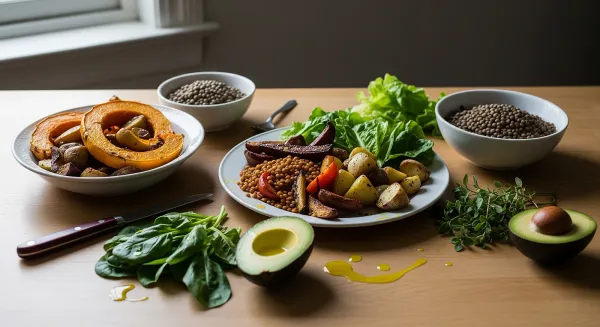
This is a 21-day reset built around a simple idea: vegetables are the main event for three weeks, not the afterthought. It is plant-forward, not protein-free, and that distinction matters. I eat meat. I built this anyway, because I have seen what happens when people genuinely shift the balance, even temporarily, and it is worth doing.
Here is what you get inside:
- The full 21-day protocol with clear guidance on what comes out, what stays in, and exactly how to eat through the window
- A paired vegetarian meal plan so you are never standing in front of the fridge wondering what counts
- Six daily trackers: Digestion, Energy, Regularity, Mood, Skin, and Sleep, rated every day so you can actually see what shifts
Three weeks is enough time to feel a real difference in how your gut moves, how your energy holds through the afternoon, and how your skin looks when you are actually feeding it. You do not have to go plant-based forever. You just have to give it 21 days and pay attention.
Why three weeks is the right window for this reset
Three weeks is not an arbitrary number. It is long enough to get past the first week, which is almost always the hardest, and settle into a new normal. It is short enough that it feels doable on day one. Most people notice real shifts in digestion and energy somewhere around the ten-day mark, but the data you collect across the full 21 days is what gives you the whole picture.
This is not a permanent dietary identity. It is a window. You are not becoming a vegetarian. You are turning the volume up on plants for three weeks so you can hear what they actually do for your body. That is a very different thing.
Meat and seafood come off the plate for 21 days
For the full 21 days, meat and seafood come off the plate. That means no chicken, no beef, no pork, no fish, no shellfish. This is the shift that actually forces the re-center. If meat is still on the plate, the vegetables will drift back to the edges. That is just human habit.
What stays in, and what you genuinely lean on:
- Eggs. A whole food with a complete amino acid profile. They carry a lot of this protocol on their back, and that is fine.
- All vegetables. Roasted, raw, sautéed, blended, fermented. The more variety the better. Color variety is not just pretty; it means different phytonutrients hitting different systems.
- Legumes. Lentils, chickpeas, black beans, white beans. These are your primary plant proteins alongside eggs, and they pull double duty as fiber sources. If legumes have bothered your gut before, start with red lentils and well-rinsed canned beans. They tend to be the easiest starting point.
- Nuts and seeds. Hemp seeds in particular are worth knowing about because their protein content is genuinely substantial. Nut butters, tahini, pumpkin seeds, and walnuts all belong here.
- Whole grains. Quinoa, brown rice, oats, farro. Quinoa is technically a seed and one of the few complete plant proteins, so it earns its spot.
- Full-fat dairy, if you tolerate it. Greek yogurt, quality cheese, and butter are not excluded. If dairy has been a problem for you historically, leave it out and note it in your trackers.
- Fruit, healthy fats, herbs, spices, good olive oil. All of it, no restriction.
What also comes out for this window: heavily processed foods, refined seed oils, added sugar beyond what is naturally occurring in whole food, and alcohol. Not because one glass of wine will ruin you, but because this reset works best when you are not muddying the signal.
Building every meal around a real protein anchor
Here is the structure that keeps people full and keeps protein where it needs to be. Every main meal should have a real protein anchor. That means eggs, legumes, dairy, or a combination. It should have at least two cups of vegetables, cooked or raw. And it should have a fat source, because fat is what makes a plant-forward plate satisfying instead of sad.
If you are staring at the logistics of that and feeling overwhelmed, the paired vegetarian meal plan does the thinking for you. The recipes are built to this structure so you do not have to count or calculate. Just cook and eat.
Snacks follow the same logic in smaller form. A handful of nuts and an apple. Greek yogurt with hemp seeds. Hard-boiled eggs with whatever vegetable you have around. The goal is to never let yourself get so hungry that you make a desperate decision.
Week one digestion, week two energy, week three clarity
Week one is the adjustment. If you have been eating a lot of meat and not a lot of fiber, your digestion will notice the change. That is normal. Drink more water than you think you need. Be patient with your gut. It is doing new work.
Week two is usually where people start to feel it. Energy tends to level out. The afternoon slump that a lot of us just accept as normal starts to soften. Digestion usually settles into something more predictable. Sleep often improves, though people do not always connect it to what they ate that day. That is exactly what the trackers are for.
Week three is where the picture gets clear. You have enough data, enough days, and enough lived experience with the protocol to know what is actually working. Some people feel genuinely great. Some people feel fine but not transformed. Both are useful information. What you do with it after day 21 is yours to decide.
Rating digestion, energy, mood, skin, and sleep daily
Every day you will rate six things: Digestion, Energy, Regularity, Mood, Skin, and Sleep. Simple numerical ratings, takes about thirty seconds.
Memory is not reliable here. I want to be honest with you about that. If I ask you on day 21 how your digestion was in week one, you will not actually remember. You will remember the last few days and call it a trend. The daily log is the only thing that catches the real pattern, including the pattern you would not have noticed otherwise, like the fact that your mood dipped every time your sleep dipped, or that your skin started clearing up right around day ten.
Rate it every day. Even when nothing feels dramatic. The undramatic days are data too.
Bringing meat back after day 21 on your own terms
This program does not have a formal reintroduction phase, and that is intentional. The goal here is not elimination in the clinical sense. It is observation and recalibration. When day 21 is done, you bring meat back however you want to.
But before you do, look at your tracker data. Look at the full 21 days as a picture. Where did you feel best? What week was the clearest? What did your digestion look like by the end compared to the beginning?
Then make a decision from that information rather than just snapping back to old habits by default. Maybe you keep eggs as your weekday breakfast anchor because your mornings felt better. Maybe you keep legumes in the rotation twice a week because your digestion was noticeably steadier. Maybe you loved how you felt and you want to keep eating this way most of the time with some meat worked in on weekends. All of those are valid outcomes. The point is that you get to choose based on actual evidence about your own body, not someone else's theory.
Under-eating and losing the protein anchor
Not eating enough. This is the big one. Plant foods are less calorically dense than meat, and if you just remove the meat without replacing the volume and the protein, you will be hungry, cranky, and ready to quit by day four. Build the plate intentionally every single time.
Relying on processed vegetarian convenience foods. Veggie burgers, plant-based deli slices, packaged grain bowls with six grams of protein. These are not what this protocol is built on. They will not give you the results you are looking for and they will keep your gut inflamed. Whole food, full stop.
Skipping the trackers when nothing feels notable. Those are actually the most important days to log. Consistency in the data is what makes the pattern visible.
Treating a hard day like a failure. One rough day in week one does not tell you anything except that your body is adjusting. Keep going.
Before you begin this plant-forward protocol
If you have a diagnosed health condition, are pregnant or nursing, or have any history of disordered eating, please talk to your doctor or a registered dietitian before starting this or any structured eating protocol. This program is built on whole, nourishing food and is not intended to diagnose or treat anything. But you know your body and your history, and a professional who knows your full picture is always worth the conversation.
What the evidence actually says
Harvard Health covers what changes when you move toward vegetarian eating, and the Academy of Nutrition and Dietetics lists the nutrients worth paying attention to, including B12, iron, zinc and calcium. This program names them rather than assuming plant-forward automatically means well-fed.
The upside is real too: fiber intake is one of the strongest dietary influences on the gut microbiota, and plant-forward patterns sit at the center of the anti-inflammatory dietary literature.
These are the sources behind this program. They are worth reading yourself; none of them were written to sell you anything.
Sources
- Harvard Health: Becoming a vegetarian
- Academy of Nutrition and Dietetics: Food Sources of 5 Important Nutrients for Vegetarians
- PMC: Dietary Fiber Intake and Gut Microbiota in Human Health
- Harvard T.H. Chan Nutrition Source: Diet Review: Anti-Inflammatory Diet