

You know you're supposed to eat more fish. You've known for years. You buy a piece of salmon, it sits in the fridge for three days, and then it's Thursday and you're having chicken again. Sound familiar?
That's not a willpower problem. It's a habit problem. Most of us never built the rhythm for cooking seafood, so it stays this thing we mean to do more of, right after we figure out what to do with it.
The 14-Day Seafood Reset fixes that. Two weeks where fish and shellfish move to the center of your plate, on purpose, with a structure that makes it actually doable. Not a punishment. Not a bland poached-tilapia situation. Real food, real flavor, and a real reason your body is going to notice the difference.
The standard advice is two servings of oily fish a week. Almost nobody manages it by accident. This program makes it unavoidable, in the best possible way.
Here's what you get inside:
- The full 14-day seafood-forward protocol with clear daily guidance
- A paired meal plan built specifically for this window
- Six daily trackers: Energy, Mental clarity, Joint comfort, Skin, Digestion, and Mood
Two weeks from now you'll have new recipes in your rotation, a real sense of how seafood makes you feel, and the confidence to keep going. That's the whole point.
Fish and shellfish as your primary protein for 14 days
The 14-Day Seafood Reset is a focused, seafood-forward nutrition protocol. For two weeks, fish and shellfish become the primary protein source in your diet. Not the only thing you eat, not a weird restrictive cleanse. Just a deliberate two-week window where you crowd out the usual chicken-beef-repeat cycle and replace it with some of the most nutrient-dense food on the planet.
The reason for 14 days specifically is simple. One week is long enough to try a few new recipes. Two weeks is long enough to build a habit, feel a real shift in your body, and collect enough data from your daily trackers to actually see patterns. One week goes by fast. Two weeks sticks.
This is not a calorie-restriction protocol. There is no macro target. You eat real food, you eat enough of it, and you let the quality of what you're putting in do the work.
Salmon, sardines, shrimp and everything on the menu
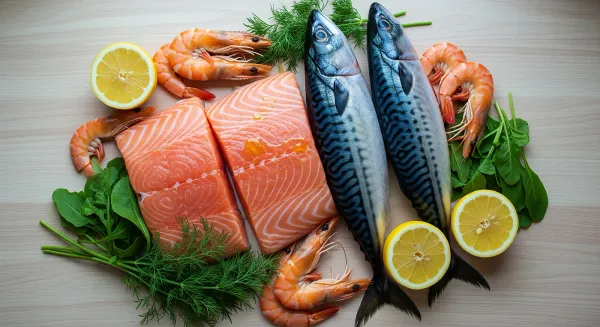
For 14 days, every main meal is built around seafood. Think salmon, sardines, mackerel, anchovies, trout, tuna, shrimp, scallops, clams, mussels, oysters, cod, halibut, and whatever looks good at your fish counter that day. Oily fish like salmon, sardines, and mackerel are the stars because of their fat profile, but white fish and shellfish absolutely count and belong on the table regularly.
Everything else that you'd normally eat alongside a protein, you still eat. Vegetables, fruit, good fats like avocado, olive oil and coconut oil, starchy vegetables if that's your thing, nuts, seeds, eggs. This program is not about taking more away. It's about making seafood the anchor of your plate for two weeks straight.
What you do set aside for the 14 days is other animal proteins as your main protein source. Not because there's anything wrong with beef or chicken, but because the point is to actually flood your system with the nutrients in seafood, not sneak them in between everything else. That means if you're going to feel the difference, you have to actually make the shift.
The paired meal plan takes all the guesswork out of the what-to-actually-cook part. It's built specifically for this window, so use it. Especially in the first week when the new habit feels most unfamiliar.
Days one through three then the shift that follows
The first two or three days are mostly logistical. You're figuring out where to buy the fish, how to store it, what recipes you like. Some people feel great immediately. Some feel nothing yet. Both are normal. Stay the course.
By the end of the first week, most people start noticing something. The usual pattern is that energy becomes more even across the day. Less of that mid-afternoon crash. Sleep sometimes improves. Joint comfort, especially for people who carry any chronic stiffness, often starts to shift around days five through eight. Skin is usually a slower mover; give it the full two weeks.
Week two is where it gets interesting. The new habits are starting to feel less forced. You probably have three or four recipes you actually like now. Your body has had long enough to respond to a consistent intake of the fats and nutrients in seafood that most people are genuinely low on. The daily tracker data from your first week gives you something to compare against, which is the whole reason you're logging it every day.
Some days will feel better than others. That's not the program failing; that's life. Log it anyway.
Rating energy, clarity, joints, skin, digestion and mood
Every day you rate six things: Energy, Mental clarity, Joint comfort, Skin, Digestion, and Mood. You rate them, you don't narrate them. This keeps it fast enough that you'll actually do it.
Here's the thing about memory. You will not remember how your joints felt on day four when you're sitting on day twelve. You will not remember whether your digestion was rough in the first week or the second. Memory for physical symptoms is genuinely terrible, especially when things are gradually improving, because gradual improvements feel invisible until you look back at the data and realize you've been rating your energy two points higher for five days straight.
The trackers are not about perfection. They are about pattern. Rate honestly, even on the days that feel boring or unchanged. The most useful data often comes from the flat days in the middle, not just the highs and lows.
Running out of fish and other things that sink the reset
The first one is not having fish in the house. This sounds obvious and yet. Seafood requires a little more planning than a package of ground beef because you're working with shorter shelf life and less familiarity. Batch-buy at the start of each week, know what you're cooking in the next two days, and keep a few shelf-stable options on hand: canned sardines, canned salmon, jarred anchovies, canned tuna. These are not backup options. They are real, legitimate, nutrient-dense food that belongs in your regular rotation.
The second mistake is getting precious about variety and then panicking. You do not need a different recipe every single day. Find two or three preparations you love in week one and repeat them. The goal is the nutrient intake and the habit, not a cooking show performance.
The third is skipping the trackers when you feel fine. "Nothing to report" is data. Log it.
The fourth is deciding on day three that nothing is happening and quietly going back to chicken. Two weeks is the protocol. Give it two weeks. Your body is not a light switch.
What to keep when the 14-day window closes
This program doesn't have a reintroduction phase because nothing was eliminated for sensitivity testing. When the window closes, you just go back to eating normally. The question to ask yourself is what you actually want to keep.
Go back through your tracker data before you decide. Look at the trend lines. Notice which week felt better and think about what was on your plate. Most people come out of this with a genuine answer to "how does regular seafood make me feel," possibly for the first time in their lives, because they've never actually done it consistently enough to know.
The goal is not to eat seafood forever and nothing else. The goal is to make two or three strong seafood meals a week feel as natural and automatic as the meals you already have on autopilot. If this reset got you there, it did its job.
Keep the recipes that surprised you. Keep the canned fish habit if it worked. Keep checking in with your body, because that's what all of this is really about: learning to pay attention.
Mercury, pregnancy, and when to ask
If you have a diagnosed thyroid condition, kidney disease, a shellfish or fish allergy, a history of disordered eating, or if you're pregnant or nursing, please talk to your doctor or a registered dietitian before starting this or any structured nutrition protocol. They know your full picture; I don't. This program is designed for generally healthy adults who want to eat more intentionally, and it is not a substitute for personalized medical advice.
What the evidence actually says
The NIH Office of Dietary Supplements describes EPA and DHA as coming mainly from fish and seafood, and notes the standard advice of one to two seafood servings a week. Most people do not hit that by accident, which is the entire premise of these two weeks.
ODS is also clear that food comes first: nutrients are best obtained from food rather than supplements, which is why this is a cooking program and not a fish-oil recommendation.
These are the sources behind this program. They are worth reading yourself; none of them were written to sell you anything.
Sources
- NIH Office of Dietary Supplements: Omega-3 Fatty Acids: Consumer Fact Sheet
- Harvard T.H. Chan Nutrition Source: Omega-3 Fatty Acids: An Essential Contribution
- MedlinePlus: Omega-3 fats: Good for your heart
- PMC: The Mediterranean Diet: An Update of the Clinical Trials