
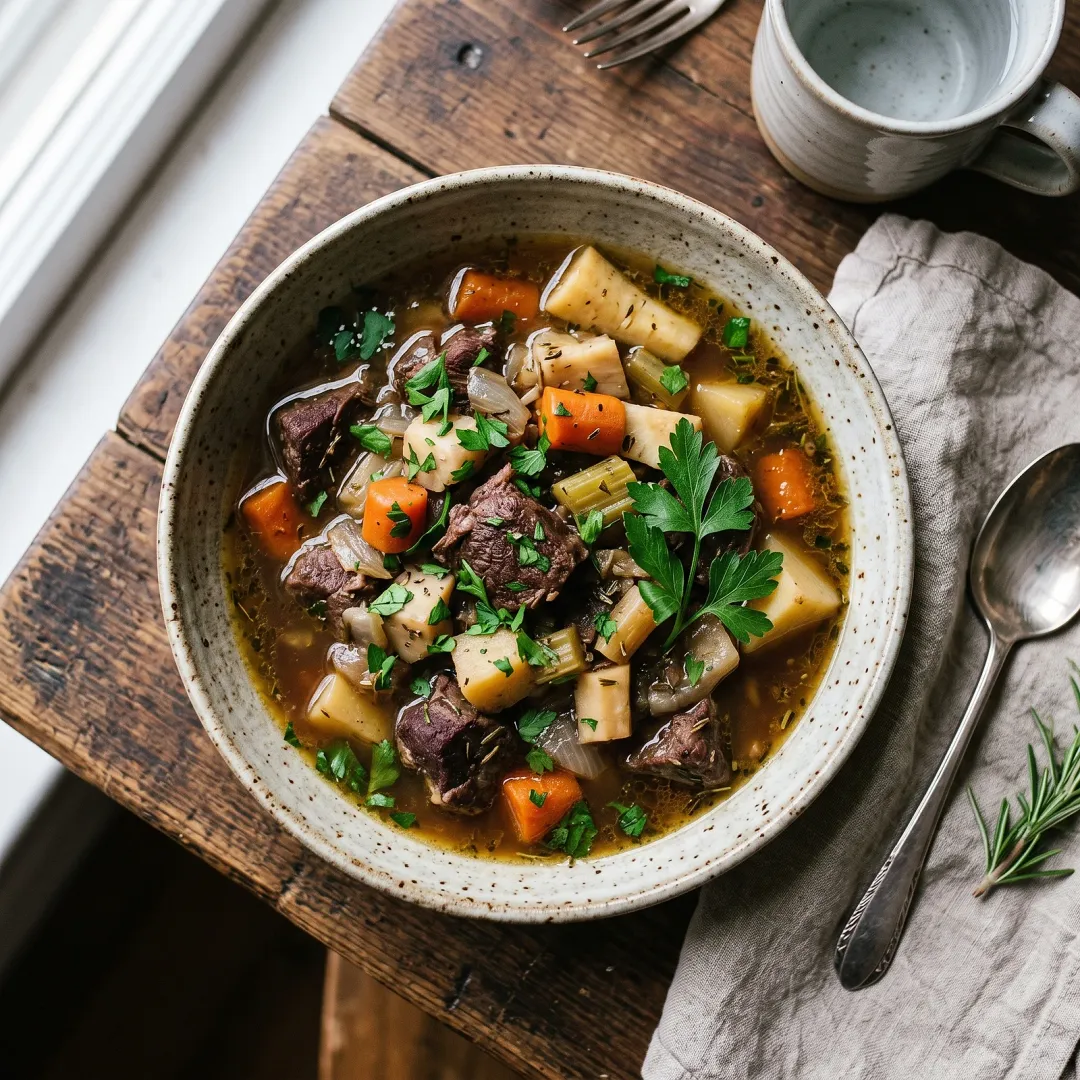

Elk stew has been simmering in my slow cooker since early morning, and by the time noon rolls around my whole house smells like something a ranch cook would have made over an open fire a hundred years ago. That is not an accident. This is one of those recipes I keep coming back to because elk is genuinely one of the cleanest proteins you can put in your body, and most people have no idea what to do with it past a backstrap on the grill. If your husband hunts, if you have a freezer stash of wild game from a friend, or if you have found a good source at a local butcher or farmers market, please make this. Elk shoulder is inexpensive compared to the backstrap, it is ideal for low-and-slow cooking, and it comes out impossibly tender after a full day in the slow cooker. The root vegetables soak up everything good from the broth, and you end up with a bowl that is rich and hearty without feeling heavy. This is a real lunch. Not a sad desk salad. Not a protein shake. Actual food that fills you up and keeps you going.
Nutritional Benefits
Elk: Wild Protein Worth Talking About
- Elk is one of the leanest red meats available, with significantly less fat than grain-fed beef while still delivering a complete amino acid profile.
- A single serving provides roughly 40 to 45 grams of protein, which makes it one of the highest protein-per-calorie wild game options out there.
- Because elk are wild and free-ranging, the meat is naturally rich in omega-3 fatty acids compared to conventional feedlot beef.
- Elk is a strong source of iron, zinc, and B12, three nutrients that are critically important for energy, immune function, and neurological health.
Root Vegetables: Slow-Cooked and Nourishing
- Parsnips provide a naturally sweet, earthy flavor and are a solid source of vitamin C, folate, and prebiotic fiber that feeds beneficial gut bacteria.
- Carrots deliver beta-carotene, which the body converts to vitamin A, an essential nutrient for immune defense and eye health.
- Celery root (celeriac) is low-glycemic, rich in vitamin K, and adds a subtle savory depth that you cannot get from regular celery alone.
- Slow cooking these vegetables in bone broth allows them to absorb collagen and minerals from the broth, making the whole dish more nutrient-dense than the sum of its parts.
Bone Broth Base: Not Just for Flavor
- A quality beef or elk bone broth provides collagen, glycine, and proline, compounds that support gut lining integrity, joint health, and skin.
- The long cook time allows minerals from the broth to fully infuse into the vegetables and meat, essentially creating a mineral-rich meal in a bowl.
- Coconut aminos add depth and a slight umami note without any soy or gluten, keeping the whole pot Whole30 and strictly paleo.
FAQs
Where do I buy elk meat if I don't hunt?
More and more specialty butchers and farmers markets carry elk, and there are several reputable online wild game meat suppliers that ship frozen elk cuts directly to your door. Look for ranched elk that is still pasture-raised and hormone-free. It is worth seeking out.
Can I use a different cut of elk?
Shoulder is ideal for slow cooking because it has enough connective tissue to break down into silky, tender bites over a long cook. If you only have elk stew meat or chuck-style cuts, those work perfectly too. Avoid using backstrap or loin cuts here since they are too lean and will dry out.
Can I make this in an Instant Pot instead?
Yes. Sear the elk using the sauté function, add everything else, and pressure cook on high for 45 minutes with a 15-minute natural release. The texture will be slightly different from a true all-day slow cook, but it will still be delicious and fully tender.
Is this recipe Whole30 compliant?
Yes, as written it is fully Whole30 compliant. Just make sure your tomato paste and bone broth have no added sugar, and skip the optional arrowroot thickener since arrowroot is technically a gray area on strict Whole30. The broth is naturally flavorful and satisfying without it.
Can I add potatoes or sweet potatoes?
Absolutely. White potatoes are actually approved on Whole30 now, and sweet potatoes are paleo-friendly. Add them cut into 1.5-inch chunks at the beginning of the cook time just like the other root vegetables.
How do I store and reheat leftovers?
This stew keeps beautifully in an airtight container in the refrigerator for up to 4 days, and it freezes well for up to 3 months. The flavor actually deepens overnight, so day-two leftovers are arguably better than day one. Reheat gently on the stovetop over medium-low heat, adding a splash of broth if needed.
If you made this elk stew, I really want to hear how it went. Drop a comment below and tell me where you sourced your elk. And if you have a wild game freezer situation going on at your house and need more inspiration, poke around the lunch section because I am always adding more recipes built around real, whole, nourishing food. Save this one, share it with a hunter friend, and come back and tell me what you thought.
Slow Cooker Elk Stew with Root Vegetables and Herb Broth
Tender slow-cooked elk shoulder simmered low and slow with parsnips, carrots, celery root, and a rosemary-thyme broth. Deeply savory, totally paleo, and the kind of hearty lunch that genuinely sustains you all afternoon.
Ingredients
- 2 lbs elk shoulder, cut into 1.5-inch chunks
- 2 tablespoons avocado oil
- 1 teaspoon sea salt, plus more to taste
- 1/2 teaspoon black pepper
- 1 teaspoon smoked paprika
- 3 medium carrots, cut into 1-inch pieces
- 2 medium parsnips, cut into 1-inch pieces
- 1 small celery root (celeriac), peeled and cut into 1-inch chunks
- 1 medium yellow onion, roughly chopped
- 4 cloves garlic, smashed
- 2 tablespoons tomato paste (no sugar added)
- 2 cups beef bone broth (or elk broth if you have it)
- 1 cup water
- 2 sprigs fresh rosemary
- 4 sprigs fresh thyme
- 2 bay leaves
- 1 tablespoon coconut aminos
- 1 tablespoon arrowroot starch (for thickening, optional)
- 2 tablespoons cold water (to mix with arrowroot, if using)
- Fresh flat-leaf parsley, chopped, for serving
Instructions
- Pat the elk chunks completely dry with paper towels. Season all over with sea salt, black pepper, and smoked paprika.
- Heat the avocado oil in a large skillet or cast iron pan over medium-high heat. Once the oil shimmers, sear the elk pieces in a single layer, working in batches so you don't crowd the pan. Sear 2 to 3 minutes per side until a deep brown crust forms. Transfer seared elk to the slow cooker insert.
- In the same skillet, reduce heat to medium. Add the chopped onion and cook 2 minutes, stirring and scraping up any browned bits from the bottom of the pan. Add the garlic and tomato paste, stir to combine, and cook another 60 seconds. Pour in about 1/4 cup of the bone broth and scrape up any remaining fond. Pour this entire mixture over the elk in the slow cooker.
- Add the carrots, parsnips, and celery root to the slow cooker. Pour in the remaining bone broth and the water. Add the coconut aminos, rosemary sprigs, thyme sprigs, and bay leaves. Give everything a gentle stir to distribute.
- Place the lid on the slow cooker and cook on LOW for 7 to 8 hours, or until the elk is fork-tender and pulling apart easily. Do not cook on HIGH, elk is a lean, dense wild protein and low-and-slow is what gets you melt-in-your-mouth results instead of rubbery chunks.
- About 15 minutes before serving, remove the rosemary sprigs, thyme sprigs, and bay leaves and discard. If you want a slightly thicker broth, whisk the arrowroot starch into the 2 tablespoons of cold water until smooth, then stir it into the stew. Replace the lid and cook on HIGH for 10 to 15 minutes until the broth thickens.
- Taste and adjust salt as needed. Ladle into bowls, scatter with fresh chopped parsley, and serve hot.
Nutrition per serving
- Calories: 390
- Total Fat: 13g
- Carbohydrates: 22g
- Protein: 44g
- Dietary Fiber: 5g
- Sugar: 7g
 That Paleo Chick
Real food that heals
That Paleo Chick
Real food that heals
RecipePaleoLunchGluten-Free

Fits these needs
Checked ingredient by ingredient. Tap one to see every recipe that fits.
Ingredients
Instructions
Nutrition Facts Amount per serving
Estimated from the ingredients. Values vary with brands and portions.

Join the conversation
Made it? Tell us how it went.
Free members can comment, reply and like. It takes ten seconds.