


If you live with an autoimmune condition, you've probably wondered whether food could be quietly working against you. The Autoimmune Protocol, or AIP, is one structured way people try to answer that question. It's a stricter, paleo-based elimination diet designed to calm inflammation and then help you pinpoint your own personal food triggers.
Here's the honest framing up front: AIP is not a forever diet, and it isn't a proven cure. It's a short-term experiment on your own body, the evidence behind it is still early and limited, and because it removes so many foods at once, it's genuinely best done with guidance from a doctor or registered dietitian. Let's walk through what it actually involves.
What is the AIP diet?
The Autoimmune Protocol is a two-phase elimination diet built on a paleo foundation. In the first phase you remove a long list of foods thought to trigger gut inflammation or immune reactions in some people. In the second phase you methodically add them back, one at a time, to learn which ones your body tolerates and which ones it doesn't.
During the elimination phase, AIP typically cuts out grains, legumes, dairy, eggs, nuts and seeds, nightshade vegetables (tomatoes, peppers, potatoes, eggplant), refined and processed sugars, most vegetable and seed oils, coffee, alcohol, and food additives. Many versions also ask you to pause alcohol, tobacco, and non-steroidal anti-inflammatory drugs (NSAIDs) like ibuprofen, since those can affect the gut lining too.
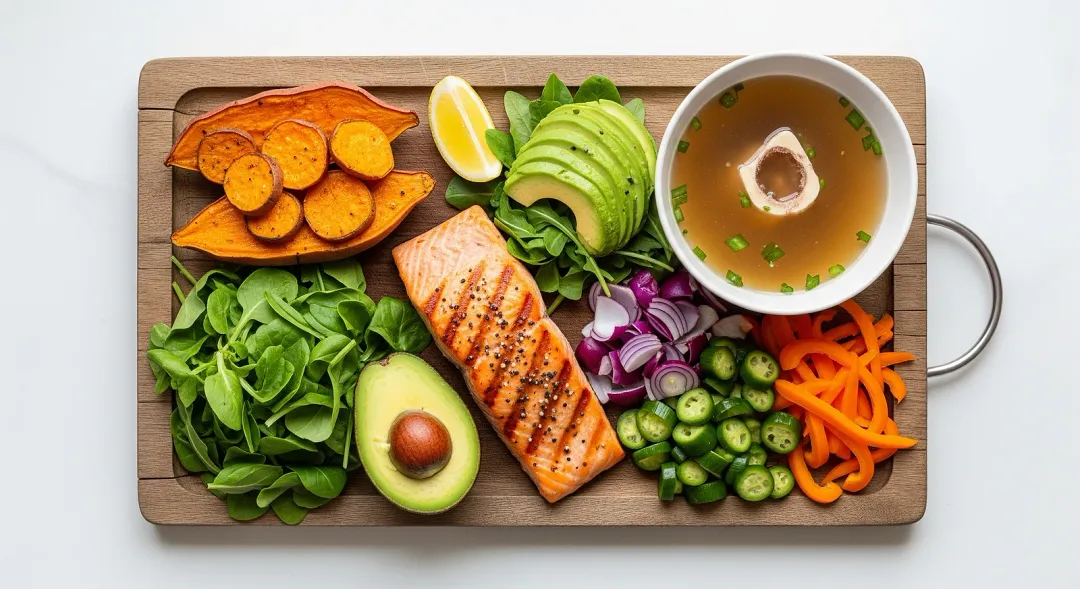
What's left is a focused, whole-food menu: fresh vegetables (apart from nightshades), fruit in moderation, quality meat and poultry, fish and seafood, bone broth, and healthy fats like olive oil, avocado, and coconut. It looks a lot like paleo eating with extra guardrails.
How it works
The idea behind AIP is that in some people with autoimmune disease, certain foods contribute to intestinal permeability (sometimes called "leaky gut") and low-grade immune activation that shows up as symptoms. By stripping the diet back to foods least likely to provoke that response, the theory goes, you give the gut and immune system a chance to settle.
The elimination phase usually runs anywhere from about six weeks up to several months. A 2024 review in Metabolism Open notes the phase length is loosely tied to how long certain immune cells and antibodies circulate, which is why some people extend it. Once symptoms have improved and stabilized, you move into reintroduction.
Reintroduction is arguably the most important part, and the part people most often rush. Foods are added back one at a time, then you wait several days, watching for any return of symptoms before trying the next food. The American College of Rheumatology suggests allowing five to seven days between reintroductions so you can actually tell which food did what. The goal isn't to stay maximally restricted forever; it's to end up with the least restrictive diet that keeps you feeling well.
Evidence-based benefits
This is where honesty matters most. The research on AIP is early, the studies are small, and most lack a control group, so results should be read as promising signals rather than proof.
- Inflammatory bowel disease (IBD): the strongest early signal. A 2017 study of 15 people with Crohn's disease or ulcerative colitis, published in Inflammatory Bowel Diseases, reported that 73% reached clinical remission by week six, and everyone who did maintained it through week 11. A related 2019 analysis in Crohn's & Colitis 360 found quality-of-life measures improved as early as week three.
- Hashimoto's thyroiditis: improved quality of life, but labs unchanged. A 2019 pilot study in Cureus followed 16 women through a 10-week AIP-based program. They reported meaningful gains in quality of life and a roughly 29% drop in the inflammation marker hs-CRP, but there were no significant changes in thyroid hormones or thyroid antibodies. In other words, people felt better without measurable change in the underlying thyroid disease.
- Other autoimmune conditions: mostly anecdotal. For rheumatoid arthritis, lupus, and similar conditions, high-quality evidence is thin; reports are largely individual rather than from controlled trials.
The takeaway: early studies suggest some people with autoimmune conditions feel better and show lower inflammation on AIP, especially in IBD. But the trials are tiny and can't yet prove the diet changes disease progression.
Who should consider it
AIP tends to appeal to people who have an autoimmune diagnosis, still have bothersome symptoms despite standard medical care, and are curious whether specific foods are contributing. It has the most supporting evidence for inflammatory bowel disease, and some people with Hashimoto's use it to chase symptom and quality-of-life improvements.
It fits best when you're able to commit to a structured, temporary experiment, you can cook most of your own meals, and, ideally, you're working with a clinician or dietitian who can help you stay nourished and interpret what you find. AIP works alongside your prescribed treatment, not instead of it.
Common mistakes & important details
The biggest pitfall is treating AIP as permanent. Staying in the elimination phase indefinitely is where the real risks appear. The 2024 Metabolism Open review warns that cutting grains and other groups can lead to shortfalls in fiber, iron, and B vitamins, and noted that in one study half of participants showed deficiencies in folate, B12, or riboflavin. Skipping reintroduction means you never learn which foods you actually need to avoid, and you keep restricting for no reason.
Other common missteps: reintroducing several foods at once (so you can't tell what caused a reaction), underestimating how much planning and cooking it takes, and ignoring the social and emotional load. That same review flagged that the diet's restrictiveness can lead to social isolation. Going in with a plan, some batch-cooked staples, and realistic expectations makes a big difference.
How the AIP diet fits a real-food approach
In many ways AIP is paleo eating turned up a notch, with the same emphasis on whole, minimally processed foods, just with a stricter temporary exclusion list. If you already cook from scratch, you have a real head start, because the core of AIP is vegetables, quality proteins, seafood, and good fats prepared at home.
Where it diverges from everyday real-food eating is the extra removals: no eggs, no nuts and seeds, no nightshades, no coffee. Those foods are nutritious and well tolerated by plenty of people, which is exactly why reintroduction matters. For most people they're meant to come back. Think of AIP as a short diagnostic detour off the real-food path, not a stricter destination. The aim is to gather information about your own body, then return to the most varied, sustainable whole-food diet you can happily live with.
Key takeaways
- AIP is a strict, temporary paleo-based elimination-and-reintroduction diet for autoimmune conditions, not a permanent way of eating.
- The elimination phase removes grains, legumes, dairy, eggs, nuts, seeds, nightshades, added sugars, most oils, coffee, and alcohol; reintroduction is what makes the protocol worthwhile.
- Evidence is early and limited: small, mostly uncontrolled studies, strongest for IBD, with quality-of-life gains in Hashimoto's but no measured change in thyroid antibodies.
- It carries real risks of nutrient gaps and can be socially and emotionally heavy, so it's best done with a doctor or registered dietitian.
- Skip it, or proceed only with supervision, if you're pregnant, a child, or have a history of disordered eating.
- Done well, AIP is a short experiment to find your personal triggers, then widen your diet back out again.
Frequently Asked Questions
How long does the AIP elimination phase last?
Most people follow the strict elimination phase for about six weeks up to a few months, depending on how their symptoms respond. Once symptoms have improved and stabilized, the plan is to begin reintroducing foods one at a time, not to stay in elimination indefinitely.
Is the AIP diet scientifically proven?
Not conclusively. The research is early and limited, built mostly on small studies without control groups. The strongest signals are in inflammatory bowel disease, where one study saw 73% of participants reach remission by week six. But no large trials yet prove AIP changes disease progression, so it's best viewed as a promising personal experiment rather than a proven treatment.
What's the difference between AIP and paleo?
AIP is a stricter, temporary version of paleo. Both focus on whole, unprocessed foods and drop grains, legumes, and dairy. But AIP also removes eggs, nuts, seeds, nightshade vegetables, coffee, and most seed oils during the elimination phase, and many of these are meant to be reintroduced later once you know how your body reacts.
Do I have to avoid these foods forever?
No, and that's a common misunderstanding. The reintroduction phase is designed to add foods back one at a time so you can identify only the ones that actually cause you problems. The goal is the least restrictive diet that keeps you feeling well, not permanent elimination.
Should I try AIP on my own?
It's best not to go it alone. Because AIP removes many food groups at once, it carries a real risk of nutrient gaps, and it isn't appropriate for everyone. Talk to your doctor or a registered dietitian first, especially if you're pregnant, feeding a child, take medications that need dietary consistency, or have any history of disordered eating.
Sources
- Cleveland Clinic: What Is the AIP (Autoimmune Protocol) Diet?
- American College of Rheumatology: What Is the Autoimmune Protocol Diet?
- Inflammatory Bowel Diseases (via NCBI PMC): Efficacy of the Autoimmune Protocol Diet for Inflammatory Bowel Disease
- Crohn's & Colitis 360 (Oxford Academic): An Autoimmune Protocol Diet Improves Patient-Reported Quality of Life in Inflammatory Bowel Disease
- Cureus (via NCBI PMC): Efficacy of the Autoimmune Protocol Diet as Part of a Multi-disciplinary, Supported Lifestyle Intervention for Hashimoto's Thyroiditis
- Metabolism Open (via NCBI PMC): Autoimmune protocol diet: A personalized elimination diet for patients with autoimmune diseases
This guide is for general education and is not medical advice. Everyone is different, so talk with your doctor or a registered dietitian before making a major change to how you eat, especially if you are pregnant, managing a health condition, or have a history of disordered eating.







Join the conversation
What do you think?
Free members can comment, reply and like. It takes ten seconds.