

On this page
Somewhere between the kombucha aisle and the Facebook group telling you to do a 90-day elimination diet before touching a single bite of sauerkraut, the actual science got buried. Fermented foods are genuinely good for your gut. The overcomplicated protocol around them? That part I want to push back on.
First, Let's Be Clear About What Fermented Foods Are
Fermented foods are foods that have been transformed by live bacteria, yeast, or other microorganisms. That transformation breaks down sugars and starches, produces beneficial compounds like short-chain fatty acids and organic acids, and, in many cases, leaves the food populated with live microbes.
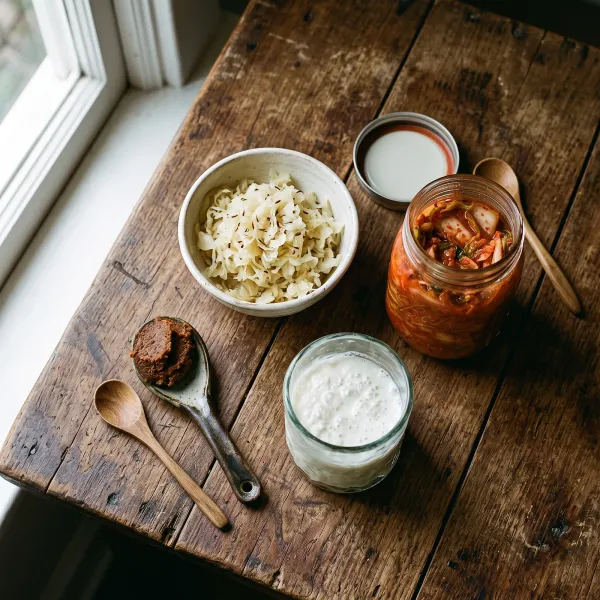
The classics are kimchi, sauerkraut, plain whole-milk yogurt, kefir, miso, tempeh, and traditionally made pickles (the kind that are lacto-fermented in salt brine, not vinegar-packed shelf-stable ones). Kombucha is in the category too, though it's more variable in terms of actual live culture content by the time it hits your hands.
These are not new inventions. Humans have been fermenting food for thousands of years, across every culture, every continent. Preservation was the original goal. The gut benefits were just something our ancestors stumbled onto and kept doing because their bodies told them it worked.
The Myth: You Need to Do a Long Elimination First
This is the one I hear constantly in coaching conversations, and it drives me a little crazy. The idea goes like this: your gut is too damaged, too dysbiotic, too leaky for fermented foods right now. You need to strip everything back first. Do GAPS, or carnivore, or low-FODMAP, or some 90-day elimination protocol, and THEN, once you've done the work, fermented foods can come in.
I understand where this came from. Some people do experience bloating or discomfort when they first introduce fermented foods, particularly if they're dealing with significant dysbiosis or SIBO (small intestinal bacterial overgrowth). And there are certain clinical situations where a practitioner might temporarily reduce fermented foods. I'm not dismissing that.
But the idea that the average person with general gut complaints needs weeks or months of elimination before fermented foods are safe or useful? That's not what the research supports. And the longer someone sits on a restricted, low-diversity diet waiting to "earn" fermented foods back, the worse off their microbiome can get. A 2022 Stanford study published in Cell00754-6) found that a high-fermented-food diet increased microbiome diversity and decreased inflammatory markers, and it did so without requiring participants to first strip their diet down to nothing. They ate more fermented foods alongside their regular eating. That was the intervention. It worked.
What the Evidence Actually Shows
The same Stanford Cell study is worth sitting with for a minute because it was well-designed and the findings were significant. Nineteen participants ate a diet high in fermented foods for ten weeks. Nineteen ate a high-fiber diet for comparison. The fermented-food group showed increased microbiome diversity and reduced levels of 19 inflammatory proteins, including markers associated with chronic disease. The high-fiber group's microbiome diversity didn't increase, and in some cases declined, possibly because a sudden surge of fiber without the microbial diversity to process it can backfire.
That last part matters. Diversity is the goal. And fermented foods appear to be one of the most reliable dietary ways to move toward it.
A 2021 review in Nutrients looked at the evidence across multiple fermented food types and found consistent associations between regular fermented food consumption and improved gut microbiome composition, reduced intestinal permeability (the "leaky gut" marker a lot of us care about), and better immune function. The authors were appropriately measured in their language, noting that the mechanisms aren't fully worked out and that more long-term human trials are needed. That's honest science. But the direction of the evidence is clear enough to act on.
What fermented foods do not do is magically colonize your gut with specific strains the way a probiotic supplement promises to. Most live cultures in fermented foods are transient. They pass through. But while they're passing through, they interact with your existing microbiome, they produce beneficial compounds, and they appear to create an environment where your own native bacteria can diversify and thrive. Think of them less like a transplant and more like good company that brings out the best in whoever's already there.
The Overcomplicated Protocol Is Often the Problem
I want to be real with you about what I see happen when people get deep into gut-healing rabbit holes. They start with a real symptom, maybe bloating after meals, or inconsistent digestion, or a general sense that something is off. They Google. They find a forum. Suddenly they're doing a 6-week elimination of gluten, dairy, legumes, fermented foods, high-FODMAP vegetables, eggs, and nightshades simultaneously, while taking 14 supplements and dry brushing before breakfast.
And then they wonder why they feel worse, and why they're scared of food.
Here's what a restricted, low-diversity diet does to your microbiome over time: it starves it. The gut microbiome runs on variety. Different microbial species feed on different substrates, different fibers, different fermented compounds. When you narrow your diet dramatically, you narrow your microbial landscape. A review published in Cell Host and Microbe30266-7) described how dietary diversity directly drives microbiome diversity, and how loss of that diversity is associated with increased risk of inflammatory and metabolic conditions.
This does not mean elimination diets have no place. They do, in the right clinical context, with the right support, for the right amount of time. But "I read online that I should do 90 days" is not a clinical context. And a long, unsupported elimination diet followed by a slow re-introduction of fermented foods is, for most people, working backwards.
What to Actually Eat and How to Start
Most people can start adding fermented foods now. Not after a cleanse. Not after a protocol. Now.
Start low and slow, but start. If you've never eaten fermented foods regularly, a tablespoon or two of sauerkraut with dinner is a completely reasonable beginning. Your digestion might notice the shift. Give it a week or two before you decide it's not for you.
Variety matters more than quantity. Rotating through different fermented foods gives your gut exposure to a broader range of microbial species and fermentation byproducts. Kimchi one night, a scoop of plain whole-milk yogurt the next morning, some miso stirred into a vegetable broth-based soup at lunch on another day. That's more useful than eating the same single fermented food every day.
Some of my favorite practical pairings:
Sauerkraut with roasted vegetables. A bowl of roasted beets, carrots, and shredded cabbage drizzled with olive oil, topped with a big spoonful of raw sauerkraut after the veggies come off the heat (you want to add fermented foods after cooking to preserve the live cultures).
Miso in salad dressing. A tablespoon of white miso whisked into lemon juice and olive oil makes a brilliant dressing for a big raw vegetable bowl. Shredded cabbage, cucumbers, radishes, shaved fennel. No protein required if it's a side, or add a soft-boiled egg if you want it to stick.
Kefir as a base. Plain full-fat kefir blended with a handful of frozen berries and a tablespoon of flaxseed is breakfast in three minutes and gives you live cultures, fiber, and real fat all at once.
Kimchi folded into scrambled eggs or a veggie stir-fry. Add it at the end, off the heat. It adds fermented funk and heat without losing all its live culture benefit.
The bottom line is this: a diverse, real-food diet that regularly includes fermented foods is doing more for your gut than any elimination protocol that delays getting you there.
Who Actually Should Be Careful
I said I'd come back to the nuance, and I will. There are real situations where someone needs to approach fermented foods more carefully.
If you've been diagnosed with SIBO (confirmed by a breath test, not self-diagnosed), some practitioners recommend temporarily reducing high-fermented and high-fiber foods while treating the overgrowth, because you're essentially feeding bacteria in a place they shouldn't be in large numbers. That's a specific, time-limited, clinically guided situation.
If you have a histamine intolerance (not just a suspicion, but actual documented symptoms that track consistently with high-histamine foods), fermented foods are among the highest-histamine foods there are. Aged and fermented foods produce histamine as a natural byproduct of fermentation. This is real and worth paying attention to.
If you're immunocompromised for any reason, talk to your doctor before increasing live-culture foods.
Those are real caveats. But they apply to a fraction of the people who've been told to wait on fermented foods. If you don't fall into those categories, you're probably waiting for a green light that you don't actually need.
This article is for general informational purposes only and is not medical advice. Always consult a qualified healthcare professional before making changes to your diet or health routine.
The Deeper Thing I Keep Coming Back To
We were designed to eat real food. Not engineered food, not supplemented food, not food that came through a 12-step manufacturing process. Real food, including food that's been naturally preserved and transformed through fermentation the way humans have done it since the beginning.
When I look at the modern gut health crisis and I look at how dramatically we've shifted away from fermented, traditionally prepared foods over the last century, I don't think that's a coincidence. We chased shelf life and convenience, and we accidentally stripped out something our gut microbiomes were counting on.
Getting fermented foods back into your regular rotation isn't complicated. It doesn't require a protocol or a cleanse or a coach's permission. It requires real food, some patience while your gut adjusts, and the willingness to let something simple actually be enough.
Key Takeaways
- Fermented foods (kimchi, sauerkraut, kefir, miso, plain yogurt) are linked to increased gut microbiome diversity and reduced inflammatory markers in research.
- Most people do not need a lengthy elimination diet before adding fermented foods. Waiting can actually reduce microbial diversity.
- A high-fermented-food diet was shown to outperform a high-fiber diet for microbiome diversity in a well-designed 2022 Stanford study.
- Variety of fermented foods matters more than eating large amounts of one single type.
- Add fermented foods after cooking, not during, to preserve live cultures.
- Exceptions: diagnosed SIBO, confirmed histamine intolerance, or immunocompromised status are real reasons to be cautious and work with a practitioner.
Frequently Asked Questions
Do fermented foods actually put good bacteria in your gut?
Not in the way a probiotic supplement claims to. Most live cultures in fermented foods are transient, meaning they pass through rather than permanently colonizing your gut. But while they're moving through, they interact with your existing microbiome, produce beneficial compounds, and appear to create conditions where your native bacteria can diversify and thrive. The benefit is real, even if the mechanism isn't a simple "adding bacteria" story.
Can fermented foods make bloating worse?
They can, especially when you first introduce them, or if you have a condition like SIBO or confirmed histamine intolerance. Starting with small amounts (a tablespoon or two) and increasing gradually gives your gut time to adjust. If significant bloating or discomfort persists beyond the first couple of weeks, it's worth talking to a practitioner about whether something like SIBO might be a factor.
What's the difference between fermented foods and probiotic supplements?
Probiotic supplements deliver concentrated, specific strains of bacteria in capsule form. Fermented foods deliver a more diverse, variable mix of live cultures alongside real-food compounds like vitamins, enzymes, organic acids, and fiber (in the case of vegetable-based ferments). Research suggests the whole-food matrix may confer benefits that isolated strains in capsules don't fully replicate. They're not direct substitutes for each other.
Are store-bought pickles and sauerkraut the same as traditionally fermented ones?
Usually, no. Most commercially pickled vegetables on grocery store shelves are preserved in vinegar, not through lacto-fermentation in salt brine. Vinegar-packed products don't contain the live cultures that make lacto-fermented foods valuable for the microbiome. Look for refrigerated versions that list "live cultures" or "naturally fermented" on the label, with no vinegar in the ingredients.
Sources
- Cell (Stanford University): Gut-Microbiota-Targeted Diets Modulate Human Immune Status
- Nutrients (MDPI): Fermented Foods: Definitions and Characteristics, Impact on the Gut Microbiota and Effects on Gastrointestinal Health and Disease
- Cell Host and Microbe: Diet-Induced Alterations in Gut Microflora Contribute to Lethal Pulmonary Damage in TLR2/TLR4-Deficient Mice
This article is for general informational purposes only and is not medical advice. Always consult a qualified healthcare professional before making changes to your diet or health routine.