

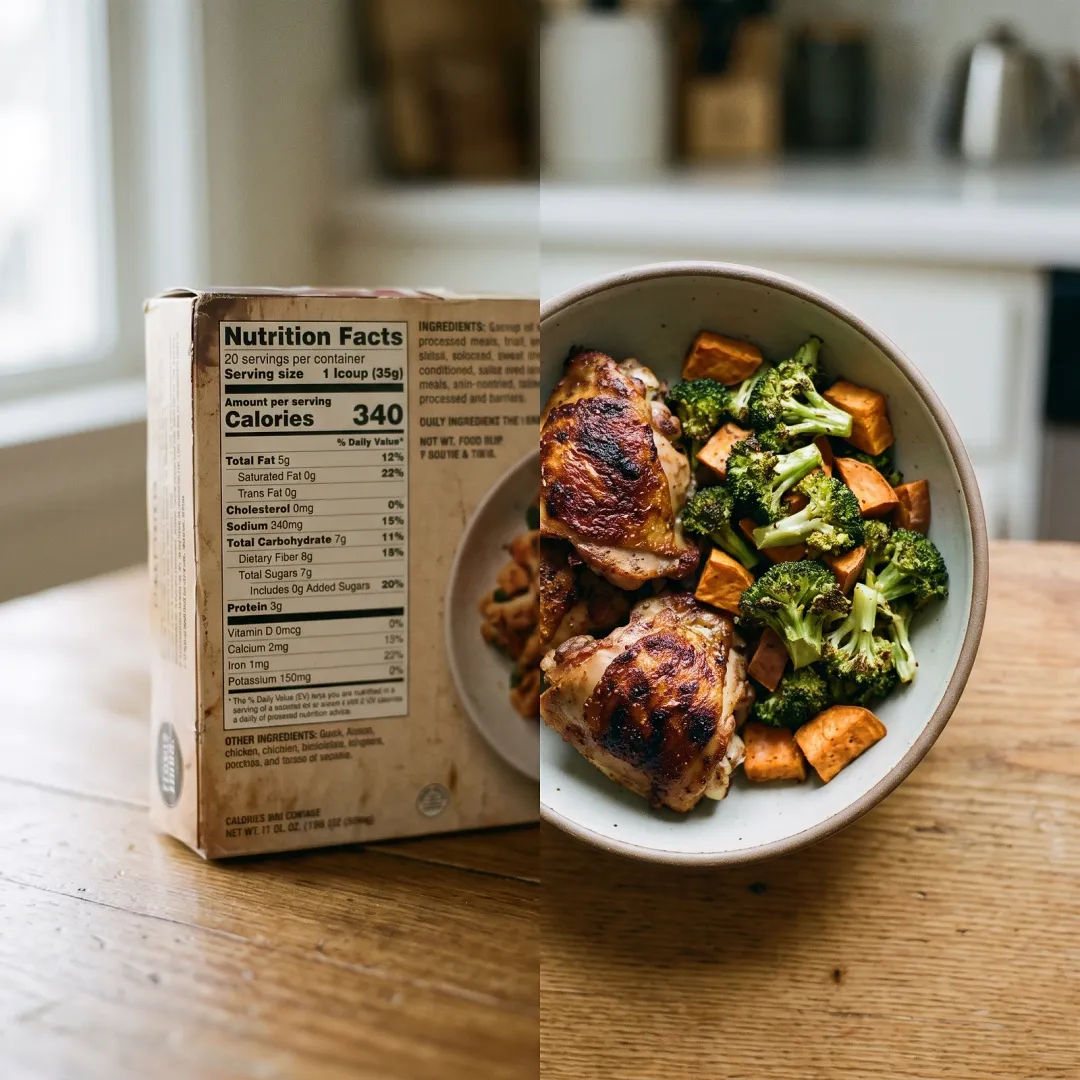

The calorie count printed on that package is not a measurement. It's a formula from the 1800s, applied to food that didn't exist in the 1800s, sold to you by companies that have every financial reason to want you staring at a number instead of reading the ingredient list. And now the science is making that little number look even more fictional than it already was.
The Claim: 'A Calorie Is a Calorie'
For decades, the official line from nutrition authorities and the processed-food industry has been beautifully simple: track your calories in, track your calories out, and weight management is just arithmetic. The USDA's dietary guidance has built its foundation on this idea. Food manufacturers love it because it means a 100-calorie pack of crackers is morally equivalent to 100 calories of roasted chicken, at least on paper.
The Atwater system, which is how calorie counts on food labels are still calculated today, was developed in the late 1800s by burning food in a laboratory device called a bomb calorimeter. It measures heat released. Not digestion. Not absorption. Not what your body actually does with something once it enters your gut. Just heat. That method, with modest tweaks, is still what every food label in the United States is based on, according to the FDA's guidance on nutrition labeling.
For over a century, we took that number and we ran with it. Whole diet industries were built on it. Entire medical recommendations were structured around it. And the processed-food world happily printed it on every box and bag, because a number in a box is a conversation they can control.
The Receipt: What the Research Actually Shows
Scientists have now built a computational model demonstrating that gut bacteria play a significant and largely unaccounted-for role in how many calories a person actually absorbs from food. In a controlled study cited by ScienceDaily, people eating a high-fiber diet absorbed roughly 116 fewer calories per day compared to people eating a typical Western diet, and they didn't feel hungrier doing it.
116 calories per day. That's not a rounding error. Over a year, that difference compounds to the equivalent of more than ten pounds, and the food label didn't capture any of it.
The mechanism matters here. Your gut microbiome ferments fiber that your own digestive enzymes can't break down. Different bacterial communities do this at different efficiencies. Some microbiomes extract more energy from the same food. Some extract less. The composition of your gut bacteria, which is shaped by what you eat, affects what that food ultimately costs you in absorbed calories. The label on the package has no idea what your microbiome looks like. It can't. It was designed before we even knew the microbiome existed as a meaningful metabolic player.
This is not a fringe position. Research published in peer-reviewed journals has been building this case for years. A 2019 study in Cell Host and Microbe30248-7) found that gut microbial communities significantly influenced how much energy hosts extracted from food, with measurable differences based on microbiome composition. The science on this is not finished, but it is consistent: the gut changes the math.
Why This Matters More Than the Diet Industry Will Admit
The calorie-counting framework has always been convenient for food manufacturers. When the conversation is about numbers on a label, it's not about what the ingredients actually are. You can sell 100 calories of ultra-processed, fiber-stripped, seed-oil-soaked snack food and stack it right next to 100 calories of real food, and the label says they're the same thing.
But they are not the same thing to your gut.
Ultra-processed food is engineered to be rapidly absorbed. It bypasses much of the work your digestive system normally does. That means the calorie count on a processed-food label is arguably closer to accurate than the calorie count on a whole food, because there's very little left for your microbiome to work with. The fiber is gone. The intact cell structures are gone. The resistant starches are gone. What's left absorbs fast and feeds the lining of your gut instead of feeding beneficial bacteria.
Real food, particularly food that's high in fiber and intact plant structures, feeds a diverse microbiome, which ferments that fiber into short-chain fatty acids, which have their own downstream effects on satiety, inflammation markers, and gut lining integrity, according to a review in Nature Reviews Gastroenterology and Hepatology. The calorie label doesn't capture any of that chain of events.
So when someone eats real food and can't understand why the numbers don't match what their app says, it's not a math problem. The app is using the wrong math.
What a High-Fiber, Real-Food Day Actually Looks Like
None of this means you need to micromanage fiber grams or start tracking your microbiome. It means that eating real food, the way people ate before labs started engineering it, may support a gut environment that handles calorie absorption differently than a processed-food diet does. That's not a marketing claim. That's what the research suggests.
A practical day built around this principle isn't complicated. A breakfast with eggs and a big handful of sauteed greens. Lunch built on a base of roasted vegetables and legumes if you tolerate them, or leftover roasted sweet potato and a clean protein. Dinner with something like baked chicken thighs, a pile of roasted broccoli, and whatever is left in the vegetable drawer. Snacks that are actual food: an apple, some raw nuts, sliced vegetables with guacamole.
Chicken is one of the most practical proteins you can batch-cook for exactly this kind of eating. Roast a full tray of bone-in thighs on Sunday. The fat from the skin bastes the meat, you get more flavor without more effort, and you have protein ready to pull into four or five different meals across the week. Pair it with fiber-dense vegetables at every meal and you're building exactly the kind of gut environment this research points to as beneficial.
None of this requires an app. It requires paying more attention to what's on your plate than to what's on the label.
The Bigger Problem with Trusting the Label
The calorie-count issue is one layer of a much larger problem, which is that we were taught to trust packaged-food labels as authoritative sources of nutritional truth, and those labels are produced by the same companies selling the food.
The FDA allows a 20% margin of error on nutrition labels. Twenty percent. That means a product labeled 200 calories could legally contain 240, and still be compliant. Add to that the microbiome variable this new research is surfacing, and the number on that label starts to look less like science and more like a legal formality.
I'm not saying don't read labels. I'm saying read the ingredient list with far more urgency than you read the calorie count. The ingredient list tells you what you're actually putting in your body. The calorie count tells you what a formula from the nineteenth century predicts you might extract from it, give or take twenty percent, and completely ignoring the trillion microorganisms that are about to have their own opinion on the matter.
Our bodies are not bomb calorimeters. They were designed with an incredibly sophisticated system for processing food, and that system responds, profoundly, to what we feed it. Real food supports that system. Ultra-processed food undermines it. That's the conversation the label is never going to start.
This article is for general informational purposes only and is not medical advice. Always consult a qualified healthcare professional before making changes to your diet or health routine.
Key Takeaways
- Food label calorie counts are based on a 19th-century formula that doesn't account for gut bacteria or individual digestion differences.
- New research suggests people eating a high-fiber diet may absorb around 116 fewer calories per day than those eating a typical Western diet, without feeling hungrier.
- Your gut microbiome composition significantly influences how much energy your body actually extracts from the food you eat.
- Ultra-processed food is engineered to bypass much of the digestive work your microbiome would otherwise do, meaning less benefit and faster absorption.
- The FDA allows a 20% margin of error on nutrition labels, making the calorie count even less reliable as a precise guide.
- Reading the ingredient list gives you far more useful information about a food than its calorie count does.
Frequently Asked Questions
Do gut bacteria really affect how many calories you absorb?
Research suggests yes, significantly. A recent study found that people eating a high-fiber diet absorbed roughly 116 fewer calories per day than those eating a typical Western diet, and scientists attribute a meaningful portion of that difference to how gut bacteria ferment and process food. The composition of your microbiome affects how much energy your body actually extracts from what you eat.
Are food label calorie counts accurate?
They're an approximation, not a precise measurement. Calorie counts on food labels in the US are based on the Atwater system, a formula developed in the 1800s from controlled combustion experiments. The FDA also allows a 20% margin of error on nutrition labels, meaning a product labeled at 200 calories could legally contain up to 240. Individual differences in gut microbiome composition add another layer of variability the label can't account for.
What does fiber have to do with gut bacteria and calorie absorption?
Fiber that your own digestive enzymes can't break down becomes food for beneficial gut bacteria. Those bacteria ferment the fiber into short-chain fatty acids, which research links to effects on gut health, satiety signaling, and how efficiently energy is extracted from food. Ultra-processed food tends to be stripped of this fiber, which means less feeding of beneficial bacteria and faster, more complete calorie absorption compared to whole, fiber-rich food.
Should I stop counting calories and just eat real food?
This is a personal decision worth discussing with your doctor or a qualified health professional, especially if you have specific health goals. What the research does suggest is that the quality and composition of food, particularly its fiber content and how processed it is, affects digestion and absorption in ways that a calorie count can't capture. Many functional-medicine practitioners focus on food quality and gut health rather than strict calorie tracking as a starting point.
Sources
- ScienceDaily: Your gut bacteria could be changing how many calories you absorb
- FDA: How to Understand and Use the Nutrition Facts Label
- Cell Host and Microbe: Gut Microbial Ecology Is Shaped by Fiber Type and Determines the Host Metabolic Response
- Nature Reviews Gastroenterology and Hepatology: Gut microbiota features associated with Clostridioides difficile colonization in dairy cattle
This article is for general informational purposes only and is not medical advice. Always consult a qualified healthcare professional before making changes to your diet or health routine.




Join the conversation
What do you think?
Free members can comment, reply and like. It takes ten seconds.