

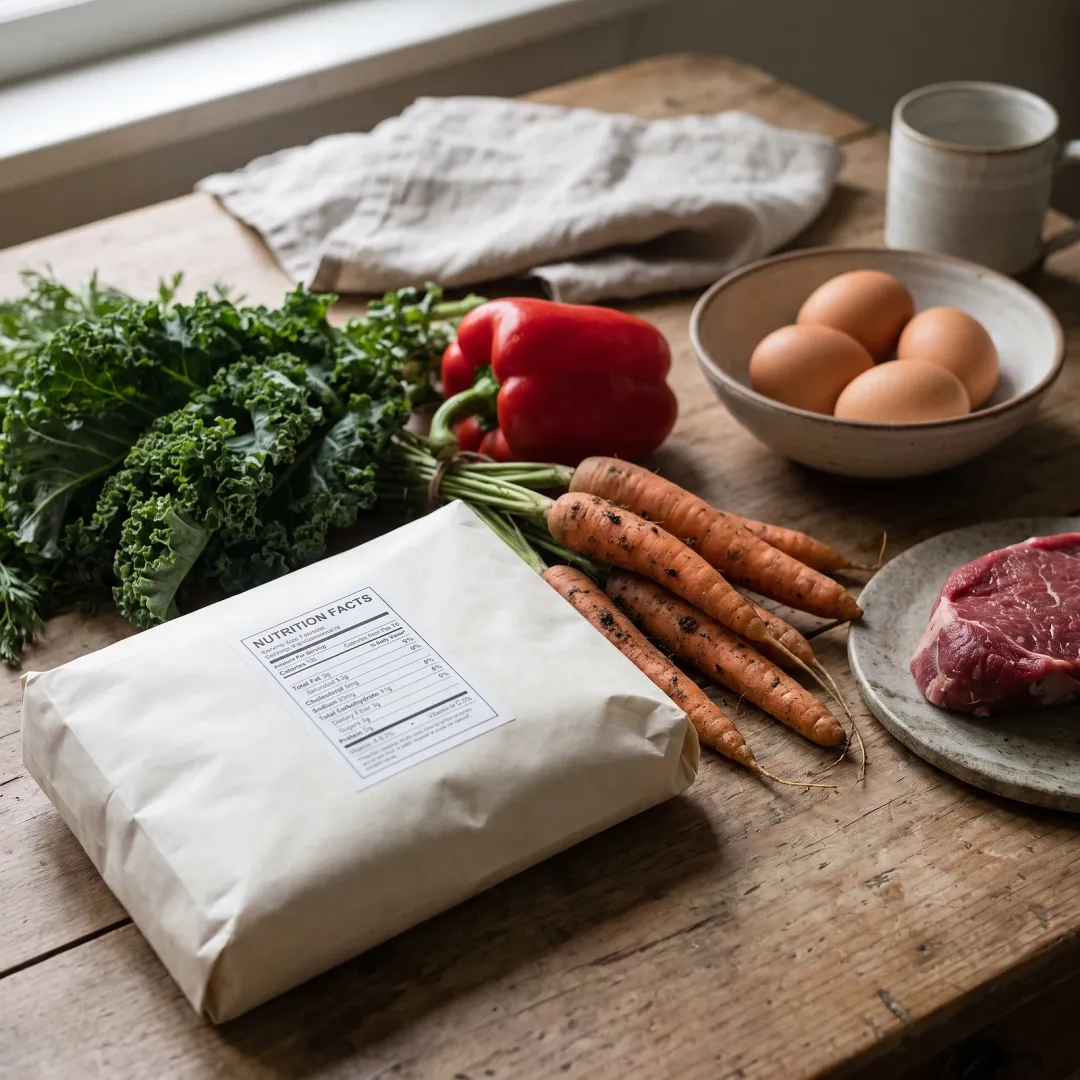

The front of the box is a billboard. The back of the box is the truth. Most people never make it to the back, and that is exactly how the food industry wants it.
Why the Label Exists (And Why It's Still Designed to Trick You)
The Nutrition Facts panel was created after the Nutrition Labeling and Education Act of 1990, and the FDA updated the format in 2016 to make it more useful. In theory, it's supposed to give you everything you need to make an informed choice. In practice, the food industry has spent decades figuring out exactly how to follow the letter of the law while still misleading you at every turn.
I say this as someone who spent years thinking I was making good choices because the front of the package said "natural" or "made with whole grains." It wasn't until I started actually learning what I was looking at, through a functional-medicine lens, that I realized how much I didn't know.
So here's the full walkthrough. Not just sugar. All of it.
This article is for general informational purposes only and is not medical advice. Always consult a qualified healthcare professional before making changes to your diet or health routine.
Step 1: Serving Size Is the First Manipulation
Before you look at a single calorie, gram of fat, or milligram of sodium, look at the serving size and servings per container. This is where a lot of people get lost.
A bag of chips that looks like a single-serve snack might list the nutrition for "about 2.5 servings." A bottle of juice sitting on a convenience store shelf is often labeled as two or even three servings. The FDA's updated 2016 label rules required manufacturers to use serving sizes that better reflect how much people actually eat in one sitting, which helped, but it didn't eliminate the problem. Manufacturers still have wiggle room.
My rule: always multiply every number on that label by the number of servings you're actually going to eat. If you're going to eat the whole bag, you owe it to yourself to do that math.
Step 2: Total Carbs vs. Net Carbs vs. Fiber Quality
This one gets people constantly, especially in the "low-carb" and "keto-friendly" packaged food space.
Total carbohydrates include fiber, sugar alcohols, and starch. The "net carb" number you see marketed on so many packages is not an FDA-regulated term. Manufacturers calculate it by subtracting fiber (and sometimes sugar alcohols) from total carbs. Some do it honestly. Many don't.
The bigger issue is fiber quality. Not all fiber is equal. Soluble fiber from real food, think flaxseed, vegetables, and fruit, feeds your gut microbiome and helps support steady blood glucose. A lot of packaged foods pad their fiber numbers with isolated functional fibers like chicory root (inulin), polydextrose, or soluble corn fiber. The FDA allows these to count toward fiber on the label, but the research on whether they deliver the same benefits as intact food fiber is still genuinely mixed. Some of them cause significant digestive distress. If you see inulin or chicory root extract near the top of an ingredient list, know that the fiber content you're excited about is largely from that source, not from the whole food you think you're eating.
Bottom line: real fiber comes with a real food. If the fiber in a "high-fiber" snack bar is coming from an additive rather than an ingredient you recognize, I'd put it back on the shelf.
Step 3: The Protein Line Doesn't Tell You Protein Quality
Seeing 10g of protein on a label sounds great. But the Nutrition Facts panel gives you a number, not a story. It does not tell you whether that protein is complete, meaning it contains all nine essential amino acids, or whether it's a low-quality isolate added purely to boost that number.
Plant-based protein bars and snacks often combine multiple protein sources (pea protein, rice protein, hemp protein) to create a more complete amino acid profile, which is fine, but you'd never know that from glancing at the label. Meanwhile, collagen is sometimes listed as the primary protein source in a product, and while collagen has real benefits, it is not a complete protein. It's missing tryptophan. Some manufacturers add it anyway because "collagen protein bar" sounds premium and the number on the label looks good.
A 2019 review in the Journal of the International Society of Sports Nutrition found that leucine content and overall essential amino acid profile matter far more for muscle protein synthesis than total protein grams alone. The label doesn't give you that.
For protein, I go to the ingredient list. I want to see a recognizable whole-food protein source, eggs, meat, fish, nuts, or legumes, near the top. Not a string of protein isolates listed after a paragraph of other ingredients.
Step 4: The Fat Section and the Oils That Hide in Plain Sight
The fat section of the label shows total fat, saturated fat, trans fat, and sometimes polyunsaturated and monounsaturated fat. What it does not show you is which specific oils the product contains. For that, you have to go to the ingredient list.
This matters because industrial seed oils (soybean oil, canola oil, sunflower oil, safflower oil, corn oil) are almost universally used in packaged snacks, crackers, dressings, and frozen foods. They're cheap, shelf-stable, and largely invisible on the Nutrition Facts panel because they show up as unsaturated fat, which most people have been taught to see as "good."
The concern with seed oils isn't simply that they're high in polyunsaturated fat. It's about the omega-6 to omega-3 ratio and the oxidation that happens during high-heat processing. A review published in the British Medical Journal raised serious questions about replacing saturated fat with polyunsaturated vegetable oils and cardiovascular outcomes. The science here is genuinely contested and still evolving, but I'm not going to sit here and tell you that highly refined, industrially extracted oils are health food.
Scan the ingredient list. If you see soybean oil, canola oil, or "vegetable oil" anywhere in the first five ingredients, that product is built on a foundation I don't trust.
Step 5: The Sodium Line and What It's Hiding
Sodium is one of the most over-consumed minerals in the American diet, largely from packaged and processed food. The 2020-2025 Dietary Guidelines for Americans recommend no more than 2,300 mg per day for most adults, and a large chunk of that is coming from foods you might not even think of as salty. Bread. Canned soup. Sauces. Protein bars.
Check the % Daily Value column on the sodium line. The FDA defines anything at or above 20% DV as "high" in that nutrient. A lot of single-serving packaged foods sit at 25, 30, even 40% DV for sodium, and if you eat two servings, do the math.
High sodium intake from processed food is also often paired with very little potassium. That ratio matters more than the sodium number alone. Real whole food naturally delivers both in a balanced ratio. Packaged food usually doesn't.
Step 6: The Ingredient List Is the Real Label
The Nutrition Facts panel gives you numbers. The ingredient list gives you truth.
FDA regulations require ingredients to be listed in descending order by weight. So the first ingredient is what the product is mostly made of. If the first ingredient in your "almond" crackers is enriched wheat flour and almonds show up eighth, those are wheat crackers with a little almond flavor.
A few specific things I look for:
Enriched or bleached flour. "Enriched" means they stripped the natural nutrients out during processing and then added a few synthetic ones back. That is not a net gain.
"Natural flavors." This term is an FDA-allowed catch-all that can include hundreds of chemical compounds derived from plant or animal sources, processed in ways that are anything but natural. It tells you almost nothing about what you're actually eating.
Carrageenan. A seaweed-derived thickener used in dairy alternatives and some dairy products. Some research has raised concerns about its effects on gut inflammation, though the evidence is still debated. I avoid it when I can.
BHA, BHT, and TBHQ. Synthetic preservatives used to extend shelf life. The National Toxicology Program has flagged concerns with some of these at high doses. They are generally recognized as safe at current food-use levels, but they have no business being in food I'm feeding my family.
Partially hydrogenated oils. Technically banned by the FDA as of 2020, but some products made before that deadline are still being sold. If you see this, put it down.
My personal rule is simple: if I can't picture the ingredient as something that exists in a kitchen or a field, I'm skeptical.
Step 7: Don't Trust the Front of the Package
"Made with whole grains." "A good source of fiber." "Low fat." "No artificial preservatives." "Gluten free." "Keto friendly."
These are marketing claims. Some are regulated. Some are not. All of them are designed to get you to put the product in your cart without reading the back.
"Made with whole grains" can legally appear on a product where whole grain is the fifth or sixth ingredient. "Low fat" often means they replaced fat with sugar or industrial starches to keep it palatable. "Gluten free" tells you nothing about whether a product is nutritious. Rice flour and tapioca starch are gluten free. So is candy.
"Natural" is one of the most meaningless words in the food industry. The FDA has acknowledged it hasn't formally defined the term for use on food labels, which means manufacturers use it almost however they want.
I have a hard rule in my house: the front of the package is a sales pitch. The back is the data. I make decisions from data.
What a Label I Actually Trust Looks Like
Short ingredient list. Ingredients I recognize as real food. No seed oils in the first five ingredients. No "natural flavors" mystery. No synthetic preservatives. Serving size that reflects reality.
Honestly? The foods I eat most don't have labels at all. A grass-fed ribeye doesn't have a Nutrition Facts panel. Neither does a sweet potato, a bag of arugula, or a carton of pastured eggs. That's the point. Real food doesn't need a label to prove it's food.
But when packaged food is part of life, because it is for most of us sometimes, knowing how to read what's in front of you is a non-negotiable skill. You were given a body to steward. That starts with knowing what you're actually putting in it.
Key Takeaways
- Always check the serving size first and multiply every number by how many servings you'll actually eat.
- The ingredient list is more informative than the Nutrition Facts panel. Ingredients are listed by weight, so what comes first is what the product is mostly made of.
- Not all fiber is equal. Isolated functional fibers (inulin, chicory root, soluble corn fiber) inflate the fiber count without delivering the same benefits as intact whole-food fiber.
- The fat section won't tell you which oils are in the product. Go to the ingredient list and look for seed oils by name.
- Front-of-package claims like "natural," "made with whole grains," and "low fat" are marketing, not nutrition. Ignore the front, read the back.
- Ingredients like "natural flavors," carrageenan, BHA/BHT, and enriched flour are red flags worth knowing.
- The cleanest foods usually don't have a label at all. Prioritize real, whole food and use label-reading as a skill for when packaged food is part of the picture.
Frequently Asked Questions
What is the most important part of a food label to read?
The ingredient list is the most revealing part of any food label. Ingredients are listed in descending order by weight, so whatever comes first is what the product is mostly made of. The Nutrition Facts panel gives you numbers, but the ingredient list tells you what those numbers are actually made of. Start there.
What does 'natural flavors' mean on a food label?
Surprisingly little. The FDA allows manufacturers to use the term 'natural flavors' to cover a broad range of flavoring compounds derived from plant or animal sources but often heavily processed. It's a legal catch-all that tells you almost nothing specific about what's in your food. If you're trying to eat clean, it's worth noting and, when possible, choosing products without it.
How can you spot seed oils on a food label?
You won't find them on the Nutrition Facts panel. You have to read the ingredient list. Look for soybean oil, canola oil, sunflower oil, safflower oil, corn oil, cottonseed oil, and the catch-all 'vegetable oil.' If any of these appear in the first five ingredients, the product is built around a refined industrial oil.
Is 'high fiber' on a food label always a good sign?
Not automatically. Fiber content on a label can come from intact whole-food sources or from isolated functional fibers added during manufacturing, like inulin, chicory root extract, or soluble corn fiber. The FDA allows these to count toward the fiber total on the label. Some research suggests isolated fibers may not deliver the same benefits as intact food fiber, and some can cause digestive discomfort. Check the ingredient list to see where the fiber is actually coming from.
Sources
- U.S. Food and Drug Administration: Changes to the Nutrition Facts Label
- Nutrition Reviews: Dietary fiber type reflects physiological functionality: comparison of grain fiber, inulin, and polydextrose
- Applied Physiology, Nutrition, and Metabolism: Protein: A nutrient in focus
- The BMJ: Use of dietary linoleic acid for secondary prevention of coronary heart disease and death
- Dietary Guidelines for Americans 2020-2025: Dietary Guidelines for Americans 2020-2025
- Environmental Working Group: Natural vs. Artificial Flavors
- Environmental Health Perspectives: Review of harmful gastrointestinal effects of carrageenan in animal experiments
- National Toxicology Program: Technical Report on Butylated Hydroxyanisole (BHA)
- U.S. Food and Drug Administration: Use of the Term Natural in Food Labeling
This article is for general informational purposes only and is not medical advice. Always consult a qualified healthcare professional before making changes to your diet or health routine.




Join the conversation
What do you think?
Free members can comment, reply and like. It takes ten seconds.