


Your nails keep snapping. You are cold when nobody else is cold. You read the same paragraph three times and still have no idea what it said. And every time you bring it up, someone tells you you're just tired or stressed or getting older. That explanation is too convenient, and it lets a real nutritional problem slide right past the warning window.
The Mistake: Waiting for the Doctor to Call It Deficient
Here is the most common thing I see in the real-food world: someone feels off for months, gets a blood panel, and is told their iron or B12 is "within normal range" so everything is fine. They go home, still exhausted, still foggy, still assuming it must be something else.
The problem is that "normal range" and "optimal" are not the same address.
Conventional lab reference ranges are built around a population average, not a picture of thriving. A serum ferritin (the storage form of iron) can sit at 12 ng/mL and still be flagged as "normal" at many labs, even though research published in the British Journal of General Practice has suggested that fatigue and functional impairment often show up at ferritin levels well below what practitioners would consider treatment-worthy. Similarly, serum B12 can read in-range while tissue-level B12 activity is already compromised, something a 2013 review in Nutrients addressed when it noted that standard serum B12 assays do not reliably capture functional deficiency.
Waiting for the lab to wave a red flag is a losing strategy. By the time ferritin is flagged as low or B12 triggers a formal deficiency diagnosis, the body has often been running on fumes for a long time. The smart move is learning to read the earlier signals.
What Your Body Is Actually Saying
Iron and B12 are not interchangeable, but they produce a strikingly overlapping set of symptoms when they start running low, because they are both essential to oxygen delivery and cellular energy.
Iron is the mineral your red blood cells use to carry oxygen. Without enough of it, every cell in your body gets less fuel. B12 is a water-soluble vitamin that your body cannot make on its own. It is critical for red blood cell formation, neurological function, and DNA synthesis, according to the National Institutes of Health Office of Dietary Supplements.
When either one starts to slide, the signals often include:
Fatigue that sleep does not fix. Not the "I stayed up too late" kind. The kind where you wake up already behind.
Brain fog and word-finding trouble. You are searching for a word you have used a thousand times.
Cold hands and feet, even in a warm room. Poor oxygen delivery to the extremities shows up as a constant chill.
Brittle or spoon-shaped nails. Koilonychia (a scooped nail shape) is a recognized clinical sign of iron deficiency, noted in sources including the American Academy of Family Physicians.
Palpitations or breathlessness on easy exertion. Your heart works harder when blood oxygen is low.
Tingling or numbness in hands or feet. This one leans more B12. Nerve function depends heavily on B12-dependent myelin production, as outlined by the NIH.
Pale inner eyelids or gums. Pull down your lower eyelid. The inner rim should be a healthy pink-red. Pale signals low hemoglobin.
A sore, swollen, or unusually smooth tongue. Glossitis is listed as a clinical symptom of both B12 and iron insufficiency.
None of these symptoms alone seals a diagnosis. But a cluster of them, especially with a lifestyle or history that creates risk, is a signal worth chasing, not explaining away.
Who Is Actually at Risk (And Why It Isn't Just About Eating Red Meat)
A lot of people assume iron and B12 problems only happen to strict vegetarians. That is not close to the full picture.
For iron, the highest-risk groups include people with heavy menstrual cycles, anyone with gut inflammation or low stomach acid (because iron absorption is highly acid-dependent), and people who train hard without paying attention to recovery nutrition. A 2021 review in Nutrients confirmed that gut health plays a significant role in iron absorption, with conditions like celiac disease and inflammatory bowel disease among the leading drivers of iron-related problems.
For B12, the picture is even wider. B12 from food requires a protein called intrinsic factor, produced by stomach acid. If stomach acid is low, whether from age, chronic stress, long-term use of acid-suppressing medications, or gut issues, absorption can drop dramatically even if you are eating pork liver and eggs every week. The NIH notes that older adults, people with atrophic gastritis, and those on long-term proton pump inhibitors or metformin are at elevated risk.
So the real risk factor is often not food choices alone. It is absorption.
The Food-First Foundation (And Where It Has Limits)
Real food is where I always start. Not because it fixes everything, but because it fixes the foundation, and because the body recognizes food-form nutrients in ways that isolated supplements do not always match.
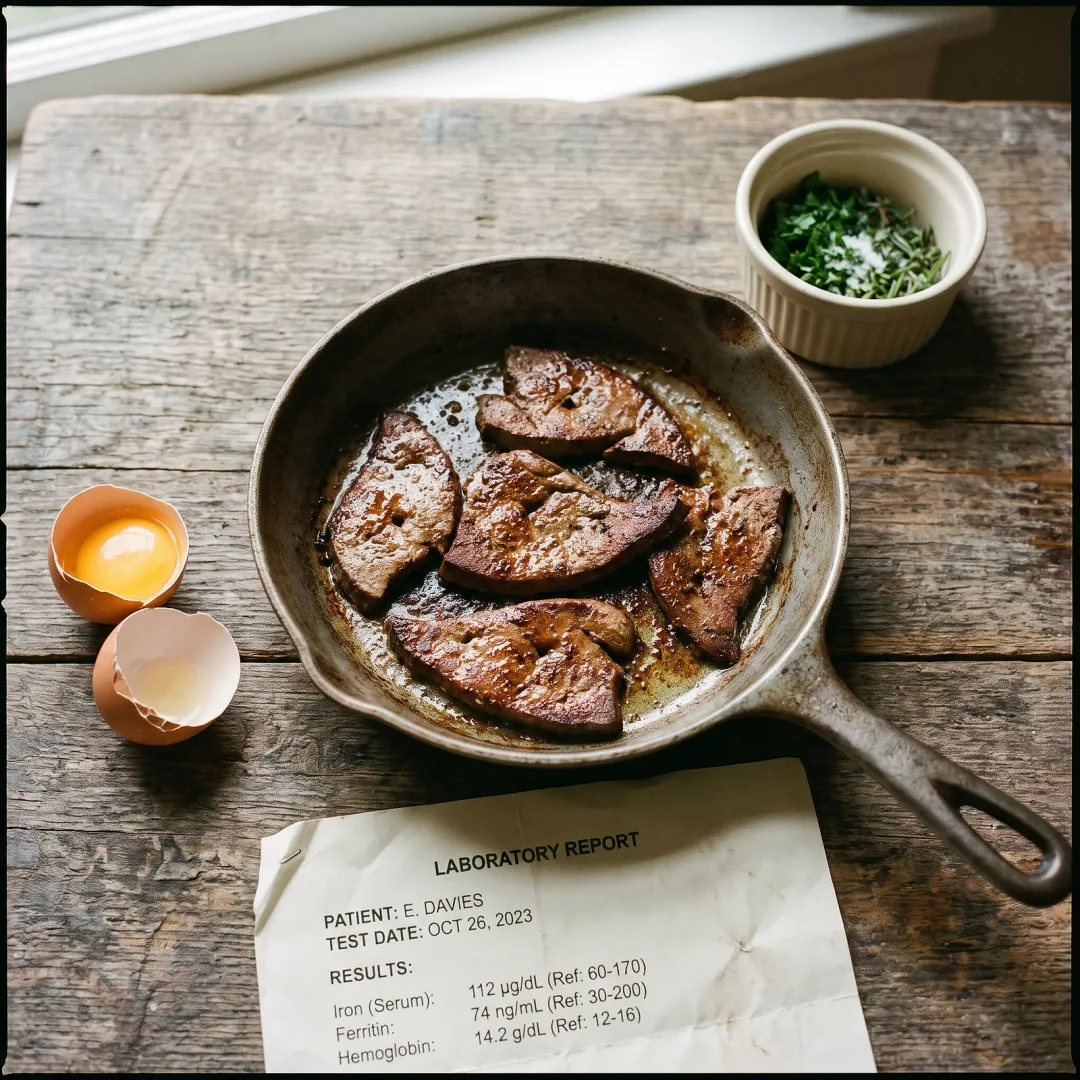
For iron, the most absorbable form is heme iron, found only in animal foods. We are talking about organ meats like pork liver (one of the most nutrient-dense foods on the planet), beef, lamb, and dark-meat poultry. A 3-ounce serving of pork liver contains a significant amount of heme iron alongside B12, copper, and vitamin A that all support its use in the body. Pairing iron-rich foods with vitamin C sources may enhance non-heme iron absorption, according to a review published in Critical Reviews in Food Science and Nutrition.
For B12, animal protein is non-negotiable. Liver again, eggs, pork, beef, clams. B12 simply does not exist in meaningful amounts in plant foods. If you are eating a diverse, animal-based real-food diet and still showing low-normal B12, absorption is the conversation to have, not just intake.
That said: if absorption is impaired, food alone may not be enough. This is where I always say go back to the root cause. Low stomach acid from chronic stress, a gut that has been battered by years of processed food, an underlying absorption issue, those need to be addressed alongside the dietary changes. And if your numbers are already in a clinical hole, talk to your doctor about whether supplementation makes sense for you. Some people with absorption issues need a form of B12 that bypasses the gut entirely. That is a conversation for your healthcare provider, not something to guess at.
The Labs Worth Asking For (Before You Hit Rock Bottom)
Your annual CBC (complete blood count) is a starting point, but it is not the full picture for either of these nutrients. By the time your CBC shows anemia, things have been off for a while.
For iron, the more useful markers include ferritin (storage iron), serum iron, TIBC (total iron-binding capacity), and transferrin saturation taken together. Ferritin alone can be misleading because it is also an acute-phase reactant, it rises with inflammation, so a "normal" ferritin in the presence of active inflammation may still mask true iron insufficiency.
For B12, beyond serum B12 you can ask about methylmalonic acid (MMA) and homocysteine. Both elevate when B12 is functionally insufficient at the tissue level, even if serum B12 looks passable. The NIH ODS acknowledges that MMA and homocysteine are more sensitive markers of B12 status than serum B12 alone.
You are allowed to ask your doctor for these tests. Write them down before your appointment, say what symptoms you have been noticing, and ask if it makes sense to run them. A good provider wants the fuller picture too.
And pay attention to your trending numbers over time. A ferritin that dropped from 68 to 24 over two years is a story, even if 24 is still "in range." That trend matters.
The Mindset Shift That Changes Everything
Here is the real coaching piece underneath all of this: most people treat nutritional status as something to fix when it breaks, not something to tend before it does. And I get why. We are all busy, the healthcare system rewards crisis intervention over prevention, and "you're fine, your labs are normal" feels like permission to move on.
But the body gives warnings. Long ones. It runs on reserves for a surprisingly long time before the labs catch up to the symptoms. The fatigue, the fog, the nails, the chill, those are your body asking for something before it resorts to screaming.
Stewardship of your physical health means paying attention at that early whisper stage. It means eating the liver pate (I know, I know, we can talk about how to make it taste good another day). It means asking your doctor for the fuller panel. It means not accepting "you're fine" as the full story when you do not feel fine.
You were given one body. The goal is not just to avoid a diagnosis. It is to actually feel well inside the life you are living.
---
This article is for general informational purposes only and is not medical advice. Always consult a qualified healthcare professional before making changes to your diet or health routine.
Key Takeaways
- "Normal" lab ranges and optimal nutritional status are not the same thing, iron and B12 problems often show up as symptoms long before labs wave a red flag.
- Fatigue that sleep doesn't fix, brain fog, cold extremities, brittle nails, and tingling hands are common early signals worth paying attention to.
- Absorption is often the root issue, not just food intake, low stomach acid, gut inflammation, and certain medications can tank B12 and iron absorption even on a real-food diet.
- Ask your doctor for ferritin, TIBC, transferrin saturation, and MMA or homocysteine, not just a standard CBC.
- Pork liver is one of the most iron- and B12-rich foods available; real-food animal protein is the foundation, with absorption addressed alongside it.
- Track your trend over time, not just a single snapshot number.
Frequently Asked Questions
What are the first signs of iron deficiency before anemia sets in?
Before iron deficiency progresses to full anemia, common early signals include persistent fatigue that rest doesn't relieve, difficulty concentrating, feeling cold (especially in the hands and feet), brittle or spoon-shaped nails, pale inner eyelids or gums, and reduced exercise tolerance. These symptoms can appear when ferritin (iron storage) is low even if hemoglobin is still technically in range. If you notice a cluster of these, it's worth asking your doctor to run a fuller iron panel including ferritin and transferrin saturation, not just a standard CBC.
Can you have a B12 deficiency even if you eat meat?
Yes, and it's more common than most people expect. B12 from food requires adequate stomach acid and a protein called intrinsic factor to be absorbed properly. If your stomach acid is low, which can happen with age, chronic stress, or long-term use of certain medications like proton pump inhibitors or metformin, absorption can be compromised even on a diet rich in animal protein. This is why functional markers like methylmalonic acid (MMA) and homocysteine are more revealing than serum B12 alone. Talk to your doctor if you suspect an absorption issue.
What is the difference between serum ferritin and serum iron, and which one matters more?
Serum iron measures the iron currently circulating in your blood at the moment of the draw, it fluctuates a lot and can be influenced by recent meals, inflammation, or even time of day. Ferritin reflects your body's stored iron reserves and gives a much longer-term picture. For most people, ferritin is the more clinically meaningful number, though it has a catch: ferritin is also an acute-phase reactant, meaning it rises with inflammation. So a 'normal' ferritin in someone with active inflammation may still mask genuinely low iron stores. Looking at ferritin, serum iron, TIBC, and transferrin saturation together gives the clearest picture.
What foods are highest in iron and B12 for someone eating paleo?
Organ meats, especially pork liver and beef liver, are among the most concentrated food sources of both heme iron and B12 available. Beef, lamb, pork, and dark-meat poultry are solid sources of heme iron. Eggs provide B12 in a bioavailable form. Clams and oysters are exceptionally high in both nutrients. For non-heme iron from plant sources (like leafy greens and pumpkin seeds), pairing them with a vitamin C source at the same meal may support absorption. Heme iron from animal foods, however, is absorbed at a significantly higher rate than non-heme iron and doesn't depend on that pairing.
Sources
- British Journal of General Practice: Ferritin levels, fatigue, and iron deficiency without anemia
- Nutrients (MDPI): Vitamin B12 and Health (2013 Review)
- NIH Office of Dietary Supplements: Vitamin B12, Health Professional Fact Sheet
- American Academy of Family Physicians: Iron Deficiency Anemia: Evaluation and Management
- Nutrients (MDPI): Gut Microbiota and Iron Absorption (2021 Review)
- USDA FoodData Central: Pork liver, cooked, nutrient profile
- Critical Reviews in Food Science and Nutrition: Interactions between dietary iron and vitamin C
This article is for general informational purposes only and is not medical advice. Always consult a qualified healthcare professional before making changes to your diet or health routine.



Join the conversation
What do you think?
Free members can comment, reply and like. It takes ten seconds.