

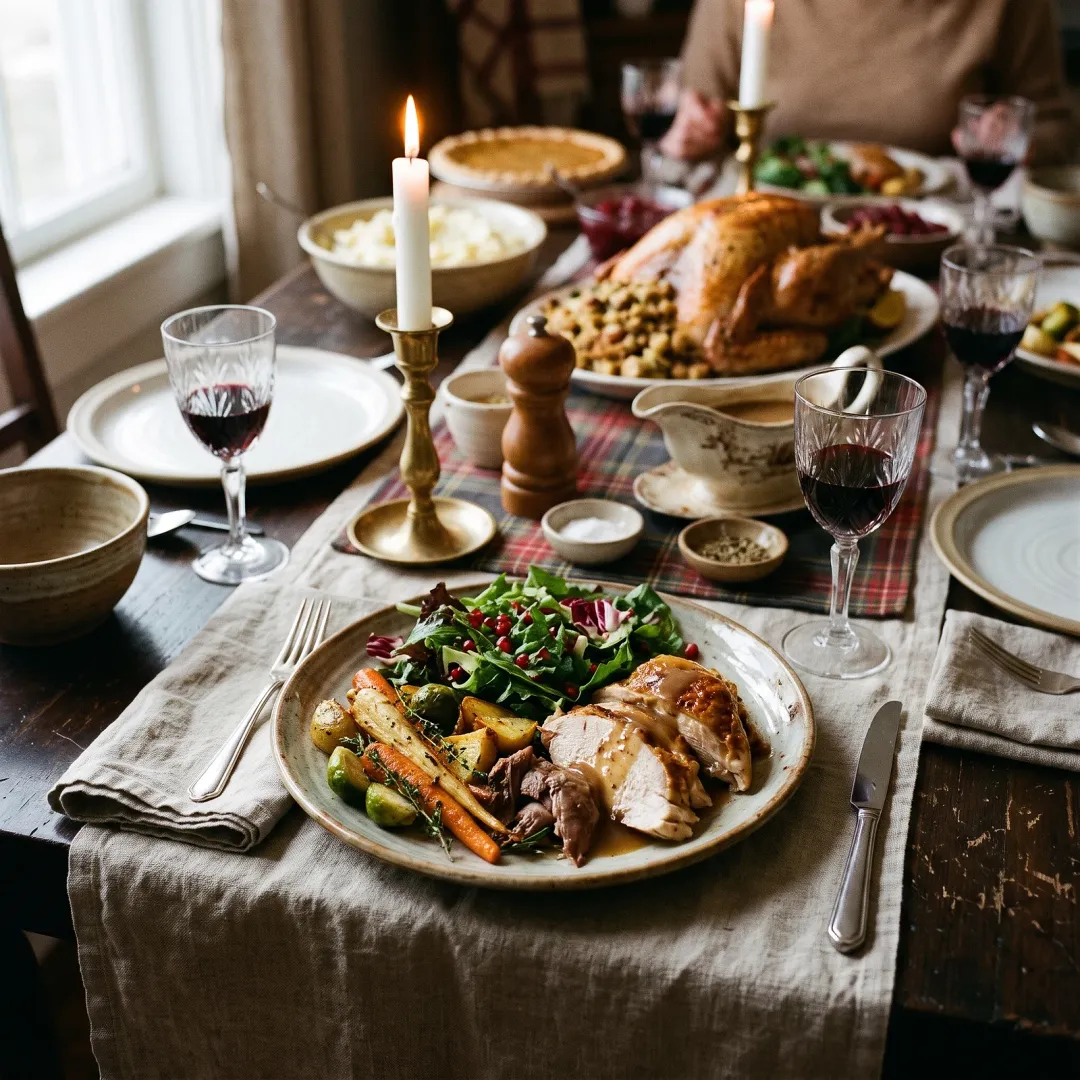

Everyone is coming over, or you are driving to someone else's house, and you already know what the spread looks like. Rolls, green bean casserole with fried onions from a can, the sweet potato dish drowned in marshmallows, a dessert table that goes on forever. You eat paleo. Or gluten-free. Or you have just been doing the real-food thing long enough that most of that food genuinely does not make you feel good anymore, and you know it. This is not about being difficult. It is not about making a statement. It is just about wanting to get through the holidays without spending the next two days on the couch feeling terrible, while also not ruining anyone else's dinner with your food opinions. You can do both. Here is how.
Why the Holiday Table Feels Harder Than It Actually Is
Food is love at a holiday table. That is not a metaphor. Your aunt made that casserole from her mother's recipe. Your mom spent two days on that pie. When you don't eat it, it can feel like a rejection of something way bigger than a dish, and everyone at the table feels that, including you.
The social pressure around holiday eating is well-documented. Research published in the journal Appetite found that people consistently adjust what they eat to match the people around them, a phenomenon researchers call "social modeling," and it is a powerful pull even for people with strong dietary intentions (Herman et al., Appetite, 200300028-3)). Knowing that this pressure is real, predictable, and extremely normal does not make it disappear, but it does mean you can plan for it instead of just hoping willpower shows up on the day.
The good news: most of the stress around this comes from under-preparation and over-explaining. Fix those two things and the rest gets manageable fast.
Before You Go: The Five Things Worth Doing Ahead of Time
1. Eat before you arrive. This is the single highest-leverage move. A small, real-food meal or snack before you walk in the door means you are not standing next to the cheese dip at 5 p.m. making desperate decisions on an empty stomach. Something with protein and fat, like a few sardines on cucumber slices or a handful of nuts with a hard-boiled egg, keeps your blood sugar stable and your decision-making intact. Research on meal timing and appetite regulation consistently shows that arriving hungry to a social eating event is one of the most reliable ways to override your own intentions.
2. Offer to bring something, then bring something you can actually eat. This is not sneaky. It is generous. A big roasted vegetable dish, a whole-30-compatible sweet potato casserole made with coconut milk and no marshmallows, a herb-crusted whole mackerel or a smoked trout dip with vegetable crudites. You contribute, you bring something that works for you, and nobody has to know it was partly strategic. Win-win.
3. Know the menu if you can. A quick text to the host before the holiday is not weird. "Hey, I want to make sure I bring something that fills a gap, what are you already making?" Most hosts love the initiative. It also gives you a preview of what the table will look like so you are not caught off guard.
4. Pack a backup. Stash something small in your bag or the car. A packet of almond butter, a few strips of compliant jerky, a small bag of walnuts. If the entire spread is off the table for you, you are not stranded.
5. Decide your line ahead of time, privately. Not a dramatic announcement. Just an internal decision. Are you strict today, or are you allowing one flex item? Decide before you walk in so you are not negotiating with yourself in real time under social pressure. Pre-commitment is a genuinely effective strategy. Research on implementation intentions (the "if-then" decision structure) shows it significantly increases follow-through on personal goals compared to vague intentions alone.
At the Table: How to Navigate Without Making It a Thing
Keep your plate looking like a plate, not a protest. Fill it with the things that work for you: the roasted turkey or whatever protein is there, roasted vegetables, a salad, your dish if you brought one. A full, colorful plate draws no attention. A plate with nothing on it, or one token carrot, is what gets questions.
You do not owe anyone an explanation, but a short one defuses tension fast. If someone asks why you are not eating the rolls, "I'm just doing a real-food thing right now, everything else looks amazing" is complete. You do not need to list your reasons, explain the seed oil content of the green bean casserole, or mention the ultra-processed food research that keeps stacking up. Save that for people who actually ask. The holiday table is not the place.
Redirect with genuine curiosity. Food comments die quickly when you change the subject to something the other person actually wants to talk about. Ask about their garden, their job, their kid's soccer season. This sounds obvious, and it works every single time.
Handle the pusher with warmth, not war. Every family has the person who will not let it go. "Come on, just try a little." "You're no fun." "Your grandmother made this." The warmest possible response is a smile, a "it looks incredible, I'm just so full," and a subject change. You are not obligated to defend yourself. And you are definitely not going to change their mind about anything food-related at the dinner table on a holiday.
What to Actually Eat: Building a Real-Food Plate From a Conventional Holiday Spread
Most holiday tables have more paleo-friendly options than they look like at first glance. Here is how to work the spread.
Yes, almost always:
- The turkey, roasted chicken, ham, or other whole protein (ask if it was basted with vegetable oil or butter, and decide accordingly)
- Roasted vegetables, especially if they are simply prepared
- A green salad (dressing on the side; most bottled dressings contain canola or soybean oil)
- Olives, pickles, crudites
- Fruit if there is a fruit dish
- Nuts if they are plain
- Sweet potatoes if they are not in a casserole with marshmallows and sweetened condensed milk
Check on these:
- Mashed potatoes (often made with cream, butter, or both; decide where you land)
- Stuffing or dressing (almost always contains bread and is not a paleo food, though some families make a cornbread version or a grain-free version if you ask ahead)
- Gravy (often thickened with flour; sometimes made with cornstarch, which some people tolerate and others do not)
Skip or take a small courtesy bite if it matters that much:
- Rolls and bread
- Traditional green bean casserole (canned soup, flour, fried onion topping)
- Marshmallow sweet potato casserole
- Pies with conventional crusts
- Most commercial desserts
You can build a genuinely satisfying, real-food plate at almost any holiday table. It just takes a few seconds of actually looking at what is there.
The Emotional Side Nobody Talks About
Being the only one eating differently at the table can feel lonely, and that is worth saying out loud. Food has always been how humans signal belonging. Sharing a meal from the same pot is one of the oldest forms of community there is, which makes it sting a little when what you need to eat puts you outside that common ground.
What I have come to believe, personally, is that the food itself is not the community. The people are. You can sit at that table, eat a plate of roasted turkey and vegetables and the dish you brought, and still be fully present in the warmth of that gathering. You do not need to eat the rolls to love the people. And honestly, feeling good the next day, actually being energetic and clear-headed instead of bloated and crashed on the couch, means you are more present for the people you love in the days after the holiday too. That is not being difficult. That is stewardship.
If your faith shapes how you think about your body and what you put in it, the holidays can actually be a beautiful place to live that out quietly. Not loudly. Not with a speech. Just by being someone who takes care of themselves with intention, while remaining fully, warmly present with the people around you.
When You Are the Host: Making It Work for Everyone
If the holiday is at your house, you have the most control, and you can run a table that serves everyone without anyone feeling like a burden or a project.
Keep the protein clean and simple. A whole roasted turkey, a standing rib roast, or a whole baked mackerel for a smaller gathering. Season with herbs, olive oil, salt. That is it. No one misses a complicated sauce.
Offer two versions of the high-impact sides. A traditional mashed potato situation and a mashed cauliflower or roasted root vegetable situation. A grain-free stuffing made with almond flour bread and herbs alongside a classic. Nobody feels singled out, and you have covered the table.
Label things simply if the group is mixed. Small cards that say "gluten-free" or "dairy-free" mean people can navigate without asking. This is a kindness in every direction.
Make the dessert table more interesting than a standard pie lineup. A dark-chocolate bark with dried cherries and sea salt. A coconut milk panna cotta. Roasted pears with cinnamon. Desserts can be real-food-forward and still feel festive enough for a holiday table.
This article is for general informational purposes only and is not medical advice. Always consult a qualified healthcare professional before making changes to your diet or health routine.
Key Takeaways
- Eat a real-food snack before you arrive so hunger does not make your decisions for you.
- Offer to bring a dish you can eat. It is generous and strategic at the same time.
- Build your plate from what already works on the table: whole proteins, roasted vegetables, simple sides.
- You do not owe anyone a lecture or a lengthy explanation. A warm, short answer and a subject change handles almost every situation.
- Pre-decide your line before you walk in. Implementation intentions reduce in-the-moment caving under social pressure.
- The community is the people, not the rolls. You can be fully present without eating everything on the table.
Frequently Asked Questions
What do I eat at a holiday dinner if I'm gluten-free and there's nothing safe?
Start with the whole protein on the table (turkey, ham, roast), then look for simply roasted vegetables, salads, olives, nuts, and fresh fruit. These are on most holiday tables and are naturally gluten-free-friendly. If you're unsure about anything, ask the host quietly. And honestly, eating a real-food snack before you arrive means you're never relying entirely on what's available.
How do I handle family comments about my diet at the holidays?
Keep it short and warm. Something like 'I'm just doing a real-food thing right now, everything looks amazing' and then redirect the conversation is usually enough. You don't need to defend, explain, or debate. The goal is a good time with the people you love, not winning a nutrition argument at the dinner table.
What's the best dish to bring to a holiday party when you eat paleo?
Something that looks festive and tastes great so nobody even clocks that it's paleo. A big pan of herb-roasted root vegetables, a grain-free sweet potato casserole made with coconut milk, a smoked fish dip with vegetable crudites, or a dark-chocolate bark with sea salt and dried cranberries for dessert. Bring something beautiful and abundant, not something that looks like a consolation prize.
Is it okay to just cheat on the holidays if everyone else is eating normally?
That's entirely your call, and I mean that. Only you know how your body responds and how much a flex matters to you. What I'd suggest is making that decision before you walk in the door, on purpose, rather than in the moment under social pressure. Pre-deciding, whether you're allowing one thing or staying strict, makes the whole evening much calmer.
Sources
- Appetite (Elsevier): Social influences on eating: The role of social modeling
- NIH / PMC: Meal timing, appetite regulation, and satiety
- Psychological Review (APA): Implementation intentions: Strong effects of simple plans (Gollwitzer, 1999)
- The BMJ: Ultra-processed food intake and risk of cardiovascular disease and all-cause mortality (EPIC study, 2019)
This article is for general informational purposes only and is not medical advice. Always consult a qualified healthcare professional before making changes to your diet or health routine.

Join the conversation
What do you think?
Free members can comment, reply and like. It takes ten seconds.