
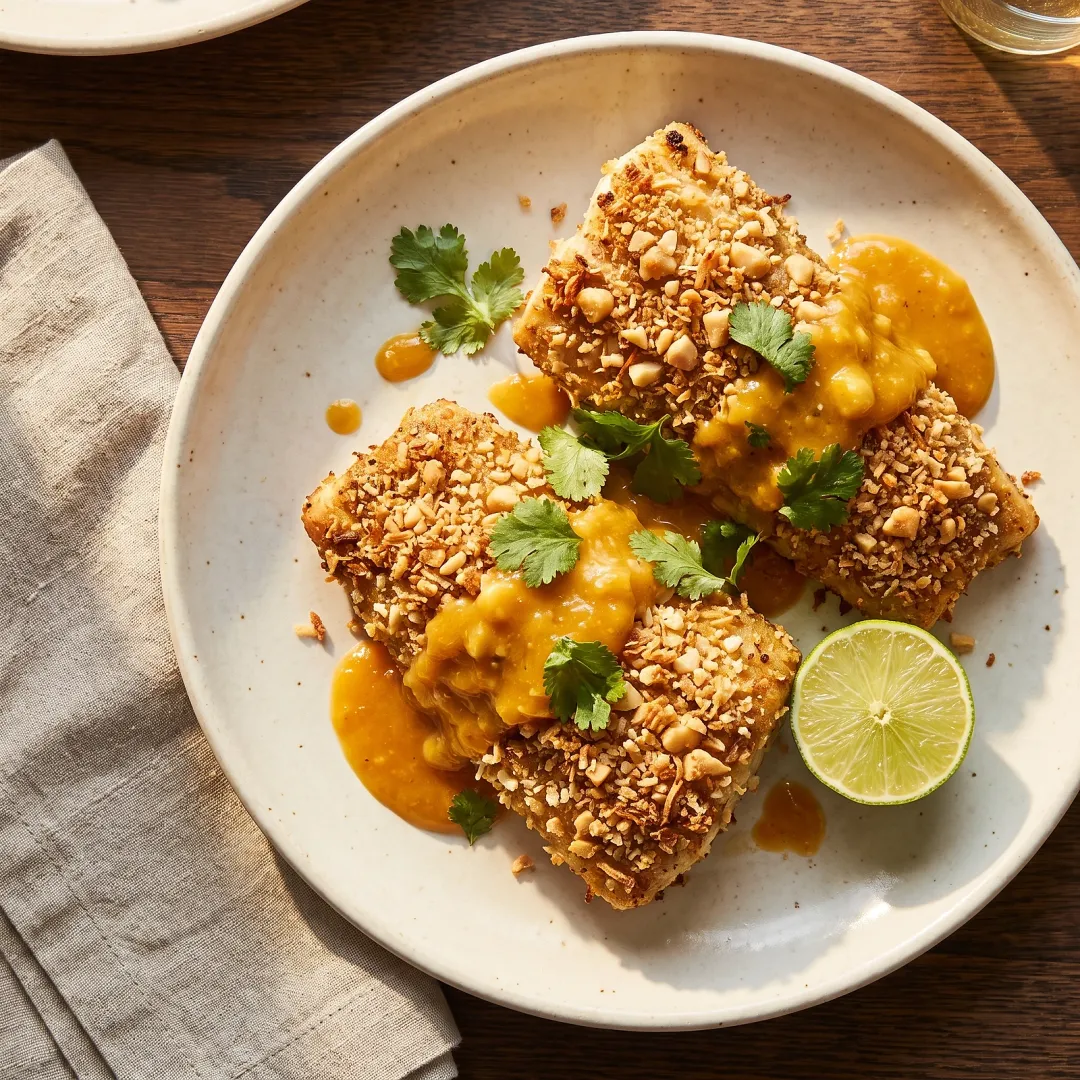

A lot of people overcomplicate fish, and that fear of messing it up keeps them stuck making the same boring chicken every single night. But a good piece of mahi-mahi? It practically wants to be cooked. It is firm, meaty, forgiving, and it takes a crust like a champ. This recipe came together because I wanted something that felt like a real restaurant dinner but used nothing I would have to apologize for eating. No breadcrumbs. No flour. No seed oils. Just macadamia nuts, coconut, good spices, and one egg to hold it all together. The mango coconut drizzle on top is what takes it from good to memorable. It is sweet and creamy and bright all at once, and it is made in about four minutes flat. Thirty minutes from fridge to table. Paleo, grain-free, dairy-free, and genuinely delicious. This is the kind of dinner that makes the people around your table stop talking for a second and just eat. I love when that happens.
Nutritional Benefits
Mahi-Mahi: Lean Protein That Actually Fuels You
- Mahi-mahi is a naturally lean, mild white fish that delivers around 30 grams of protein per 6-ounce fillet, making it one of the most efficient protein sources you can put on your plate.
- It is a solid source of B vitamins, particularly B12, which supports healthy nerve function, red blood cell production, and energy metabolism. A lot of people running on empty are quietly low in B12.
- Mahi-mahi also contains selenium, a trace mineral that matters enormously for thyroid function and antioxidant defense. Most people do not think about selenium until something goes wrong.
Macadamia Nuts: The Healthy Fat You Should Eat More Of
- Macadamia nuts are unusually high in monounsaturated fats, the same heart-supportive fats found in olive oil. About 80 percent of their fat content is monounsaturated.
- They are lower in omega-6 fatty acids than most other nuts, which matters if you are actively working to balance your omega-3 to omega-6 ratio. That ratio is everything when it comes to inflammation.
- The crust here gives you real, satisfying crunch without a single grain, which keeps this meal from spiking your blood sugar the way a traditional breadcrumb crust would.
Coconut Milk and Mango: More Than Just Flavor
- Full-fat coconut milk provides medium-chain triglycerides (MCTs), a type of fat your body converts to energy quickly rather than storing. Your brain especially loves MCT fuel.
- Fresh mango brings natural sweetness along with vitamin C, folate, and digestive enzymes. A little goes a long way, and here it goes toward a sauce that is honestly worth drinking with a spoon.
- The combination of fat from the coconut milk and natural sugar from the mango means your body absorbs the fat-soluble nutrients from the fish and nuts more efficiently. Real food works together.
FAQs
Can I use a different fish if I cannot find mahi-mahi?
Yes. This crust works really well on any firm white fish. Cod, halibut, and snapper are all great options. Just adjust your cook time based on thickness, and always make sure the fish is completely dry before you coat it or the crust will not stick.
Is this recipe Whole30 compliant?
Almost. The raw honey in the mango drizzle is technically not Whole30. You can simply leave it out. The mango provides plenty of natural sweetness on its own, and the sauce is still really good without it.
Can I bake this instead of pan-searing it?
You can, though you will get a less dramatic crust. If you want to bake, press the coated fillets onto a wire rack set over a lined baking sheet and bake at 425°F for 14 to 16 minutes depending on thickness. Broil for the last 2 minutes to get some color on top.
How do I store and reheat leftovers?
Store any leftover fish and drizzle separately in airtight containers in the fridge for up to 2 days. Reheat the fish in a dry skillet over medium heat for a few minutes per side rather than the microwave, which will steam the crust and make it soggy. Reheat the drizzle in a small saucepan over low heat.
My macadamia crust is falling off while I cook. What am I doing wrong?
Two things usually cause this. First, the fish was not dry enough before you started coating it. Pat it very well with paper towels. Second, the pan was not hot enough when you added the fish. The crust needs immediate high heat to set and bond. Do not move the fish at all for the first 4 minutes, and it will release cleanly when it is ready.
If you make this tonight, I really want to see it. Tag me on Instagram or drop a comment below and tell me how it went. And if you have been sitting on the fence about eating more fish, let this be the one that gets you off it. Your body was designed to thrive on real food. This is real food.
Macadamia-Crusted Mahi-Mahi with Mango Coconut Drizzle
Tender mahi-mahi fillets pressed into a golden macadamia nut and shredded coconut crust, pan-seared until crispy, then finished with a bright, silky mango coconut drizzle. This is a paleo dinner that feels like a splurge but keeps you completely on track.
Ingredients
- 4 mahi-mahi fillets (about 6 oz each), patted completely dry
- 3/4 cup raw macadamia nuts, finely chopped (not a paste, you want texture)
- 1/3 cup unsweetened shredded coconut
- 1/2 tsp garlic powder
- 1/2 tsp smoked paprika
- 1/4 tsp cayenne pepper
- 1/2 tsp fine sea salt, plus more for seasoning the fish
- 1/4 tsp black pepper
- 1 large egg, beaten
- 2 tbsp coconut oil, for searing
- 1 cup fresh or thawed frozen mango chunks
- 1/2 cup full-fat coconut milk
- 1 tbsp fresh lime juice
- 1 tsp raw honey
- 1/4 tsp ground ginger
- Pinch of sea salt (for the drizzle)
- Fresh cilantro and lime wedges, for serving
Instructions
- Pull your mahi-mahi fillets out of the fridge about 10 minutes before you cook. Cold fish hitting a hot pan is a texture disaster. Pat them very dry with paper towels, season lightly on both sides with salt and pepper, and set aside.
- Make the crust mixture. In a shallow bowl, combine the finely chopped macadamia nuts, shredded coconut, garlic powder, smoked paprika, cayenne, salt, and black pepper. Stir it together so everything is evenly distributed.
- Beat the egg in a separate shallow bowl. Dip each fillet into the egg, letting the excess drip off, then press firmly into the macadamia coconut mixture on both sides. Really press it in. Set the coated fillets on a clean plate while you get your pan ready.
- Make the mango coconut drizzle. Combine the mango chunks, coconut milk, lime juice, honey, ginger, and pinch of salt in a small blender or use an immersion blender. Blend until completely smooth. Pour into a small saucepan and warm over low heat for 3 to 4 minutes, stirring occasionally. You just want it warm and pourable, not bubbling. Taste and adjust lime or salt if needed. Keep on the lowest setting while you cook the fish.
- Heat the coconut oil in a large oven-safe skillet (cast iron is ideal) over medium-high heat. When the oil is shimmering and hot, carefully lay the fillets in the pan crust-side down. Do NOT move them. Let them sear undisturbed for 4 to 5 minutes until the crust is deep golden brown.
- Flip each fillet carefully using a thin spatula. Cook the other side for 3 to 4 minutes. Mahi-mahi is done when it flakes easily and the thickest part is opaque all the way through. If your fillets are very thick (over 1 inch), transfer the pan to a 400°F oven for 3 to 4 minutes after flipping instead of finishing on the stovetop.
- Plate the fish immediately. Spoon the warm mango coconut drizzle generously over each fillet. Finish with fresh cilantro and a lime wedge on the side. Serve right away.
Nutrition per serving
- Calories: 487
- Total Fat: 31g
- Carbohydrates: 18g
- Protein: 38g
- Dietary Fiber: 3g
- Sugar: 10g
 That Paleo Chick
Real food that heals
That Paleo Chick
Real food that heals
RecipePaleoDinnerGluten-Free

Fits these needs
Checked ingredient by ingredient. Tap one to see every recipe that fits.
Ingredients
Instructions
Nutrition Facts Amount per serving
Estimated from the ingredients. Values vary with brands and portions.

Join the conversation
Made it? Tell us how it went.
Free members can comment, reply and like. It takes ten seconds.