

On this page
If you grew up in the 80s or 90s, you were raised on a very specific piece of nutrition gospel: fat is bad, saturated fat is the worst, and if you eat enough of it, your heart will give out on you. So we swapped butter for margarine. We bought skim milk. We ate fat-free everything and wondered why we were still tired, still gaining weight, still sick. I did it too. For years I thought I was doing the right thing. I was not. And the science that supposedly told us to do all of that? It was a lot messier than anyone admitted.
Where the Fear Came From: One Man, One Very Influential Theory
The entire anti-saturated-fat movement basically traces back to one researcher: Ancel Keys. In the 1950s, Keys proposed what he called the diet-heart hypothesis, the idea that eating saturated fat raises cholesterol and that raised cholesterol causes heart disease. His landmark Seven Countries Study became the foundation for decades of dietary policy.
Here is the part they left out of the textbooks. Keys had data from 22 countries. He chose 7. The countries that contradicted his hypothesis, places where people ate a lot of fat and had low rates of heart disease, were quietly excluded. When researchers later looked at all 22 countries, the relationship Keys claimed was much weaker and far less convincing.
That is not a minor footnote. That is the scientific basis for telling an entire generation to stop eating real food.
What "Saturated Fat Raises Cholesterol" Actually Means (and Doesn't)
Okay, let's talk about the cholesterol argument, because this one still comes up constantly. Yes, saturated fat raises LDL cholesterol. That part is generally true. But the story does not stop there, and stopping there is where the mainstream narrative goes wrong.
LDL is not one thing. There are small, dense LDL particles that are associated with cardiovascular risk, and there are large, fluffy LDL particles that are largely benign. Saturated fat tends to raise the large, buoyant kind. It also raises HDL, the so-called good cholesterol. And it favorably shifts your overall cholesterol ratio.
A 2010 meta-analysis published in the American Journal of Clinical Nutrition pooled data from 21 prospective studies, covering nearly 348,000 people, and found no significant association between saturated fat intake and cardiovascular disease or stroke. None. That study was led by Dr. Ronald Krauss and his team, and it rocked a lot of institutional boats when it came out. It is still regularly cited, and still regularly ignored by the agencies that set our dietary guidelines.
The Sugar Industry's Dirty Little Secret
Here is where it gets genuinely infuriating. In 2016, researchers at UC San Francisco published a historical analysis in JAMA Internal Medicine revealing that the Sugar Research Foundation, funded by the sugar industry, had paid Harvard scientists in the 1960s to downplay sugar's role in heart disease and point the finger at saturated fat instead. The payments were the equivalent of roughly $50,000 in today's money. The researchers who took that funding went on to shape U.S. dietary policy.
We literally built a half-century of nutrition guidelines on corrupted science. The low-fat craze that followed did not make America healthier. It made us reach for processed, low-fat, high-sugar products that manufacturers were happy to supply. Obesity rates climbed. Type 2 diabetes climbed. And we kept blaming the butter.
I'm not saying saturated fat is magic or that calories don't matter or that you can eat anything you want. I'm saying the specific campaign against saturated fat was built on a foundation that had serious integrity problems, and we all paid for it with our health.
What Real Food Contains and Why That Context Matters
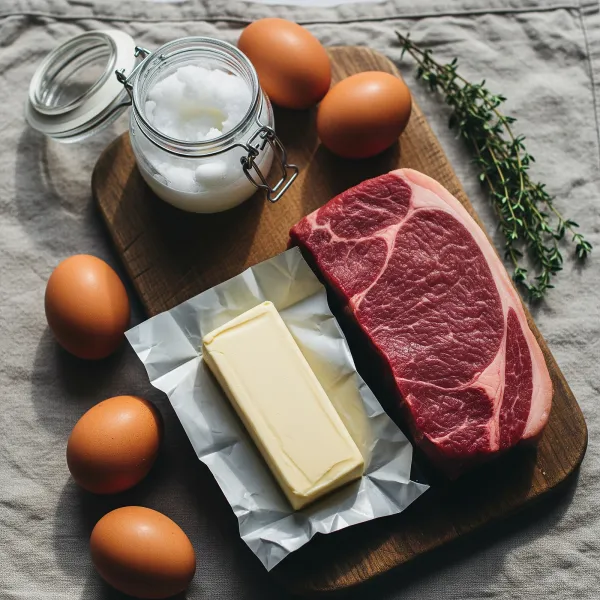
Real, whole foods that contain saturated fat do not come in a vacuum. Grass-fed beef contains saturated fat AND conjugated linoleic acid (CLA), which has been studied for its potential anti-inflammatory and body-composition benefits. Coconut oil contains medium-chain triglycerides that are metabolized differently than long-chain fats and may support energy and cognitive function. Pastured eggs contain fat AND choline, a nutrient most people are chronically short on, plus fat-soluble vitamins your body cannot absorb without fat.
When you strip fat out of a whole food, as food manufacturers love to do, you often destroy the matrix of nutrients that made it nourishing in the first place. God did not design skim milk. He designed milk. There is a reason the fat-soluble vitamins A, D, E, and K are called fat-soluble. You need fat to absorb them.
This is the whole-food lens I keep coming back to. We were designed to eat real, complete food, not engineered macronutrient profiles. When we outsmart nature, we usually lose.
The Myths, One by One
Let me just run through the big ones clearly.
Myth 1: Eating saturated fat causes heart disease. The evidence does not support a direct causal link. Large meta-analyses have repeatedly failed to find a significant association between saturated fat intake and cardiovascular events in healthy people. The picture is more nuanced than a single macronutrient causing disease.
Myth 2: You should replace saturated fat with vegetable oils. This one is especially worth pushing back on. Many of the clinical trials that replaced saturated fat with polyunsaturated vegetable oils actually saw increased rates of death from all causes, including heart disease, even when LDL went down. A re-analysis of the Minnesota Coronary Experiment, data that had been buried for decades, found exactly this. Lowering LDL with industrial vegetable oils is not the same as improving health.
Myth 3: Butter is worse than margarine. Margarine was born as a trans-fat delivery system. The FDA eventually banned partially hydrogenated oils in 2018 because the evidence against trans fats was so damning. Butter has been around for thousands of years. Margarine has been around for about 150. I know which one I trust.
Myth 4: A high-fat diet will make you fat. Dietary fat does not automatically become body fat. Insulin drives fat storage, and insulin is driven primarily by carbohydrates and blood sugar, not dietary fat. People on well-formulated ketogenic and paleo diets eat significant amounts of saturated fat and frequently see improved body composition, blood sugar regulation, and metabolic markers.
Myth 5: Low-fat equals heart-healthy. The low-fat dietary pattern has not consistently shown cardiovascular benefit in large trials. The Women's Health Initiative, one of the largest randomized controlled trials ever conducted on a low-fat diet, followed nearly 49,000 women for eight years and found no significant reduction in heart disease risk from eating low fat.
Who Should Actually Be Thoughtful About Saturated Fat
I want to be straight with you here, because I am not in the business of replacing one oversimplified story with another. There are people who probably should be more thoughtful about saturated fat intake.
Hyperresponders, people whose LDL rises dramatically on a high-fat diet, are real. If you have familial hypercholesterolemia or a specific genetic variant that affects lipid metabolism, that context matters and you should be working closely with a functional medicine practitioner or cardiologist who looks at the full picture, not just total cholesterol.
If your diet is high in saturated fat AND high in refined carbohydrates and sugar at the same time, that combination does appear to be worse than either pattern alone. The metabolic dysfunction created by high-sugar, high-refined-carb eating changes how the body processes dietary fat.
And individual context always, always matters. Your inflammation markers, your particle size, your insulin levels, your family history, your overall food quality. These things are not one-size-fits-all, and anyone who tells you otherwise, on either side of this debate, is oversimplifying.
Practical Takeaways: What to Actually Do
So what does this mean for your plate? Here is how I think about it.
Eat real food. Grass-fed butter, pastured eggs, whole milk from quality sources, beef from animals raised on pasture, coconut oil, quality pork. These foods have sustained human populations for thousands of years. They are not the problem.
Ditch the processed low-fat products. Fat-free yogurt stuffed with sugar and thickeners, low-fat salad dressing made with canola oil, reduced-fat peanut butter with added maltodextrin. These are manufactured products pretending to be health food. They are not.
Stop obsessing over a single macronutrient. Your health is a whole-body, whole-life picture. The quality of your food, where it came from, how it was raised, how processed it is, matters far more than whether it contains saturated fat.
Get curious about your own numbers. If you are worried about cardiovascular risk, ask your doctor for an advanced lipid panel that looks at particle size, oxidized LDL, Lp(a), and your inflammatory markers like hsCRP. Total cholesterol and basic LDL alone do not tell the story.
And for the love of all things good, stop putting margarine on your food.
Disclaimer
This article is for general informational purposes only and is not medical advice. Always consult a qualified healthcare professional before making changes to your diet or health routine.
Key Takeaways
- The diet-heart hypothesis that launched the war on saturated fat was built on selectively analyzed data by Ancel Keys, and has not held up well under rigorous scrutiny.
- A major 2010 meta-analysis of 348,000 people found no significant link between saturated fat intake and cardiovascular disease or stroke.
- The sugar industry paid scientists in the 1960s to shift blame for heart disease from sugar to saturated fat, a fact documented in peer-reviewed research published in 2016.
- Saturated fat raises large, buoyant LDL particles and also raises HDL, making the cholesterol picture more complex than mainstream messaging suggests.
- Replacing saturated fat with industrial vegetable oils has not been shown to improve health outcomes and in some trials worsened them.
- Whole foods containing saturated fat also deliver fat-soluble vitamins, CLA, choline, and other nutrients that work together as a complete package.
- Individual context matters: people with specific genetic lipid conditions should work with a practitioner rather than applying a blanket dietary rule.
Frequently Asked Questions
Is saturated fat actually bad for your heart?
The evidence is far less clear-cut than mainstream guidelines suggest. A 2010 meta-analysis published in the American Journal of Clinical Nutrition pooled data from 21 prospective studies covering nearly 348,000 people and found no significant association between saturated fat intake and cardiovascular disease or stroke. The relationship between saturated fat, cholesterol, and heart disease is more nuanced than a single macronutrient causing disease, and the original hypothesis it was built on has faced serious scientific criticism. That said, individual context matters, and anyone with specific lipid or cardiovascular concerns should work with a qualified healthcare practitioner.
Why did we think saturated fat was bad in the first place?
Most of it traces back to researcher Ancel Keys and his diet-heart hypothesis from the 1950s, which proposed that saturated fat raises cholesterol and that raised cholesterol causes heart disease. His Seven Countries Study became enormously influential, but later researchers found he had data from 22 countries and selectively used only 7, excluding countries that contradicted his conclusions. Additionally, research published in JAMA Internal Medicine in 2016 documented that the sugar industry paid scientists to shift blame for heart disease from sugar to saturated fat, influencing the direction of nutrition science and policy for decades.
Is butter healthier than margarine?
From a real-food, whole-food perspective, yes. Butter is a minimally processed food that has been part of human diets for thousands of years. Traditional margarine was made with partially hydrogenated oils, which contain trans fats, a type of fat that has been strongly and consistently linked to cardiovascular disease. The FDA banned partially hydrogenated oils in 2018. Modern margarines use different formulations, but they are still highly processed products. Butter, especially from grass-fed cows, contains fat-soluble vitamins A, D, E, and K2, as well as butyrate, a short-chain fatty acid that supports gut lining health.
Can I eat saturated fat on a paleo diet?
Yes. Saturated fat from whole food sources is a natural part of a paleo eating pattern. Foods like grass-fed beef, pastured eggs, coconut oil, and butter or ghee from quality sources are considered paleo staples. The paleo framework centers on eating the way humans evolved to eat, before industrial food processing, and natural animal fats have been part of the human diet for our entire evolutionary history. The emphasis in paleo is always on food quality: grass-fed and pasture-raised animal products, minimally processed fats, and the absence of refined carbohydrates and industrial seed oils alongside those fats.
Sources
- American Journal of Clinical Nutrition: Meta-analysis of prospective cohort studies evaluating the association of saturated fat with cardiovascular disease (Siri-Tarino et al., 2010)
- JAMA Internal Medicine: Sugar Industry and Coronary Heart Disease Research: A Historical Analysis of Internal Industry Documents (Kearns et al., 2016)
- BMJ: Re-evaluation of the traditional diet-heart hypothesis: analysis of recovered data from Minnesota Coronary Experiment (Ramsden et al., 2016)
- JAMA: Low-Fat Dietary Pattern and Risk of Cardiovascular Disease: The Women's Health Initiative Randomized Controlled Dietary Modification Trial
This article is for general informational purposes only and is not medical advice. Always consult a qualified healthcare professional before making changes to your diet or health routine.