
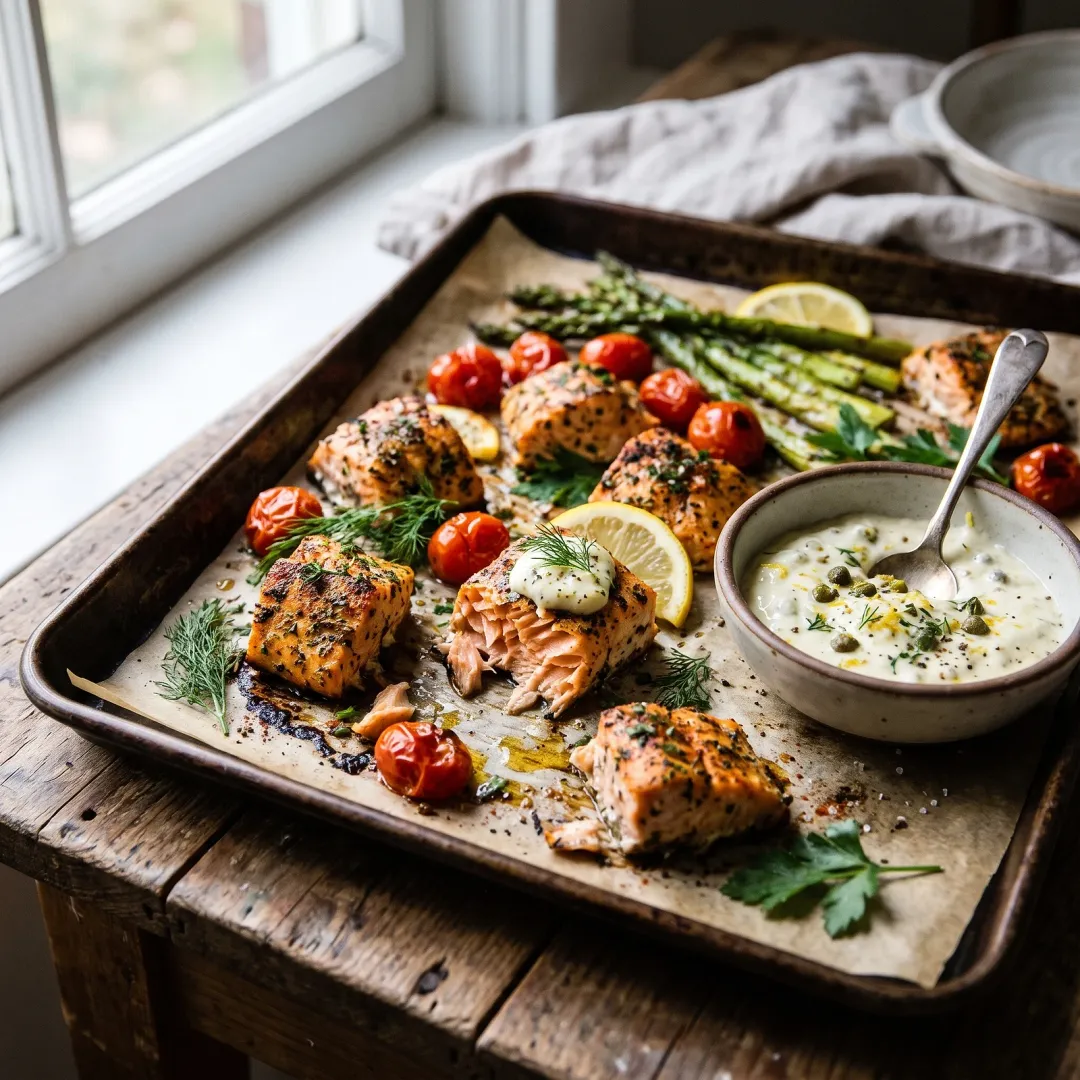

Wild salmon cubes hit a hot sheet pan, spend about 12 minutes in a 425-degree oven, and come out with crispy spiced edges and a tender, just-cooked center. That is the whole story. No skillet to monitor, no flipping, no fuss. You make the lemon caper aioli while the oven does its thing, and by the time you've washed the bowl you were whisking in, dinner party snacks (or a very respectable Tuesday afternoon snack for yourself) are ready. Salmon as a snack gets overlooked, and I think that is a real shame. It is one of the most nutrient-dense proteins you can put on a sheet pan. Wild-caught salmon is a standout source of omega-3 fatty acids, specifically EPA and DHA, which research published by the National Institutes of Health links to supporting cardiovascular health. It is also packed with high-quality protein and B vitamins. A handful of these little bites is genuinely satisfying in a way that a handful of nuts or a processed bar never quite manages. The aioli is the other main character here. No store-bought mayo. You make it from scratch with egg yolks and avocado oil, and it takes maybe four minutes if you are comfortable with the slow-drizzle technique. Capers bring a briny, punchy note that cuts right through the richness of the salmon. Lemon zest wakes the whole thing up. This dipping sauce is going to ruin all other dipping sauces for you, and I am not even a little sorry about that.
Nutritional Benefits
Wild Salmon and Omega-3 Fatty Acids
- Wild-caught salmon is one of the richest dietary sources of the long-chain omega-3 fatty acids EPA and DHA. According to the NIH Office of Dietary Supplements, these fatty acids may support heart health, healthy triglyceride levels, and normal blood pressure.
- A 3-ounce serving of wild sockeye salmon provides roughly 1,000 to 1,500 mg of combined EPA and DHA, meeting or exceeding the amount many health organizations recommend as a daily target.
- Wild salmon also provides a significant amount of astaxanthin, a carotenoid antioxidant that gives the fish its deep pink color. Research published in the journal Marine Drugs suggests astaxanthin may help protect cells from oxidative stress.
High-Quality Protein for Satiety
- Protein is the most satiating macronutrient, and salmon delivers it in abundance. A 4-ounce portion provides around 23 to 25 grams of complete protein, meaning it contains all essential amino acids your body cannot make on its own.
- The USDA Dietary Guidelines for Americans recognize seafood, including salmon, as one of the highest-quality protein sources available, particularly valuable for supporting muscle tissue and overall metabolic function.
- Because these bites are grain-free and low in carbohydrates, they are a snack that actually holds you over rather than spiking blood sugar and leaving you hungry 45 minutes later.
Avocado Oil: A Clean Cooking Fat
- Both the marinade and the aioli use avocado oil, which has a high smoke point (around 500°F for refined versions) making it well-suited to high-heat roasting without breaking down into oxidized byproducts the way many seed oils do.
- Avocado oil is predominantly monounsaturated fat (oleic acid), the same type found in olive oil. Research published in the journal Nutrients notes that monounsaturated fats are associated with supporting healthy cholesterol ratios.
- Using avocado oil in a homemade aioli means you get the creamy richness of a classic dipping sauce without any of the industrial seed oils or additives found in most commercial mayonnaises.
Capers: Small but Mighty
- Capers are the pickled flower buds of the Capparis spinosa plant and are surprisingly rich in flavonoids, particularly quercetin and rutin. A study in the journal Food Chemistry notes that capers rank among the plant foods with the highest rutin content.
- They are essentially a zero-calorie flavor bomb, which makes them a brilliant way to add punchy, briny depth to a sauce without any added sugar or artificial flavoring.
- Their natural acidity from the pickling brine also acts as a brightness booster in the aioli, doing the same job that extra lemon juice would while adding a distinct savory complexity.
FAQs
Can I use frozen salmon for this recipe?
Yes, absolutely. Thaw it completely in the refrigerator overnight, then pat it very dry before cubing and seasoning. Frozen salmon often releases more water as it thaws, so the drying step is even more important here. Moisture on the surface of the fish prevents the edges from crisping up in the oven.
What if I'm not comfortable making aioli from raw egg yolks?
You can use a good-quality paleo-friendly mayo as the base instead. Look for one made with avocado oil (Primal Kitchen is a common option). Stir in the lemon juice, lemon zest, chopped capers, grated garlic, and salt. It will not be quite as light and glossy as a from-scratch aioli, but it is still very tasty and takes about 60 seconds to make.
Is this recipe Whole30 compliant?
Yes, provided you use compliant ingredients throughout. All components as written fit Whole30 guidelines. Just double-check your capers and any store-bought mayo (if you go that route) for added sugar or off-plan additives.
Can I meal prep this snack ahead of time?
The salmon bites are best eaten fresh out of the oven, but you can season and cube the fish up to 24 hours ahead and keep it covered in the fridge. The aioli keeps well for up to 3 days refrigerated in an airtight jar. Leftover salmon bites can be refrigerated and eaten cold the next day, they're actually really good on top of a salad.
What salmon variety works best?
Sockeye is my first pick for this recipe because it has a firm texture that holds up to cubing and high-heat roasting without falling apart, and its flavor is bold enough to stand up to the smoked paprika rub. King (Chinook) also works beautifully if you can find it. Atlantic farmed salmon is softer and fattier, which means it cooks a bit faster and the bites may be a little more delicate, still delicious, just watch the oven time.
My aioli broke and turned greasy. What happened and can I fix it?
A broken aioli almost always means the oil went in too fast. To rescue it: add a fresh egg yolk to a clean bowl, then very slowly whisk your broken mixture into the new yolk, a few drops at a time, just like you did at the start. It should come back together. Going forward, start the oil addition drop by drop, especially for the first quarter of the total oil.
If you make these, I genuinely want to know how the aioli turned out for you. That dipping sauce is the part people are always surprised by. Tag me so I can see your sheet pan, and if you are new here, stick around. There are a lot more real-food recipes where this came from.
Sheet Pan Salmon Bites with Lemon Caper Aioli
Crispy-edged wild salmon cubes roasted on a single sheet pan and served with a punchy lemon caper aioli made from egg yolk, avocado oil, and fresh lemon. A high-protein, real-food paleo snack that comes together in under 25 minutes.
Ingredients
- 1.25 lbs wild-caught salmon fillet, skin removed, cut into 1.5-inch cubes
- 2 tbsp avocado oil
- 1 tsp smoked paprika
- 1/2 tsp garlic powder
- 1/2 tsp onion powder
- 1/2 tsp fine sea salt
- 1/4 tsp black pepper
- 1/4 tsp crushed red pepper flakes (optional)
- 1 tbsp fresh lemon juice
- FOR THE LEMON CAPER AIOLI:
- 2 large egg yolks, room temperature
- 3/4 cup avocado oil
- 2 tbsp fresh lemon juice
- 1 tsp lemon zest
- 1 tbsp capers, rinsed and roughly chopped
- 1 small garlic clove, finely grated
- 1/4 tsp fine sea salt
- 1 tsp cold water (to thin if needed)
- FOR SERVING:
- Lemon wedges
- Fresh flat-leaf parsley, roughly chopped
Instructions
- Preheat your oven to 425°F. Line a large rimmed sheet pan with parchment paper and set aside.
- Pat the salmon cubes completely dry with paper towels. This step matters, moisture is the enemy of a crispy edge, so don't rush it.
- In a large bowl, whisk together the avocado oil, smoked paprika, garlic powder, onion powder, salt, black pepper, and red pepper flakes if using. Add the salmon cubes and toss gently to coat every piece, then drizzle the tablespoon of lemon juice over the top and toss once more.
- Arrange the salmon cubes on the prepared sheet pan in a single layer, leaving a little space between each piece so they roast rather than steam.
- Roast for 11 to 13 minutes, until the edges are just turning golden and the centers are cooked through but still tender. Do not flip them mid-cook, let the bottom crust form undisturbed.
- While the salmon roasts, make the aioli. Add the egg yolks, lemon juice, lemon zest, grated garlic, and salt to a medium bowl. Whisk vigorously for about 30 seconds until the yolks look slightly pale and cohesive.
- Begin adding the avocado oil in the thinnest possible stream, whisking constantly. Go slow, a few drops at a time at the very start. Once the mixture begins to thicken and emulsify (about the first 1/4 cup of oil added), you can increase to a thin steady stream while still whisking. Continue until all the oil is incorporated and the aioli is thick and glossy.
- Fold in the chopped capers. Taste and adjust salt or lemon juice. If the aioli feels too thick, whisk in the cold water one small splash at a time.
- Remove the salmon bites from the oven. Let them rest on the pan for 2 minutes before serving, they firm up slightly as they rest.
- Transfer to a serving plate, scatter with fresh parsley, and set lemon wedges alongside. Serve the lemon caper aioli in a small bowl for dipping.
Nutrition per serving
- Calories: 280
- Total Fat: 18g
- Carbohydrates: 3g
- Protein: 26g
- Dietary Fiber: 0.5g
- Sugar: 0.5g
 That Paleo Chick
Real food that heals
RecipePaleoSnackGluten-Free

Fits these needs
Checked ingredient by ingredient. Tap one to see every recipe that fits.
Ingredients
Instructions
Nutrition Facts Amount per serving
Estimated from the ingredients. Values vary with brands and portions.

Join the conversation
Made it? Tell us how it went.
Free members can comment, reply and like. It takes ten seconds.