
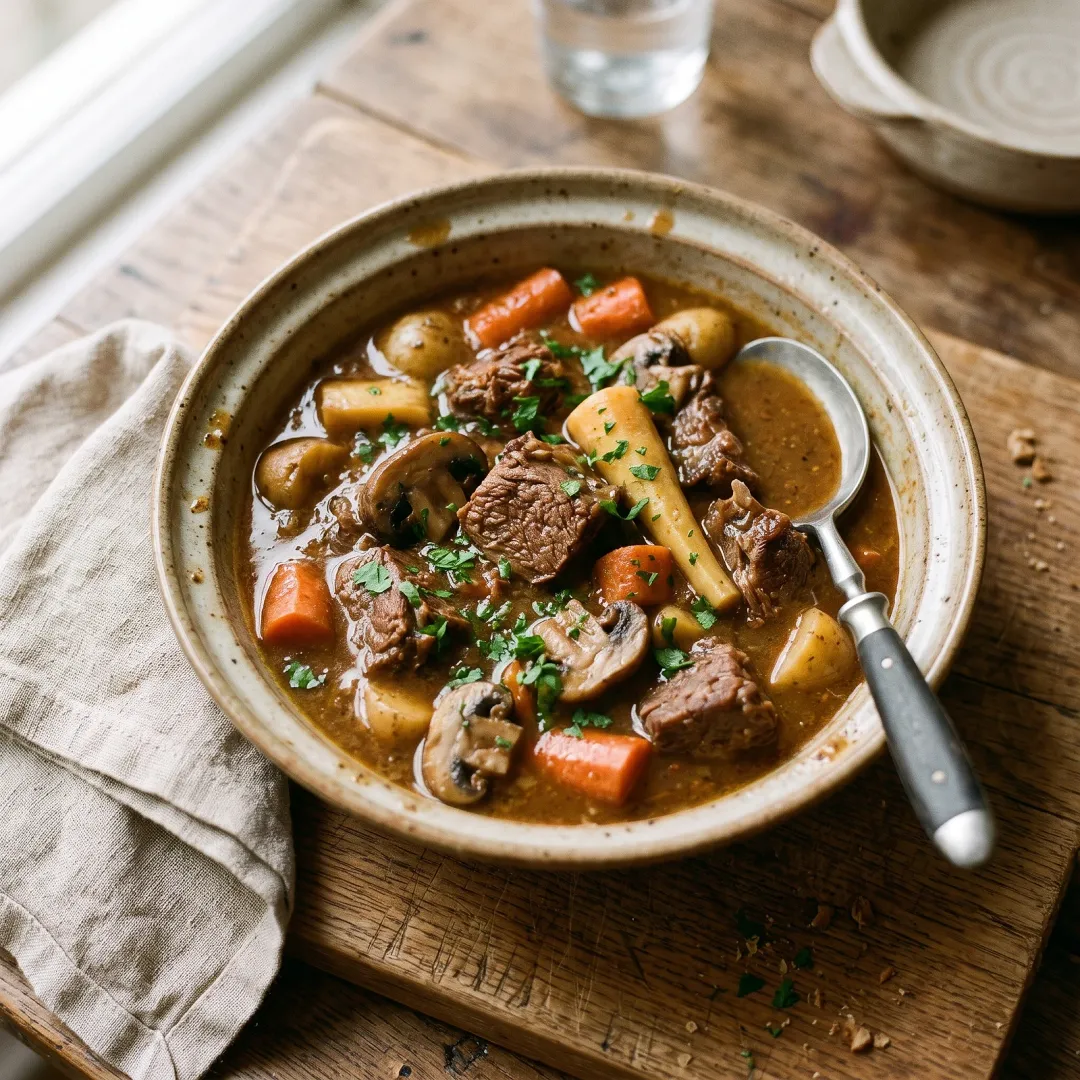

This is the kind of beef stew that makes your whole house smell like a hug. Chunks of chuck roast, slow-simmered until they're practically falling apart, root vegetables that have soaked up every bit of that herb-rich broth, and a depth of flavor you just cannot rush. Real food at its most comforting. A lot of "paleo stews" out there are fine. They're fine. But they're missing that soul that comes from actually taking your time, searing the beef properly, letting the tomato paste cook down, scraping up every last bit of those browned bits before the liquid goes in. Those aren't extra steps. That IS the recipe. No flour to thicken it. No cornstarch from a sketchy box. If you want it thick, arrowroot gets it done clean. And the broth? Bone broth. Not the watered-down stuff in a can. A good, gelatin-rich bone broth is what turns this from soup into stew. Read your labels and find one with actual ingredients. This feeds six people and gets better as leftovers, which around here is basically a love language.
Nutritional Benefits
Beef Chuck: Protein and Zinc in One Bowl
- Chuck roast is a well-worked muscle, which means it's rich in connective tissue that breaks down into gelatin during low-and-slow cooking, adding body to the broth and supporting gut lining health, according to general nutritional science.
- Beef is a complete protein source, providing all essential amino acids. A 3-ounce serving of cooked beef delivers roughly 22 to 25 grams of protein (USDA FoodData Central).
- Chuck is also a meaningful source of zinc, iron (heme iron, which is more bioavailable than plant-based iron per the NIH Office of Dietary Supplements), and B12.
Root Vegetables: Fiber and Micronutrients
- Carrots are a top dietary source of beta-carotene, a precursor to vitamin A. Research published in Nutrients (2019) notes that dietary carotenoids from whole foods are associated with healthy vision and immune function.
- Parsnips provide a solid dose of dietary fiber, vitamin C, and folate. One cup of cooked parsnips contains roughly 6.5 grams of fiber (USDA FoodData Central), which supports digestive regularity.
- Mushrooms are one of the few plant-based sources of ergothioneine, an antioxidant compound that research suggests may help protect cells from oxidative stress (Beelman et al., 2020, Penn State University).
Bone Broth: The Whole-Food Advantage
- A quality beef bone broth made from collagen-rich bones contains glycine and proline, amino acids that research suggests may support joint health and gut integrity (Daneault et al., 2017, Journal of Nutrition).
- Bone broth provides trace minerals like magnesium, phosphorus, and potassium in a bioavailable, food-matrix form.
- Using broth as the stew base instead of a roux or cream keeps this dish both dairy-free and grain-free without sacrificing an ounce of richness.
FAQs
Can I make this in a slow cooker?
Yes. Sear the beef and sauté the onion and garlic on the stovetop first (don't skip that), then transfer everything except the arrowroot slurry to your slow cooker. Cook on LOW for 7 to 8 hours or HIGH for 4 to 5 hours. Add the vegetables halfway through if you don't want them to go completely soft. Stir in the arrowroot slurry during the last 15 minutes with the lid off on HIGH.
Can I make this Whole30?
Yes, with two swaps. Skip the red wine entirely and use the broth-plus-red-wine-vinegar substitute listed on the ingredient line. And use turnips instead of baby potatoes. Potatoes are technically allowed on Whole30 now, but if you want to keep it strictly Whole30-compliant in the original spirit, turnips work great in this stew.
My stew broth is too thin. What do I do?
Two options. First, try simmering the stew uncovered for the last 20 to 30 minutes to let some liquid evaporate and concentrate. Second, mix the arrowroot slurry (2 tablespoons arrowroot starch with 3 tablespoons cold water) and stir it into the simmering broth. It thickens fast, so give it a minute before you add more.
What cut of beef works best here?
Chuck roast is the move for a slow-simmered stew. It has enough fat and connective tissue to stay tender and flavorful over a long cook. A leaner cut like round or sirloin will turn tough and dry. Stick with chuck.
How long does this keep?
Stored in an airtight container in the fridge, this stew keeps well for up to 4 days. It actually tastes better on day two after the flavors have had time to settle. It also freezes beautifully for up to 3 months. Thaw overnight in the fridge and reheat gently on the stovetop.
If you made this stew, I want to know how it went. Drop a comment below, rate the recipe, and tag me over on Instagram so I can see your bowls. Sharing this stuff is how we keep real food front and center, and I genuinely love seeing it in your kitchens.
Slow-Simmered Beef Stew with Root Vegetables and Fresh Herbs
A deeply satisfying, strictly paleo beef stew built on slow-simmered chuck roast, hearty root vegetables, and a rich herb-laced broth. No flour, no dairy, no shortcuts. Just real food that tastes like someone's grandma made it all day.
Ingredients
- 2.5 lbs beef chuck roast, cut into 1.5-inch cubes
- 1.5 tsp fine sea salt, divided, plus more to taste
- 1 tsp black pepper, divided
- 2 tbsp avocado oil, divided
- 1 medium yellow onion, roughly chopped
- 4 garlic cloves, minced
- 2 tbsp tomato paste
- 1/2 cup dry red wine (such as Cabernet Sauvignon), not strictly paleo; substitute with additional beef broth plus 1 tbsp red wine vinegar
- 3 cups beef bone broth (no sugar added)
- 1 tbsp coconut aminos
- 1 tbsp fresh thyme leaves (or 1 tsp dried)
- 1 tbsp fresh rosemary, finely chopped (or 1 tsp dried)
- 2 bay leaves
- 3 medium carrots, cut into 1-inch chunks
- 3 medium parsnips, peeled and cut into 1-inch chunks
- 1 lb baby potatoes, halved, not strictly paleo; substitute with turnips or additional parsnips for strict paleo
- 2 cups small cremini mushrooms, halved
- 2 tbsp arrowroot starch mixed with 3 tbsp cold water (optional, for thickening)
- Fresh flat-leaf parsley, chopped, for serving
Instructions
- Pat the beef cubes completely dry with paper towels. Season all over with 1 teaspoon of the salt and 3/4 teaspoon of the pepper.
- Heat 1 tablespoon of the avocado oil in a large Dutch oven or heavy-bottomed pot over medium-high heat until shimmering. Working in two batches so you don't crowd the pan, sear the beef on at least two sides until a deep brown crust forms, about 3 to 4 minutes per side. Transfer seared beef to a plate and set aside. Do not skip this step. The crust is where the flavor lives.
- Reduce the heat to medium. Add the remaining tablespoon of avocado oil to the same pot. Add the onion and cook, stirring occasionally, until softened and translucent, about 5 minutes. Add the garlic and cook 1 minute more.
- Stir in the tomato paste and cook for 2 minutes, letting it deepen in color and stick slightly to the bottom of the pot.
- Pour in the red wine (or broth-vinegar substitute) and scrape up all the browned bits stuck to the bottom of the pot. Let it simmer and reduce for about 2 minutes.
- Add the beef bone broth, coconut aminos, thyme, rosemary, bay leaves, and remaining 1/2 teaspoon salt. Stir to combine. Return the seared beef and any accumulated juices back to the pot.
- Bring the liquid to a boil, then immediately reduce the heat to low. Cover the pot with a tight-fitting lid and simmer gently for 1 hour and 30 minutes.
- After 1 hour and 30 minutes, add the carrots, parsnips, baby potatoes (or turnips), and mushrooms. Stir gently to submerge the vegetables in the broth. Cover and continue simmering on low for another 45 to 50 minutes, until the vegetables are fork-tender and the beef shreds easily when pressed.
- If you want a thicker stew, stir together the arrowroot starch and cold water in a small bowl until smooth. Push the stew ingredients aside, pour the slurry directly into the simmering liquid, and stir for 1 to 2 minutes until the broth thickens. Remove the bay leaves.
- Taste and adjust salt as needed. Ladle into bowls and top generously with fresh chopped parsley. Serve as-is or alongside paleo-friendly dinner rolls.
Nutrition per serving
- Calories: 390
- Total Fat: 18g
- Carbohydrates: 22g
- Protein: 34g
- Dietary Fiber: 4g
- Sugar: 6g
 That Paleo Chick
Real food that heals
RecipePaleoDinnerGluten-Free

Fits these needs
Checked ingredient by ingredient. Tap one to see every recipe that fits.
Ingredients
Instructions
Nutrition Facts Amount per serving
Estimated from the ingredients. Values vary with brands and portions.



Join the conversation
Made it? Tell us how it went.
Free members can comment, reply and like. It takes ten seconds.