

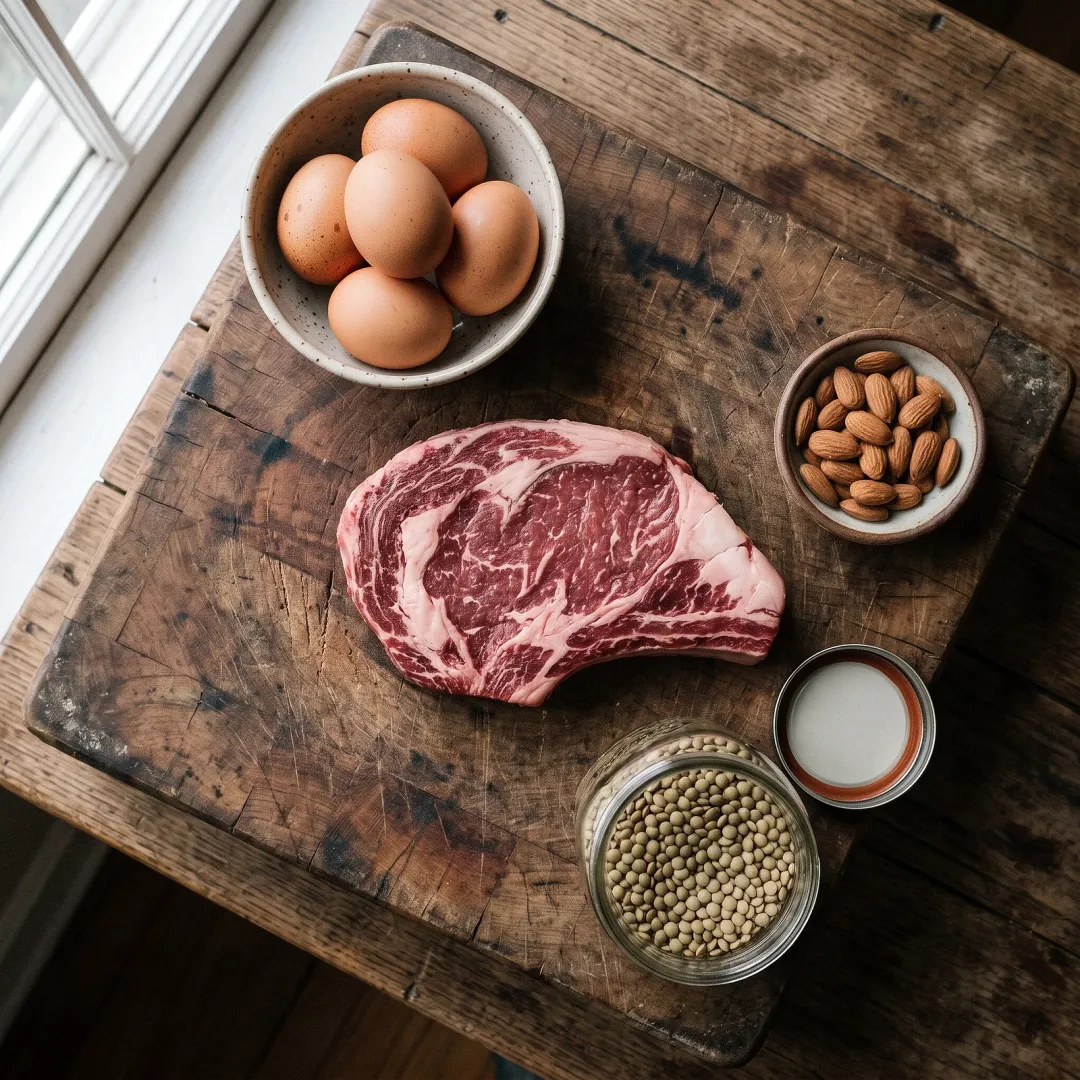

A study drops, a headline screams that beef is wrecking men's testosterone, and within 48 hours it's everywhere. Social media, men's health newsletters, your brother-in-law's group chat. What almost nobody does is stop and ask two questions: what did the study actually measure, and who benefits if men swap their ground beef for a protein shake made in a facility owned by a soy or pea-protein conglomerate?
What the Study Actually Said
The research that set off this latest round of protein panic came from a study of more than 2,500 men, published and covered by ScienceDaily. Researchers looked at dietary protein sources and found that higher animal protein intake, particularly from dairy, was associated with lower testosterone levels, while plant protein was associated with higher levels.
Read that again: dairy protein, and associated with. Association is not causation. That is not a pedantic point. It is the entire ballgame.
The study did not isolate grass-fed beef from processed deli meat. It did not separate a man eating a clean grass-fed ribeye from a man crushing whey protein shakes three times a day. The "animal protein" umbrella in most dietary surveys is enormous. It includes fast-food burgers, factory-farmed chicken, processed hot dogs, and yes, clean whole cuts of beef. When you lump all of that together and find a statistical association, you have not proven that beef lowers testosterone. You have proven that men who eat more animal protein as a category, in all its varied and highly processed forms, showed a pattern worth investigating further.
The headlines did not say that. The headlines said animal protein is a hormone problem waiting to happen.
The Dairy Variable Nobody Talked About
The specific finding that keeps getting buried in the noise is that dairy was the sub-category most strongly associated with lower testosterone. That is a different and more specific signal, and it deserves its own conversation.
Conventional dairy in the United States is not just milk. It is milk from cows that are frequently pregnant, because a pregnant cow produces more milk, and a pregnant cow also produces significantly higher levels of estrogens. Research published in Epidemiology found that conventional dairy was a source of exogenous estrogen exposure, and that estrogen from dairy was detectable in human subjects after consumption.
So the more precise question is not "does animal protein lower testosterone?" The more precise question might be "does conventional dairy, with its estrogen load, affect male hormone balance?" Those are not the same question. One implicates every piece of beef you have ever eaten. The other points at a specific product category with a specific hormonal mechanism worth taking seriously.
The distinction matters, and the fact that most coverage flattened it into a broad anti-animal-protein narrative should make you curious about what story someone wanted you to hear.
Follow the Money: Who Benefits From "Ditch Animal Protein"?
The plant-based protein industry is not a scrappy underdog. It is a multi-billion-dollar market. The global plant-based protein market was valued at over $14 billion in 2023 and is projected to keep growing. The players behind it include some of the same large food conglomerates that dominate Big Food: Archer Daniels Midland, Cargill (which has invested in plant-protein infrastructure), and multinational consumer brands that have poured money into oat, soy, and pea protein lines.
This is not a conspiracy theory. It is a business model. When consumers shift from animal protein to plant protein, the beneficiaries are not small farms. They are industrial processors who extract protein concentrates from commodity crops, many of which are themselves heavily treated with pesticides. The Environmental Working Group has documented that soy and oat crops consistently appear on pesticide residue monitoring lists.
Following the money also means looking at research funding. Nutrition science has a well-documented industry-funding problem. A 2019 analysis in PLOS Medicine found that studies funded by the food and beverage industry were significantly more likely to report outcomes favorable to the sponsor's products. That does not automatically invalidate any single study. It means you owe it to yourself to check the funding disclosure before you let a study change what you eat.
The Revolving Door Between Big Food and Nutrition Policy
The issue goes beyond who funds individual studies. It goes to who sets the guidelines that shape what gets called "healthy" in the first place.
The U.S. Dietary Guidelines Advisory Committee, the body that informs federal nutrition policy every five years, has a history of members with ties to food industry interests. An investigation published in PLOS Medicine found that many DGAC members had financial ties to companies and trade associations with a direct interest in the committee's recommendations. When a committee member has a relationship with a soy trade group or a plant-based food company, and that committee influences guidance on protein sources, that is a conflict of interest worth naming.
This is the revolving door in action: researchers get industry grants, those researchers land advisory positions, those advisory positions shape guidance, that guidance tells your doctor what to tell you, and somewhere in the chain the original financial relationship has been fully laundered into the appearance of objective public health advice.
I am not saying every member is corrupt or that every recommendation is bought. I am saying the structure creates incentives that do not automatically point toward your health. And you deserve to know that structure exists.
What Real Food, Real Science, and Common Sense Actually Say About Protein
Here is what does not get a screaming headline: a broad base of research supports adequate animal protein intake as important for muscle synthesis, satiety, and hormonal health. A review published in the Journal of the International Society of Sports Nutrition confirmed that animal-sourced proteins are complete proteins, meaning they contain all essential amino acids in the right ratios for human use, and that they tend to have higher bioavailability than most plant sources.
Testosterone production specifically depends on dietary fat and cholesterol, both of which are found in whole animal foods. Research in the Journal of Steroid Biochemistry and Molecular Biology found associations between very low-fat diets and reduced testosterone levels. Beef, eaten as a whole, clean, minimally processed food, provides the fat, the zinc, and the complete amino acid profile that the male endocrine system needs to function.
None of that means plant foods have no place on a plate. It means the binary being pushed, that animal protein is a hormonal liability and plant protein is the upgrade, is not what a thorough reading of the evidence supports. It is what a profitable narrative supports.
If you are a man watching your hormone health, the more productive questions are: Are you eating conventionally produced dairy in large quantities? Are your "plant proteins" actually ultra-processed soy isolates with a 30-ingredient label? Are you getting enough dietary fat from clean whole-food sources? Those questions do not make a tidy headline. They also do not make anyone rich.
What I Actually Do
My approach is real, whole animal food, sourced as cleanly as I can manage and afford. Grass-fed beef. Pastured eggs. I use dairy carefully and I pay attention to sourcing, partly because of the estrogen considerations above. I read funding disclosures on studies that are asking me to change something fundamental about how I eat.
This is not about being anti-science. I love good science. I am anti-captured science, and there is a difference. When a study conclusion conveniently lines up with a multi-billion-dollar market's growth projections, and the coverage flattens all the nuance out of the finding, that is not science communication. That is marketing wearing a lab coat.
God gave us bodies that are exquisitely designed to run on real, whole food. Beef is not a new food. Humans have been eating it for a very long time. The idea that we need an industrially processed pea-protein concentrate to stay healthy is a modern invention with a price tag attached.
Trust your instincts. Read the funding disclosures. Eat real food.
This article is for general informational purposes only and is not medical advice. Always consult a qualified healthcare professional before making changes to your diet or health routine.
Key Takeaways
- The study linking animal protein to lower testosterone was primarily driven by the dairy sub-category, not beef or other whole animal foods.
- Association is not causation. The study design could not separate clean grass-fed beef from processed factory-farmed animal products.
- Conventional dairy contains measurable estrogens from pregnant cows, which is a separate and more specific variable worth examining.
- The global plant-based protein industry is worth over $14 billion and is dominated by large food conglomerates with strong incentives to shift consumer behavior.
- Research shows a well-documented bias toward sponsor-favorable outcomes in industry-funded nutrition studies.
- Complete animal proteins, including beef, provide the amino acids, fat, and zinc that support healthy testosterone production according to the broader body of research.
- Always check the funding disclosure on a nutrition study before it changes what you eat.
Frequently Asked Questions
Does animal protein lower testosterone?
The research showing an association between animal protein and lower testosterone was primarily driven by the dairy sub-category in the studies reviewed, not by whole animal foods like beef. Association also does not equal causation. The full body of research on protein, dietary fat, and testosterone is more complex than a single headline suggests, and no single study has established that eating clean whole-animal protein lowers testosterone.
Why might dairy specifically affect testosterone levels?
Conventional dairy in the U.S. often comes from pregnant cows, which produce significantly higher estrogen levels. Research published in Epidemiology found that conventional dairy was a source of exogenous (external) estrogen exposure in humans. This is a more specific and biologically plausible variable than a broad "animal protein" category, and it's worth discussing with your doctor if hormonal health is a concern for you.
Who funds plant-based protein research?
The plant-based protein market is a multi-billion dollar industry with major investment from large food conglomerates. Research has shown a consistent pattern in nutrition science where industry-funded studies tend to produce results favorable to the sponsor's products. Checking the funding disclosure on any nutrition study is a reasonable first step before changing your diet based on the findings.
Is beef good or bad for testosterone?
Grass-fed beef is a source of complete protein, dietary fat, and zinc, all of which are associated with healthy testosterone production in the broader research literature. Research has linked very low-fat diets to reduced testosterone levels. This is general educational information, not personal medical advice. If you have specific concerns about your hormone levels, talk to your doctor.
Sources
- ScienceDaily Nutrition: Animal vs. plant protein reveals a surprising testosterone divide
- Epidemiology (Wolters Kluwer): Exposure to exogenous estrogen through intake of commercial milk produced from pregnant cows
- Grand View Research: Plant-Based Protein Market Size, Share & Trends Analysis Report
- PLOS Medicine: Relationship between funding source and outcome of research about fruit juice
- PLOS Medicine: Financial conflicts of interest and reporting bias regarding the association between sugar-sweetened beverages and weight gain
- Environmental Working Group: EWG's Shopper's Guide to Pesticides in Produce
- Journal of the International Society of Sports Nutrition: International Society of Sports Nutrition Position Stand: protein and exercise
- Journal of Steroid Biochemistry and Molecular Biology: Diet and serum sex hormone-binding globulin
This article is for general informational purposes only and is not medical advice. Always consult a qualified healthcare professional before making changes to your diet or health routine.


Join the conversation
What do you think?
Free members can comment, reply and like. It takes ten seconds.