

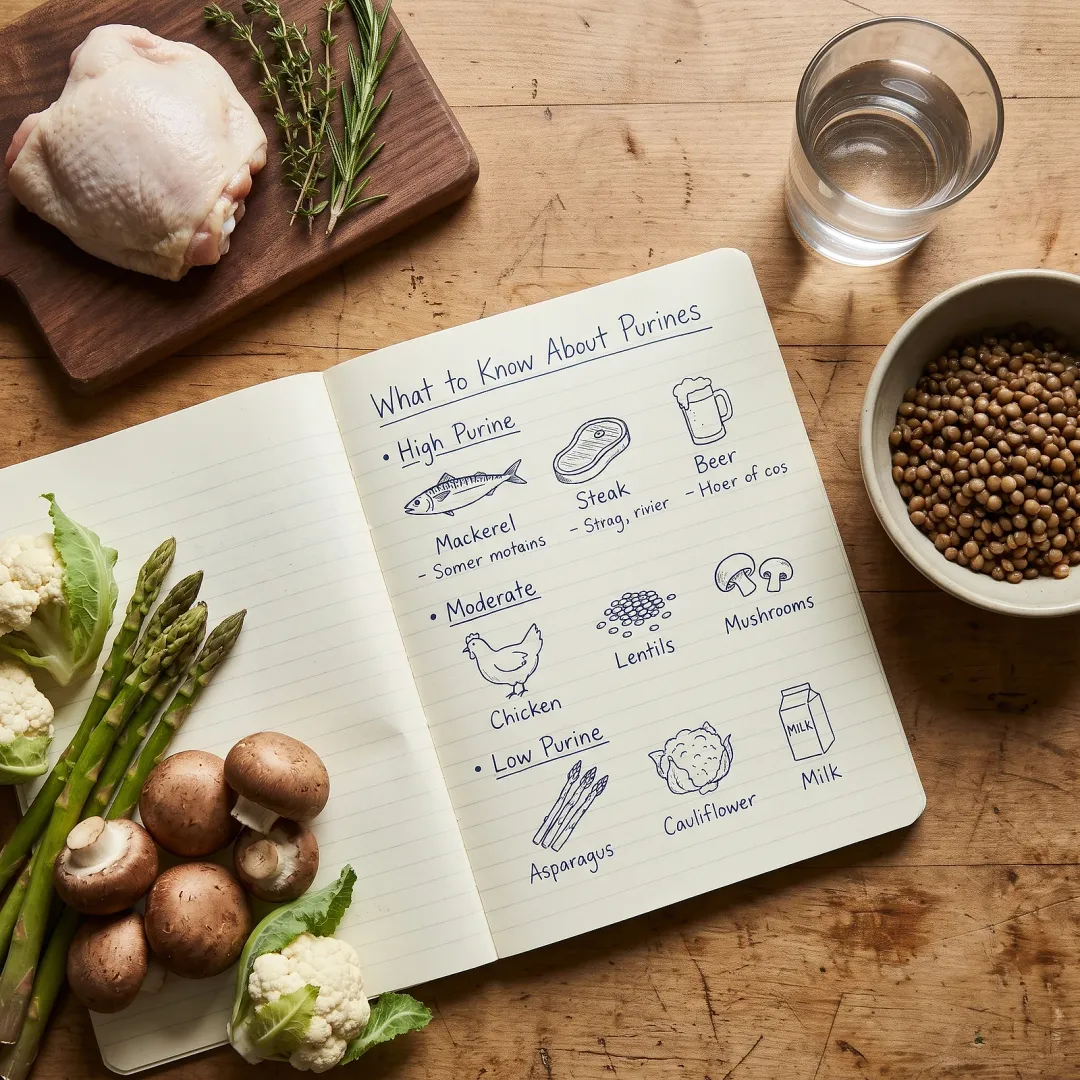

Your doctor said watch the purines, and you walked out of the office nodding, went home, and Googled it, and now you have seventeen tabs open and a growing suspicion that every food you enjoy is on a list somewhere. That is a frustrating place to land. So let's slow down and actually understand what we're dealing with, because managing gout well starts with knowing what purines really are, not just which foods to panic about.
What Purines Actually Are (The Short, Non-Boring Version)
Purines are natural chemical compounds found in almost every living cell, including yours. They are part of the structure of DNA and RNA, which means every food that ever had a cell, plant or animal, contains some amount of them. The issue for people managing gout is not that purines exist. It is what happens when your body breaks them down.
When you digest purines, your body metabolizes them into a waste product called uric acid. Normally, uric acid dissolves in the blood, moves through the kidneys, and leaves the body in urine. But if your body produces more uric acid than your kidneys can clear, or if your kidneys are not clearing it efficiently, uric acid can build up in the bloodstream. At high enough concentrations, it can form sharp, needle-like crystals that deposit in joints, most famously in the big toe, but also in the ankle, knee, wrist, and elsewhere. That crystal buildup is what causes the intense inflammation and pain of a gout flare, according to the National Institute of Arthritis and Musculoskeletal and Skin Diseases.
So the purine question is really a uric acid question. And the uric acid question is really a question of balance: how much is coming in through food and how much is your body producing on its own, versus how well your kidneys are doing their job clearing it out.
The Part Most People Miss: Diet Is Only Part of the Equation
Here is something worth understanding before you overhaul your entire way of eating. The Mayo Clinic notes that roughly two-thirds of the uric acid in your body comes from your body's own internal processes, specifically the natural breakdown of your own cells, not from food alone. Only about one-third comes from the purines you eat.
This does not mean food does not matter. It clearly does, and research consistently links certain high-purine foods to increased uric acid levels and flare risk. But it does mean that diet alone is rarely the whole answer, and it explains why some people eat very little meat and still struggle with gout, while others seem to eat freely and never have a flare. Genetics, kidney function, body weight, certain medications, and other factors all play a role, according to the Arthritis Foundation.
All of that is a conversation to have with your doctor and possibly a registered dietitian, not something to sort out alone with a Google search. What you can do is come to that conversation informed, knowing which foods are worth paying attention to and why.
High-Purine Foods: The Ones That Consistently Show Up in the Research
Not all purine-containing foods affect uric acid equally, and research has gotten more specific about which sources seem to matter most.
Organ meats sit at the very top of every evidence-based list: liver, kidney, heart, sweetbreads. These are extremely concentrated in purines, and the NIH's National Institute of Diabetes and Digestive and Kidney Diseases specifically lists them among the foods people managing gout are generally advised to limit or avoid.
Certain seafood and shellfish are consistently flagged in the research. Anchovies, sardines, mussels, scallops, trout, herring, and mackerel tend to be high in purines. Shellfish like shrimp and lobster are moderate to high. This surprises a lot of people who assumed seafood was universally healthy, and in many contexts it is. But for gout management specifically, the type of seafood matters, and that nuance is worth discussing with your care team.
Red meat is moderate-to-high in purines, with beef, lamb, and pork all appearing regularly on watchlists in the clinical literature. A large prospective study published in the New England Journal of Medicine found that higher intake of meat was associated with increased risk of gout, independent of other factors.
Poultry falls in the moderate range. Chicken is not off the table (genuinely, it is not), but it is not a free-for-all either. The same NEJM study found a more modest association with poultry compared to red meat, so it tends to be a reasonable middle-ground protein for many people working to lower purine load without eliminating meat entirely. Work with your dietitian to figure out what portion size makes sense for you.
Alcohol, particularly beer, is a double problem. Beer contains purines from yeast, and alcohol in general raises uric acid levels by slowing down the kidneys' ability to clear it. The Arthritis Foundation flags beer as particularly problematic, and spirits also raise uric acid, though somewhat less. Wine appears to have a smaller effect in the research, but no alcohol is considered risk-free for gout.
High-fructose foods and beverages, including sugary sodas, fruit juices, and highly processed sweets, also raise uric acid levels, through a different mechanism than purines but with a similar result. The same NEJM research and subsequent studies have linked high fructose consumption to elevated uric acid, which is one reason gout management is not purely about protein.
The Surprising Middle Ground: Foods People Unnecessarily Fear
Because the message "avoid purines" gets oversimplified, a lot of people managing gout start avoiding vegetables, beans, and legumes, assuming all plant purines are the same as animal purines. The research suggests otherwise.
Vegetables like spinach, mushrooms, asparagus, and cauliflower do contain purines, and they used to be on restriction lists in older dietary guidelines. But a study in Arthritis and Rheumatism found that high intake of purine-rich vegetables was not associated with an increased risk of gout, in contrast to animal-source purines. The researchers noted that the type and source of purine appears to matter, not just the total amount.
Legumes, including lentils and beans, follow a similar pattern. They contain moderate purines, but current evidence does not support restricting them for most people managing gout, particularly in the context of an otherwise real-food diet. Again, this is something to run by your doctor or dietitian, since individual responses can vary.
Full-fat dairy, interestingly, may actually be protective in some research. Low-fat dairy products were associated with lower uric acid levels in the NEJM study mentioned above. The relationship is not fully understood, but it is one reason a broadly whole-food approach, rather than a panic-driven elimination, tends to serve people better in the long run.
Plain water is worth its own mention. Staying well hydrated supports the kidneys in excreting uric acid, and the NIDDK recommends adequate fluid intake as part of a gout management approach. It is one of the simplest, lowest-barrier things you can do alongside whatever your doctor recommends.
How to Actually Use This Information Day to Day
Understanding purine content is useful, but walking through the grocery store trying to mentally calculate purines in every cart item is a recipe for burnout. A more practical approach is to build a framework you can actually live with.
Focus on what to build your plate around rather than cataloguing every forbidden food. Vegetables (yes, including the moderate-purine ones), whole grains, low-fat dairy if you tolerate it, legumes, eggs, and moderate portions of chicken or other poultry give you a solid real-food base that is not in the high-purine danger zone for most people. Organ meats and the highest-purine seafood are the clearest places to pull back. Red meat and alcohol are worth honest conversations with your care team about frequency and portion.
When you eat out or travel, the main questions to keep in mind are what protein is on the plate, how it was prepared (heavy sauces with meat stocks can add hidden purines), and whether a beer or cocktail is worth the trade-off for you that day. That is a personal call that depends on where your uric acid levels are, what your doctor has said, and how recently you have had a flare.
Keep a simple food and symptom log if flares feel unpredictable. It does not have to be elaborate. Even a week of notes connecting what you ate to how your joints felt can give you and your care team real, useful data that is specific to you, not just a generic population study.
And please, talk to your doctor before making major dietary changes, especially if you are on medication for gout or kidney function. Food matters and food can support your health, but it works alongside medical care, not instead of it.
Key Takeaways
- Purines are natural compounds in nearly all food; your body converts them to uric acid, which can build up and form crystals in joints if not cleared efficiently.
- Roughly two-thirds of uric acid in the body comes from internal cell turnover, not food alone, so diet is one piece of a larger picture.
- Organ meats, certain high-purine seafood (anchovies, sardines, mussels), red meat, beer, and high-fructose beverages are consistently linked to higher uric acid in the research.
- Plant-based purines in vegetables and legumes appear to carry less gout risk than animal-source purines, according to current evidence.
- Chicken sits in a moderate range and tends to be a more workable protein choice than organ meats or red meat for many people managing gout.
- Hydration, low-fat dairy, and a broadly whole-food plate are low-barrier supporting habits worth discussing with your care team.
- Always work with your doctor and a registered dietitian to tailor dietary changes to your specific uric acid levels, kidney function, and medications.
Frequently Asked Questions
What foods are highest in purines for gout?
Organ meats (liver, kidney, sweetbreads), certain seafood (anchovies, sardines, mussels, herring, mackerel), and red meat consistently rank highest in the clinical literature. Beer and other alcoholic beverages also raise uric acid significantly. High-fructose drinks like soda and juice are worth flagging too, through a different metabolic pathway. Your doctor or a registered dietitian can help you prioritize which changes matter most for your individual situation.
Are vegetables with purines bad for gout?
Current research suggests plant-source purines carry less gout risk than animal-source purines. A large study published in Arthritis and Rheumatism found that high intake of purine-rich vegetables was not associated with increased gout risk, unlike meat and seafood. That said, individual responses vary, so it's worth discussing your full food picture with your care team rather than following a blanket restriction list.
Can you eat chicken if you have gout?
Chicken sits in the moderate-purine range and tends to be a more manageable protein choice than organ meats or red meat for many people navigating gout. Research suggests its association with elevated uric acid is less pronounced than with red meat. Portion size and overall diet pattern still matter, so check with your doctor or a registered dietitian about how to include it in your specific plan.
Does drinking water help with gout and uric acid?
Staying well hydrated supports the kidneys in excreting uric acid, which is why adequate fluid intake is commonly recommended as part of gout management by organizations like the NIDDK. It is not a treatment on its own, but it is a low-barrier, evidence-consistent habit that works alongside whatever your doctor has prescribed.
Sources
- National Institute of Arthritis and Musculoskeletal and Skin Diseases: Gout
- Mayo Clinic: Gout: Symptoms and Causes
- Arthritis Foundation: Gout
- National Institute of Diabetes and Digestive and Kidney Diseases: Gout
- New England Journal of Medicine: Purine-Rich Foods, Dairy and Protein Intake, and the Risk of Gout in Men
- Arthritis and Rheumatism (via DOI): Purine-Rich Foods, Dairy and Protein Intake, and the Risk of Gout in Men (vegetable subanalysis)
Cook for it
Start with one of these Low-Purine recipes:
- Lox and Whipped Avocado Cream on Cassava Flour Bagel Thins
- Sheet Pan Roasted Veggie Bites with Lemon Herb Dipping Sauce
- Grilled Chicken Thighs over Charred Eggplant with Warm Cumin-Coriander Herb Oil
Browse every Low-Purine recipe
This article is for general informational purposes only and is not medical advice. Always consult a qualified healthcare professional before making changes to your diet or health routine. Nothing here diagnoses, treats or cures any condition, and food is support alongside medical care, not a replacement for it. If you have, or think you may have, the condition discussed here, work with your doctor or a registered dietitian, and do not start, stop or change any medication without talking to them first.


Join the conversation
What do you think?
Free members can comment, reply and like. It takes ten seconds.