

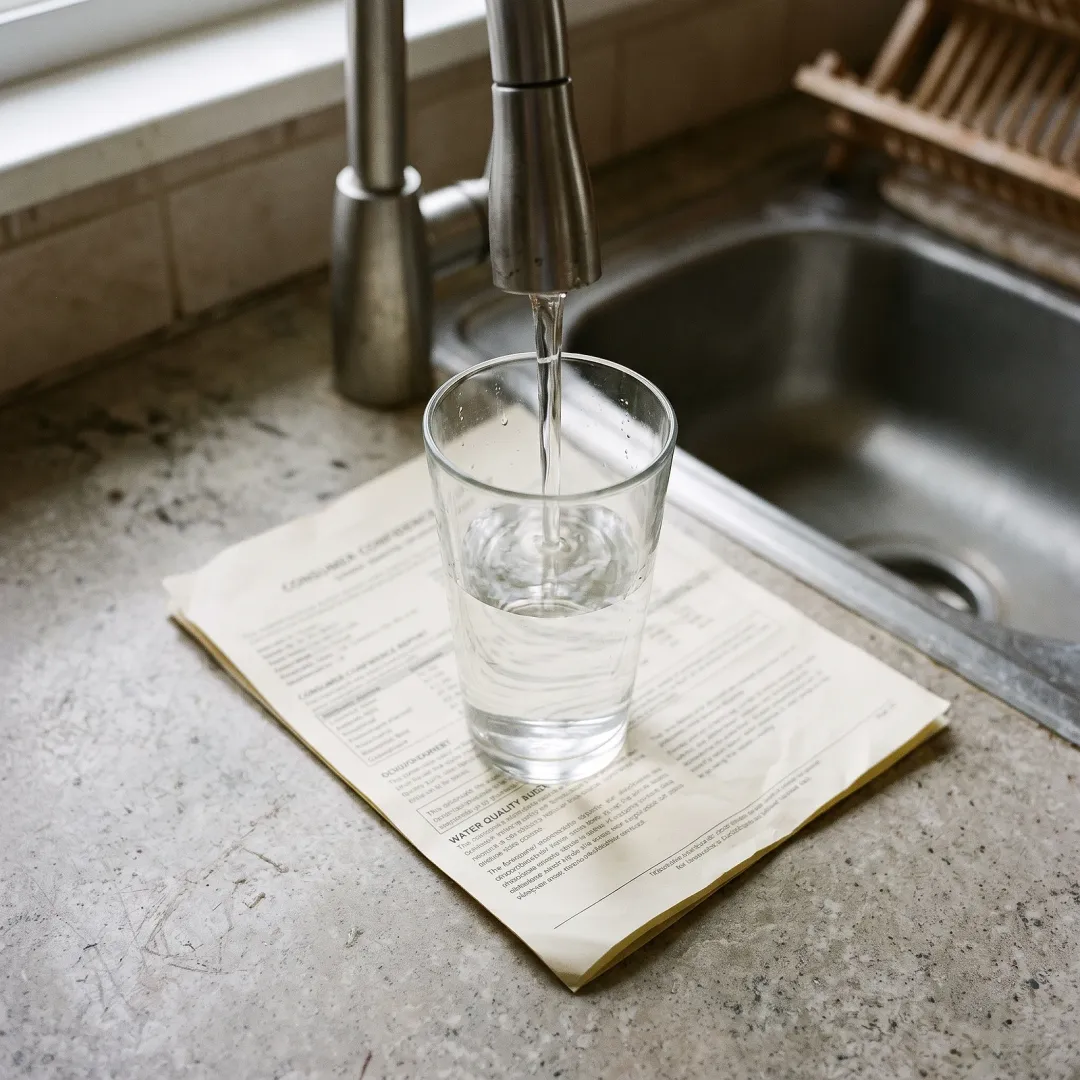

Your tap water passed every test your city is legally required to run. That's true. It's also true that there are more than 160,000 public water systems in the United States, and the federal government currently has enforceable limits on fewer than 100 contaminants. So 'legal' and 'clean' are not the same sentence, and I think you deserve to know the difference.
What the EPA Actually Regulates (The Short List)
The Safe Drinking Water Act gives the EPA authority to set legal limits for contaminants in public water. Those limits are called Maximum Contaminant Levels, or MCLs. Right now, the EPA enforces MCLs for fewer than 100 contaminants under its National Primary Drinking Water Regulations.
That sounds like a lot until you consider that over 1,000 chemicals are used in commerce in the U.S., and the EPA's own Contaminant Candidate List acknowledges hundreds of substances found in water that have no current federal limit. The CCL is basically a watchlist. Being on it doesn't mean anything gets done about it quickly.
The EPA does also maintain Secondary Drinking Water Regulations for things like taste, odor, and color. Those are non-enforceable guidelines. Your utility has to publish them, but it doesn't have to meet them.
Old habit: assuming regulated = risk-free. New habit: knowing the regulated list is a floor, not a ceiling.
Disinfection Byproducts: The Trade-Off Nobody Explains
Here's a thing that is genuinely complicated. Chlorine in municipal water is a public health win. It kills pathogens that caused mass casualties before water treatment existed. I'm not anti-chlorine in that context.
But when chlorine reacts with naturally occurring organic matter in source water, it creates a family of compounds called disinfection byproducts (DBPs). The two main groups are trihalomethanes (THMs) and haloacetic acids (HAAs). The EPA does regulate both, with limits of 80 parts per billion for total THMs and 60 ppb for HAAs.
The issue is that some research published in Environmental Health Perspectives and reviewed by the National Institutes of Health has linked long-term exposure to elevated DBPs with potential bladder concerns. The EPA's limits are set to balance microbial risk against chemical risk. That's a real trade-off, not a conspiracy. But it means your water is not just H2O.
Old habit: boiling tap water thinking it makes it cleaner. New habit: understanding that boiling concentrates DBPs rather than removing them. A carbon filter or reverse osmosis system is a better move for DBP reduction.
Lead: The Infrastructure Problem in Your Pipes
The federal Lead and Copper Rule requires utilities to monitor lead at the tap. The EPA's action level for lead is 15 parts per billion. If more than 10% of samples at high-risk sites exceed that level, the utility has to act.
Here's what matters for you personally: lead does not come from the treatment plant. It leaches from the pipes and fixtures between the plant and your faucet, including the plumbing inside your own home. If your house was built before 1986, there is a real chance your pipes or solder contain lead. The CDC is clear that there is no safe level of lead exposure for children, which is exactly why "within the action level" is not the same as "safe."
Old habit: running the tap for ten seconds and assuming you're fine. New habit: flushing cold water from the tap for 30 seconds to 2 minutes before drinking or cooking if you have older plumbing, and testing your home's water if you haven't. Many local utilities offer free test kits.
PFAS: The Chemicals That Have No Business Being in Water
Per- and polyfluoroalkyl substances, or PFAS, are a family of synthetic chemicals used in everything from nonstick cookware to food packaging to firefighting foam. They break down so slowly in the environment that they've earned the nickname 'forever chemicals.'
In April 2024, the EPA finalized the first-ever federal limits for six PFAS compounds in drinking water, setting the limit for PFOA and PFOS at 4 parts per trillion. That is a significant regulatory step, and I want to give credit where it's due. But utilities have until 2027 to comply, and many smaller systems are still figuring out how to pay for the filtration technology required to meet those limits.
The Environmental Working Group's tap water database shows PFAS detections across thousands of systems at levels their scientists consider a concern, even when utilities are technically within older limits. That's worth looking at for your zip code.
Old habit: buying bottled water and assuming it's PFAS-free. New habit: knowing that the FDA has found PFAS in some bottled water too, and that a certified granular activated carbon or reverse osmosis filter is a more reliable option than a plastic bottle. Look for filters certified to NSF/ANSI Standard 58 for RO systems.
Pharmaceuticals and Nitrates: The Unregulated Leftovers
The U.S. Geological Survey has found trace amounts of pharmaceuticals, including antibiotics, hormones, and antidepressants, in U.S. waterways and in some treated water supplies. These get into the water through human and animal waste and are not fully removed by standard treatment.
There are currently no federal MCLs for pharmaceuticals in drinking water. The concentrations detected are generally very low, but long-term cumulative exposure is an area of active research, not a closed question.
Nitrates are a different story. The EPA does regulate those, with an MCL of 10 milligrams per liter. Nitrates in drinking water are a concern especially for infants and can come from agricultural runoff, septic systems, and fertilizer use. If you're on well water in a farming region, nitrate testing is not optional in my view.
Old habit: assuming whatever doesn't taste or smell bad is fine to cook with. New habit: using filtered water for cooking, not just for drinking, especially for things like cooking grains, making bone broth, or simmering shrimp where the water reduces and concentrates what's in it.
How to Read Your Annual Water Quality Report
Every public water utility in the U.S. is required by law to send customers a Consumer Confidence Report (CCR) once a year, usually in July for the prior year's data. It lists every contaminant detected and how it compares to the MCL.
Here's what to actually look at:
- Look at the detected level vs. the MCL, not just 'pass/fail.' If a contaminant is at 95% of the allowable limit, that's worth knowing.
- Check the source water type. Surface water (rivers, reservoirs) tends to have more DBPs. Groundwater can have more naturally occurring minerals, arsenic in some regions, and agricultural runoff.
- Look for any violations. A violation doesn't mean you were drinking something catastrophically dangerous, but it does mean you have a right to know about it and ask questions.
- Search the EWG Tap Water Database at ewg.org/tapwater for a plain-language breakdown by zip code that often catches contaminants detected but not regulated.
If you're on a private well, none of this applies. You are your own utility and you should be testing annually at minimum according to the CDC.
Old habit: filing the CCR in the recycling bin unread. New habit: spending 15 minutes once a year actually reading it and cross-checking with EWG's database.
The Filter Decision: What Actually Works and What's Theater
Not all filters do the same thing. This is where I see the most confusion.
- Pitcher filters (like Brita): Most use activated carbon and are certified to reduce chlorine taste, some VOCs, and some heavy metals. They are NOT certified to remove PFAS, pharmaceuticals, or nitrates in most standard models. They are better than nothing for taste, but they are not a comprehensive solution.
- Reverse osmosis (RO) systems: These are the workhorses. A properly certified RO system can reduce PFAS, nitrates, arsenic, lead, and many other contaminants significantly. The tradeoff is that they remove minerals too, including magnesium and calcium, which is worth knowing if you're relying on water as a mineral source.
- Whole-house carbon filters: Good for chlorine and chloramines throughout the home but do not address PFAS or nitrates the same way RO does.
- Water softeners: These address hardness (calcium and magnesium) and are not water purifiers. They also often add sodium, which matters for people monitoring sodium intake.
The move: Look for the NSF certification mark on whatever filter you buy and check exactly which contaminants it's certified to reduce. The NSF database at nsf.org lets you verify claims before you spend money.
Old habit: buying a cheap pitcher filter and feeling like the problem is solved. New habit: matching the filter to the actual contaminants in your specific water report.
This article is for general informational purposes only and is not medical advice. Always consult a qualified healthcare professional before making changes to your diet or health routine.
Key Takeaways
- The EPA enforces limits on fewer than 100 contaminants. 'Legal' and 'clean' are not the same thing.
- Disinfection byproducts like trihalomethanes form when chlorine reacts with organic matter. Boiling concentrates them; a carbon filter or RO system reduces them.
- Lead risk comes from your home's pipes, not just the treatment plant. Flush cold water before drinking if you have pre-1986 plumbing.
- The EPA finalized the first-ever federal PFAS limits in 2024, but utilities have until 2027 to comply. Check EWG's tap water database for your zip code now.
- Pharmaceutical traces have no federal MCL. Nitrates do. If you're on a well in a farming area, test annually.
- Read your annual Consumer Confidence Report. Cross-check it with EWG's database. It takes 15 minutes and it's free.
- Match your filter to your actual water report. NSF certification tells you what a filter actually removes, not what the marketing says.
Frequently Asked Questions
Is tap water safe to drink?
Tap water in the U.S. that meets EPA Maximum Contaminant Levels is considered legally compliant, but 'legal' and 'risk-free' are not the same thing. The EPA sets enforceable limits for fewer than 100 contaminants, while hundreds more have been detected in water supplies with no current federal limit. Reading your annual Consumer Confidence Report and cross-checking it with the EWG Tap Water Database for your zip code gives you a much clearer picture than a simple pass/fail. If you have concerns, talk to your doctor or a water quality professional.
What does a home water filter actually remove?
It depends entirely on the filter type and its NSF certification. Standard pitcher filters using activated carbon are generally certified to reduce chlorine, some volatile organic compounds, and some heavy metals, but most are not certified to remove PFAS, nitrates, or pharmaceutical traces. Reverse osmosis systems certified to NSF/ANSI Standard 58 can significantly reduce a much broader range of contaminants including PFAS and lead. Always check the specific NSF certification for the product you're buying, not just the marketing language on the box.
How do I find out what's in my tap water?
Start with your annual Consumer Confidence Report, which every public utility in the U.S. is required by law to publish. You can find it on your utility's website or request a copy. Then search your zip code at EWG's Tap Water Database (ewg.org/tapwater) for a plain-language breakdown that often includes contaminants detected but not federally regulated. If you're on a private well, you won't have a CCR and should arrange annual independent testing through a certified lab.
Does boiling tap water make it safer?
Boiling is effective at killing biological contaminants like bacteria and parasites, which matters most in emergency situations or when there's a boil-water advisory. It does not remove chemical contaminants like PFAS, nitrates, lead, or heavy metals. For disinfection byproducts (compounds formed when chlorine reacts with organic matter), boiling can actually concentrate them as water evaporates. For everyday use, a certified carbon or reverse osmosis filter is a better choice than boiling for chemical reduction.
Sources
- EPA: National Primary Drinking Water Regulations
- NIH / NIEHS: Environmental Agents: Topics, NIEHS
- NIH / PMC: Disinfection By-Products and Bladder Cancer: Environmental Health Perspectives Review
- CDC / NIOSH: Lead: Health Effects
- EPA: PFAS National Primary Drinking Water Regulation
- Environmental Working Group: EWG Tap Water Database
- NSF International: Drinking Water Treatment Units, NSF Certification
- USGS: Pharmaceuticals and Personal Care Products in Water
- EPA: Consumer Confidence Reports (CCR)
- CDC: Private Well Testing
This article is for general informational purposes only and is not medical advice. Always consult a qualified healthcare professional before making changes to your diet or health routine.



Join the conversation
What do you think?
Free members can comment, reply and like. It takes ten seconds.