

On this page
You pick up a granola bar at the grocery store. The front of the package says 'natural,' 'wholesome,' and 'made with real ingredients.' You flip it over, glance at the nutrition label, see 12 grams of sugar, shrug, and toss it in the cart. I did that for years. What I didn't know is that 12 grams is just what they're required to tell you on one line. The full sugar story is buried in the ingredient list, split across six different names, and carefully arranged so your brain skips right over it. Food companies are not your friend here. But once you know what you're looking for, you cannot unsee it. Let me show you.
Why Hidden Sugar Is Such a Big Deal
I am not here to tell you that one date in your smoothie is going to kill you. That's not what this is about. What I am talking about is the cumulative, sneaky, daily sugar load that builds up across every packaged food in your cart before you've even gotten to dessert. The American Heart Association recommends no more than 25 grams of added sugar per day for women and 36 grams for men. The average American consumes around 17 teaspoons of added sugar daily, which is roughly 68 grams. More than double what's recommended for women. And most people have no idea, because they're not reading labels the right way. From a functional-medicine coaching perspective, chronically elevated sugar intake is connected to blood sugar dysregulation, increased inflammation, and stress on metabolic function. These are root-cause concerns, not just calorie math. Your body was designed to run on whole, real food, and it absolutely knows the difference between glucose from a sweet potato and glucose from a "healthy" breakfast bar with seven forms of sweetener hiding in the fine print. Knowing how to read a label is not optional anymore. It is a survival skill.
Step 1: Check the Serving Size First (Before Anything Else)
This is where most people get tripped up right out of the gate. Every number on that nutrition facts panel is based on the listed serving size, and food companies have historically used very small serving sizes to make the numbers look more flattering. A bag of trail mix might say 8 grams of sugar per serving. Sounds okay. But if the serving size is 1/4 cup and you're eating 3/4 cup, you just had 24 grams. That's close to the full daily recommended limit for women, from one snack. The FDA updated nutrition label rules a few years back, and larger packages that people realistically eat in one sitting are now required to show a 'per package' column alongside the per-serving column. That helps. But smaller packages and older label formats may still only show per-serving numbers, so you have to do the math yourself. Always look at the serving size. Always. Then look at how many servings are in the container. Multiply accordingly. Only then do the numbers actually mean anything.
Step 2: Find 'Added Sugars' on the Nutrition Facts Panel
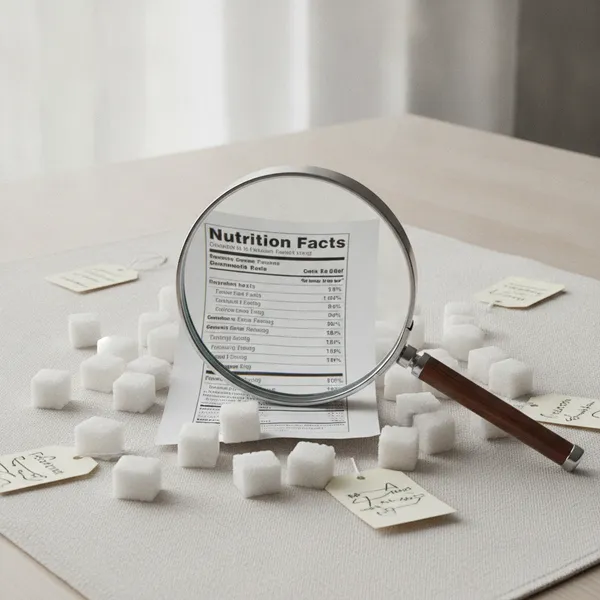
Thanks to the updated FDA nutrition label rules that went into full effect for most manufacturers in 2021, food labels are now required to list 'Added Sugars' as a separate line item under 'Total Sugars.' This is genuinely useful, and it was a long time coming. Here's the difference: 'Total Sugars' includes naturally occurring sugars, like the lactose in plain yogurt or the fructose in a whole piece of fruit, plus any sugars that were added during processing. 'Added Sugars' is just the stuff that was dumped in. Syrups, sweeteners, refined sugars, concentrated fruit juices used as sweeteners. That's what you want to watch. The daily value percentage shown next to Added Sugars is based on a 50-gram daily limit (which is the FDA's reference point, not the AHA's stricter recommendation). So if something shows 20% DV for added sugars, that's 10 grams of added sugar in that one serving. Not nothing. This line is your first flag. If Added Sugars is high, keep reading. If it's zero or near zero, you're probably okay from a sugar standpoint, but still check the ingredients because the label can sometimes be technically accurate and still misleading.
Step 3: Learn the 60+ Names for Sugar in the Ingredient List
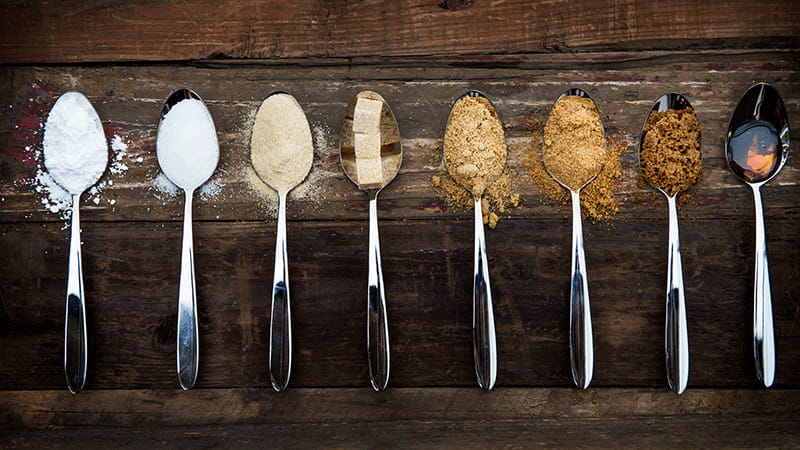
This is where it gets real. The ingredient list is where food companies get creative, and understanding this is honestly the most powerful label-reading skill you can develop. Sugar goes by a lot of names. The University of California San Francisco's SugarScience project identified more than 60 names for added sugar used on food labels. Sixty. Let that sit for a second. You don't need to memorize all 60, but you need to know the major categories so you can spot them on sight: The obvious ones: Sugar, cane sugar, raw sugar, brown sugar, powdered sugar, beet sugar, coconut sugar, date sugar. The syrups: High-fructose corn syrup, corn syrup, rice syrup, brown rice syrup, maple syrup, agave syrup (or agave nectar), tapioca syrup, barley malt syrup, oat syrup. The -ose family: These are sugars. All of them. Glucose, fructose, sucrose, dextrose, maltose, lactose, galactose. If it ends in -ose, it's a sugar. The 'natural' ones that are still sugar: Honey, molasses, fruit juice concentrate, evaporated cane juice, coconut nectar, monk fruit (generally low-glycemic, but still used as a sweetener), dates (in paste or syrup form). The sneaky ones: Dextrin, maltodextrin (this one spikes blood sugar fast), caramel, carob syrup, treacle. Coconut sugar and honey get marketed heavily in the 'natural' and even paleo-friendly space. And yes, they are less processed than white table sugar. But your liver still has to deal with the fructose. Your blood sugar still responds. Using them occasionally and intentionally is fine. Finding them as the third and fourth ingredient in a 'healthy' bar is a different story. When you see two or three of these names in the same ingredient list, even if each one appears in a small amount, the combined sugar load adds up. This is sometimes called 'sugar stacking,' and it's a deliberate formulation strategy to keep any single sugar from appearing too high on the ingredient list while still delivering a sweet product.
Step 4: Use Ingredient Order to Gauge the Sugar Load
Ingredients are listed in descending order by weight. The first ingredient is the most abundant, the last ingredient is the least. So if sugar is the first or second ingredient, that product is primarily sugar with some other stuff added in. If you see multiple sugar names scattered across the list, add them up mentally. Together they might outweigh the first-listed ingredient, even if no single sugar name appears near the top. A practical rule I use: if I count three or more sugar names in the ingredient list, I put it back. That's sugar stacking. The product was formulated to be sweet in a way that hides how sweet it actually is. Also look at where the ingredient list even starts. Some packages bury it in tiny font or wrap it around a seam. That's not an accident. Flip the package, find the list, and read the whole thing. Every word.
Step 5: Watch for These Sneaky 'Healthy' Product Categories
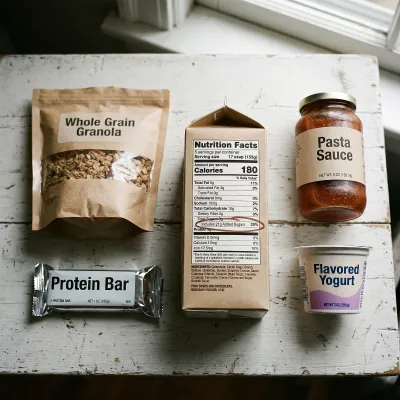
Some product categories are notorious for hidden sugar, even in the natural and paleo-friendly food space. Here are the ones I always scrutinize hard: Flavored nut milks. Vanilla almond milk, sweetened oat milk, flavored coconut milk beverages. The unsweetened versions are usually fine. The flavored ones can pack 7 to 13 grams of added sugar per cup. Check the label. Buy unsweetened and add your own vanilla extract if you want that flavor. Grain-free granolas and paleo snack bars. These are often loaded with honey, maple syrup, dates, and coconut sugar. All 'real food' sweeteners, yes. But stacked together in one bar, you might be looking at 18 to 24 grams of sugar from sweeteners alone. I'm not saying never eat them. I'm saying look first. Flavored yogurts, including 'probiotic' ones. A flavored Greek yogurt marketed for gut health can have 20-plus grams of sugar. Buy plain, full-fat, and stir in your own berries. Salad dressings and marinades. These are probably the sneakiest category. A two-tablespoon serving of a bottled balsamic vinaigrette or teriyaki marinade can contain 6 to 9 grams of added sugar. Make your own. It takes five minutes and olive oil doesn't hide anything. 'No sugar added' products. This label claim is regulated but it means no sugar was added during processing. It does not mean the product is low in sugar. It could be full of naturally occurring sugars, concentrated fruit, or sugar alcohols. Read the full label, not just the front claim. Protein powders and meal-replacement shakes. Especially the ones marketed for weight loss. Some have 15 to 20 grams of added sugar per scoop under the guise of being a health product. Wild.
Step 6: Do the Quick Mental Math (4 Grams = 1 Teaspoon)
Here's the one number you need burned into your brain: 4 grams of sugar equals 1 teaspoon. That's it. That's the conversion. Use it every time. So when you see 28 grams of sugar in a bottle of kombucha, that's 7 teaspoons of sugar. In a drink. That's being positioned as a health product. When your kid's 'all-natural' juice box has 22 grams of sugar, that's 5.5 teaspoons. In one little box. Visualizing sugar in teaspoons changes how you process those numbers on a label. 12 grams sounds manageable. 3 teaspoons of sugar in a handful of crackers suddenly sounds like a lot more. Because it is. Use this conversion. Teach it to your kids. It makes the label feel real instead of abstract.
Quick-Reference: What to Do in the Grocery Aisle
Here's how I move through a label in about 60 seconds when I'm actually shopping:
- Check the serving size. Is it realistic? Multiply if you'll eat more.
- Look at Added Sugars. Anything over 5 grams per serving gets more scrutiny from me.
- Scan the ingredient list for sugar names. Count how many you see. Three or more is a red flag.
- Check where sugar falls in the order. In the top three ingredients? Set it down.
- Translate grams to teaspoons. Divide grams by 4. Does that feel like a reasonable amount for this food?
- Ignore the front of the package. 'Natural,' 'clean,' 'wholesome,' 'guilt-free,' none of those phrases are regulated in any meaningful way. The front of a package is advertising. The back is where the truth is.
It takes practice. The first few times you'll stand in the aisle longer than you want to. But after a few weeks it becomes second nature, and you will never look at a food package the same way again. That's not a bad thing. That's you taking your health seriously. That's you stewarding the body you were given. You deserve to know what you're actually eating.
Key Takeaways
- Sugar appears under 60+ different names on food labels. Learning the major categories (the -ose sugars, syrups, and 'natural' sweeteners) is the most powerful label-reading skill you can develop.
- Always check the serving size first. Every number on the label is meaningless until you know how many servings you're actually consuming.
- The 'Added Sugars' line on updated FDA nutrition labels is your first flag. It separates added sweeteners from naturally occurring sugars.
- Sugar stacking is a real formulation strategy. Multiple sugar names scattered through an ingredient list can combine to make sugar the dominant ingredient, even when none of them appears near the top alone.
- 4 grams of sugar = 1 teaspoon. Memorize this conversion and use it to make label numbers feel real.
- The front of a food package is advertising. The nutrition facts panel and ingredient list are where the truth lives.
Frequently Asked Questions
How many names does sugar have on a food label?
Researchers at UCSF's SugarScience project identified more than 60 names for added sugar that can appear on food labels. These include obvious ones like cane sugar and brown sugar, syrups like high-fructose corn syrup and brown rice syrup, any ingredient ending in -ose (glucose, fructose, dextrose, maltose, etc.), and 'natural' sweeteners like honey, agave nectar, and fruit juice concentrate. You don't need to memorize all 60, but learning the major categories helps you spot them quickly.
What is sugar stacking on a food label?
Sugar stacking is a formulation strategy where food manufacturers use multiple different sweeteners in one product, each in a smaller amount, so that no single sugar name appears near the top of the ingredient list. Since ingredients are listed in descending order by weight, keeping each individual sweetener lower on the list makes the product look less sweet than it actually is. If you count three or more different sugar names in one ingredient list, you're likely looking at a sugar-stacked product.
What is the difference between 'Total Sugars' and 'Added Sugars' on a nutrition label?
Total Sugars includes all sugars in the product, both naturally occurring ones (like lactose in plain dairy or fructose in whole fruit) and any sugars that were added during processing. Added Sugars is just the sugars that were added, such as sweeteners, syrups, and concentrated fruit juices used to sweeten a product. Added Sugars became a required line on updated FDA nutrition labels. For most people watching sugar intake, the Added Sugars line is the more actionable number.
Is coconut sugar or honey okay on a paleo diet, or are they still hidden sugar?
Coconut sugar, honey, maple syrup, and similar sweeteners are generally considered more acceptable in a paleo framework because they're less refined and may have a marginally lower glycemic impact than white table sugar. That said, they are still sugar. Your body still processes the fructose and glucose they contain, and they still contribute to your daily added sugar load. Used occasionally and intentionally in small amounts, they're a reasonable choice. The concern is when you find them stacked two, three, or four deep in an ingredient list of a product being marketed as a health food, because the total sugar load can be surprisingly high.
Sources

 Ng, S.W., Slining, M.M., & Popkin, B.M.
 Human Foods Program
 Human Foods Program
 CDC
CDC
This article is for general informational purposes only and is not medical advice. Always consult a qualified healthcare professional before making changes to your diet or health routine.