
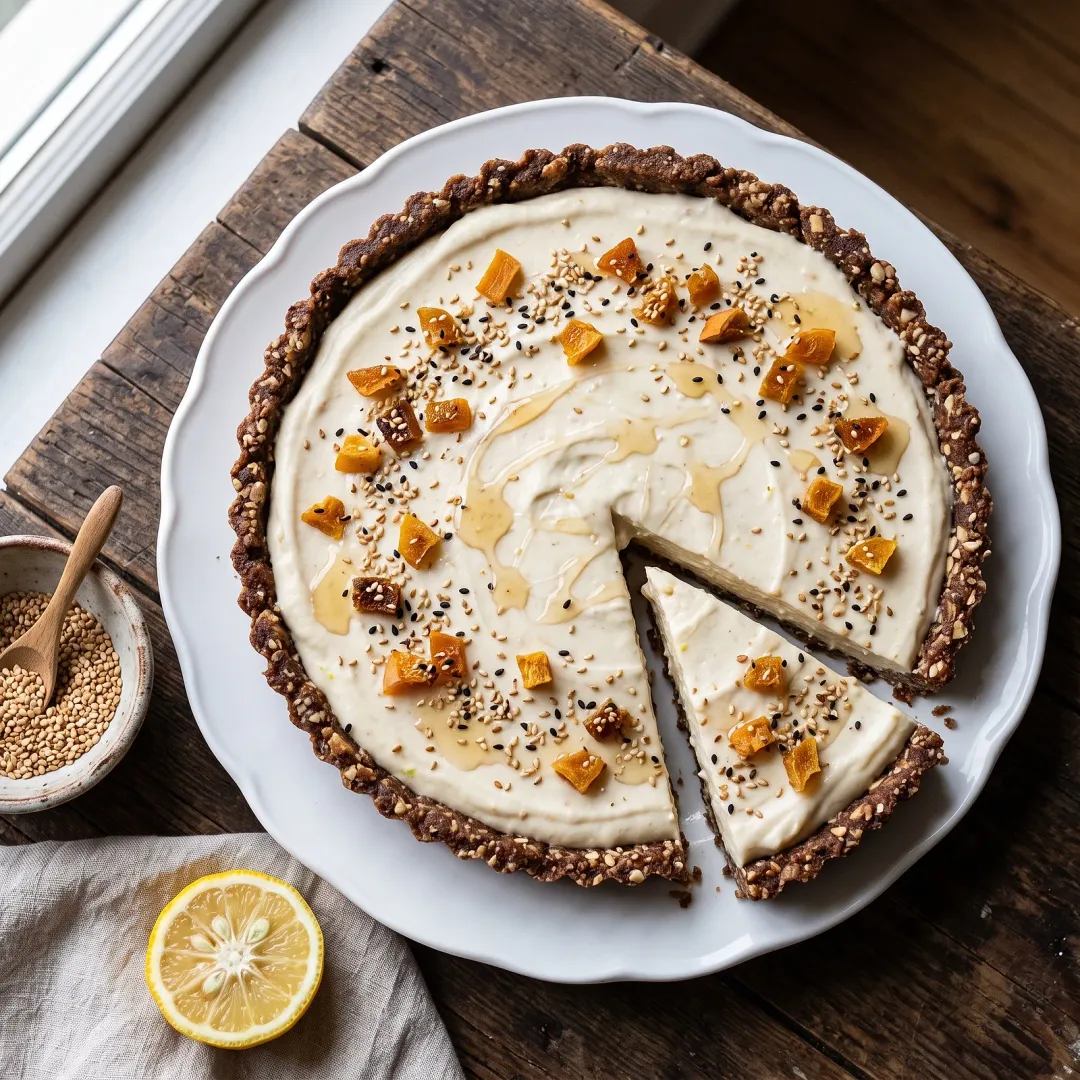

Nobody ever asks for a Korean dessert tart. That's exactly why I made one. Traditional Korean sweets don't get nearly enough love outside of Korean culture, and that is a genuine shame. Things like yugwa (those gorgeous puffed rice and honey confections), sikhye, and yuja-cha tea have this delicate, floral, lightly sweet quality that feels nothing like Western desserts. It's refined without being fussy. It's sweet without being a sugar bomb. And it hit me one afternoon while I was sipping a cup of yuja (Korean yuzu citrus) honey tea that those flavors would be absolutely perfect in a tart. So here we are. An almond-date crust with toasted sesame pressed right in, filled with a whipped coconut cream that's loaded with honey and citrus and a tiny kick of fresh ginger. Topped with dried persimmon and more toasted sesame and a drizzle of raw honey. It looks like it came from a high-end Korean patisserie. It took me about 35 minutes to put together, and then the fridge does the rest of the work. No grains. No refined sugar. No dairy. And it tastes like something you would absolutely not expect from a paleo kitchen. God made flavor. All of it. Including the stuff we haven't tried yet.
Nutritional Benefits
Raw Honey
- Contains natural enzymes and antioxidants that refined sugar completely lacks.
- Provides a lower-glycemic sweetness compared to processed sugars, especially when used in small amounts.
- Has antibacterial properties and is a traditional food across countless cultures for good reason.
Full-Fat Coconut Cream
- Rich in medium-chain triglycerides (MCTs), which the body converts to energy efficiently rather than storing as fat.
- Dairy-free and naturally creamy, making it ideal for people with dairy sensitivities or those following a paleo or Whole30 approach.
- Provides a satiating fat source that helps slow the absorption of natural sugars in the dessert.
Raw Almonds
- Packed with vitamin E, magnesium, and healthy monounsaturated fats.
- Provide plant-based protein and fiber that add staying power to the crust.
- A great grain-free base for tart crusts without any of the blood sugar spike you'd get from traditional flour-based pastry.
Fresh Ginger and Citrus Zest
- Ginger is a well-documented anti-inflammatory and digestive support, not just a flavor note.
- Citrus zest delivers a concentrated dose of flavonoids and limonene from the peel, compounds with real antioxidant activity.
- These aromatics add complexity that lets you cut back on added sweetener without the dessert feeling like it's missing anything.
Toasted Sesame Seeds
- One of the oldest cultivated oil seeds in the world, and a cornerstone of Korean cooking.
- Provide calcium, zinc, and lignans, a type of plant compound with antioxidant properties.
- The toasting process deepens their nutty flavor so a small amount goes a long way, no fillers needed.
FAQs
What is yuzu and where do I find it?
Yuzu is a tart, highly aromatic East Asian citrus fruit used widely in Korean and Japanese cooking. The juice has a flavor that is somewhere between lemon, grapefruit, and mandarin orange. You can often find bottled 100% yuzu juice at Asian grocery stores, some Whole Foods locations, or online. If you genuinely cannot find it, a mix of about 2 tablespoons fresh lemon juice and 1 tablespoon fresh grapefruit juice gives you a very close approximation for this recipe.
Does the tart filling actually set firm enough to slice?
Yes, as long as your coconut cream is properly chilled overnight before you whip it and the assembled tart goes back in the fridge for at least 2 hours. The arrowroot powder in the filling also helps it hold together. I actually prefer this tart after an overnight chill because the flavors meld and deepen. Just slice it cold straight from the fridge.
Can I use a different crust pan or make these as individual tartlets?
Absolutely. This recipe works well in a standard 9-inch removable-bottom tart pan, or you can press the crust into a muffin tin lined with parchment strips for individual tartlets. The individual version sets a little faster since the portions are smaller. Reduce chilling time to about 1 hour for those.
What can I substitute for dried persimmon?
Dried persimmon gives a beautifully honeyed, subtly spiced flavor that is very traditional in Korean sweets. If you can't find it, unsulfured dried apricots chopped very fine are the closest substitute in terms of texture and mild sweetness. Avoid sweetened dried fruit with added sugar or oils.
Is this recipe Whole30 compliant?
Not as written, because honey is not Whole30 compliant. If you want a Whole30 version, you can omit the honey entirely and rely on the natural sweetness of the Medjool dates in the crust and the dried persimmon on top. The filling will be more subtly sweet, which actually works beautifully with the bright citrus notes.
How long does this tart keep in the refrigerator?
Covered tightly, it keeps well for up to 4 days in the fridge. The crust may soften slightly after day 2 from the moisture of the filling, but the flavor actually gets better. I would not recommend freezing it as the coconut cream filling can become icy and grainy when thawed.
If this tart surprises you, that is the whole point. Real food from traditions we haven't spent enough time with is one of the best ways to keep your kitchen from getting boring. Pin this one, make it for someone who says paleo desserts are sad, and then watch their face. I'd love to know how it goes in the comments below.
 That Paleo Chick
Real food that heals
That Paleo Chick
Real food that heals
RecipePaleoDessertGluten-Free

Fits these needs
Checked ingredient by ingredient. Tap one to see every recipe that fits.
Always check labels on packaged ingredients (gluten-free certification, hidden additives) and follow your clinician's advice.
Ingredients
Instructions
Nutrition Facts Amount per serving
Estimated from the ingredients. Values vary with brands and portions.



Join the conversation
Made it? Tell us how it went.
Free members can comment, reply and like. It takes ten seconds.