
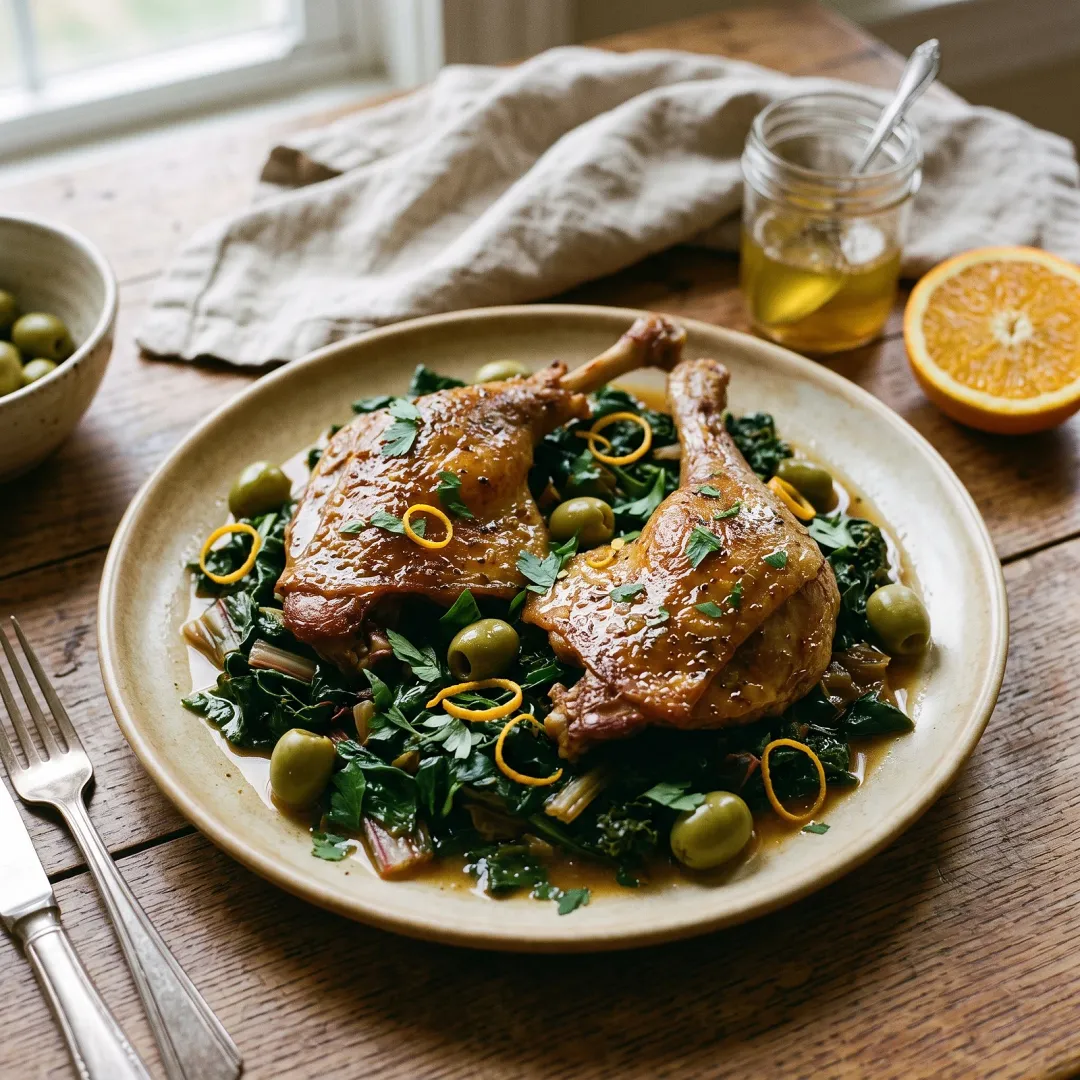

Duck doesn't get nearly enough credit as a weekday lunch protein, and I genuinely do not understand why. Maybe people think it's complicated. Maybe it feels restaurant-only. It is none of those things, especially when your slow cooker is doing the heavy lifting. These duck legs go in with a handful of pantry staples and come out unbelievably tender, almost jammy, draped in a savory orange-and-olive braising sauce that tastes like something you'd order somewhere fancy. Except you made it. At home. While doing other things. Duck is one of those proteins that real-food eaters should absolutely be leaning into more. It's rich in fat-soluble vitamins, it's deeply nourishing, and the fat that renders off during cooking is one of the most stable, clean fats you can cook with. Save every drop of it. Your roasted vegetables will never be the same. The orange and olives aren't just a flavor combination I stumbled on. It's a classic pairing in Mediterranean cooking for a reason. The brightness of the citrus cuts through the richness of the duck, and the briny, buttery olives add a depth that makes the whole braising liquid taste like it simmered for days. Served over quick-wilted greens, this is a real, whole lunch that fills you up without wrecking your afternoon.
Nutritional Benefits
Duck: A Seriously Underrated Whole-Food Protein
- Duck legs are an excellent source of complete protein, delivering around 38g per serving to support muscle repair and satiety throughout the day.
- Duck is naturally rich in B vitamins, especially B3 (niacin) and B12, which are critical for energy metabolism and nervous system function.
- The fat in duck skin and meat is predominantly oleic acid, the same heart-healthy monounsaturated fat found in olive oil. It is not something to fear.
- Duck provides meaningful amounts of iron and zinc, two minerals that many people eating a standard diet are deficient in.
Olives: Tiny but Mighty
- Castelvetrano olives and other whole green olives are a whole-food source of oleic acid and natural plant polyphenols with anti-inflammatory properties.
- Olives contribute to the richness of the braising liquid without any processed or seed oil inputs, keeping this dish clean from start to finish.
- They also provide small amounts of vitamin E and copper, both of which support immune and connective tissue health.
Dark Leafy Greens: The Mineral Base
- Lacinato kale and Swiss chard are among the most nutrient-dense vegetables you can eat. Both are loaded with vitamins K, A, and C.
- The fat in the duck and the avocado oil help your body actually absorb the fat-soluble vitamins from those greens. Eating your greens with a fat source isn't just tasty, it's smarter.
- Kale and chard are both good sources of magnesium, a mineral that supports sleep, stress response, and hundreds of enzymatic reactions in the body.
Orange Juice (Fresh): More Than Just Flavor
- Fresh-squeezed orange juice provides natural vitamin C, which also plays a role in helping your body absorb the non-heme iron from the greens.
- Using the whole orange, zest included, means you're getting the beneficial flavonoids concentrated in the peel alongside the juice.
- The natural sugars in orange juice are minimal per serving once spread across the entire braising liquid, and they are completely unrefined.
FAQs
Can I use duck breasts instead of legs?
For slow cooking, legs are the right call. Duck breasts are lean and better suited to a fast, hot sear. In a slow cooker, they'll toughen up and dry out. Legs have the fat content and connective tissue that makes long braises actually work. Stick with legs for this one.
Do I have to sear the duck first?
Technically no, but please do it. The sear gives you the golden skin, the caramelized fond on the pan bottom, and a much richer braising liquid. It adds maybe 10 minutes and it is completely worth it. Pale, unseared duck legs just aren't the same thing.
What can I do with the leftover duck fat?
Strain it, pour it into a glass jar, and refrigerate it. It will keep for up to a month in the fridge or several months in the freezer. Use it to roast sweet potatoes, sauté vegetables, or cook eggs. It is one of the most flavorful and stable cooking fats available.
Is this Whole30 compliant?
Yes. Every ingredient in this recipe is Whole30 compliant as written. Coconut aminos, bone broth, avocado oil, fresh orange juice, olives, and greens all check out. Just make sure your bone broth has no added sugar or off-program ingredients on the label.
Can I make this in a Dutch oven in the oven instead of a slow cooker?
Absolutely. After the sear and building the braising liquid, transfer everything to a Dutch oven, cover tightly, and braise at 325°F for about 2 to 2.5 hours, until the meat is pull-apart tender. Same great result, just a different vessel.
What other greens work for the wilted greens base?
Swiss chard is the most tender option and wilts the fastest. Lacinato kale takes a couple extra minutes. Spinach will also work but wilts down to almost nothing, so use a larger quantity. Beet greens are an underused gem here if you can find them.
If you made it this far and you've never cooked duck before, I hope this was the push you needed. The body was designed to run on real, whole, nutrient-dense food, and duck is exactly that. Rich, satisfying, and loaded with the kind of fat and protein that actually keeps you going. Give this one a try on a Sunday when the slow cooker can do its thing while you do yours, and let me know what you think in the comments below. And for the love of all things good, save that duck fat.
Slow-Cooked Duck Legs with Orange, Olives, and Wilted Greens
Tender slow-cooked duck legs braised in a savory orange-herb sauce with briny olives and finished over wilted greens. A rich, deeply satisfying paleo lunch that feels special without being fussy.
Ingredients
- 4 duck legs (about 3.5 lbs total), trimmed of excess fat
- 1 teaspoon fine sea salt, plus more to taste
- 1/2 teaspoon black pepper
- 1/2 teaspoon smoked paprika
- 1 tablespoon avocado oil
- 1 medium yellow onion, thinly sliced
- 4 garlic cloves, smashed
- 1 cup fresh orange juice (about 3 large oranges)
- 1 tablespoon orange zest
- 1/2 cup chicken bone broth (low-sodium)
- 2 tablespoons coconut aminos
- 1 tablespoon tomato paste
- 1 teaspoon dried thyme
- 1 teaspoon dried rosemary
- 1/2 teaspoon ground coriander
- 1/4 teaspoon crushed red pepper flakes
- 1/2 cup pitted Castelvetrano olives (or green olives of choice)
- 2 tablespoons fresh flat-leaf parsley, roughly chopped (for garnish)
- FOR THE WILTED GREENS:
- 1 tablespoon avocado oil
- 4 cups lacinato kale or Swiss chard, stems removed and leaves roughly torn
- 2 garlic cloves, minced
- Juice of 1/2 lemon
- Pinch of sea salt
Instructions
- Pat the duck legs completely dry with paper towels. This step matters, moisture is the enemy of a good sear. Season all over with salt, pepper, and smoked paprika.
- Heat 1 tablespoon avocado oil in a large cast-iron or heavy skillet over medium-high heat. Once shimmering, place duck legs skin-side down. Sear without moving them for 5 to 6 minutes, until the skin is deep golden brown and has released most of its fat. Flip and sear the other side for 2 minutes. Work in batches if needed. Transfer seared legs to the slow cooker insert.
- Pour off all but about 1 tablespoon of duck fat from the skillet (save the rest, it's liquid gold for roasting vegetables). Reduce heat to medium and add the sliced onion. Cook for 3 to 4 minutes, stirring occasionally, until softened and starting to turn golden. Add smashed garlic and cook 1 minute more.
- Add the orange juice, orange zest, bone broth, coconut aminos, tomato paste, thyme, rosemary, coriander, and red pepper flakes to the skillet. Stir well, scraping up any browned bits from the bottom. Let it bubble for 1 minute, then pour the entire mixture over the duck legs in the slow cooker.
- Scatter the olives over and around the duck legs. Place the lid on the slow cooker and cook on LOW for 6 hours. The legs are done when the meat is completely tender and pulling away from the bone.
- About 10 minutes before serving, make the wilted greens. Heat 1 tablespoon avocado oil in a large skillet over medium heat. Add the minced garlic and cook for 30 seconds. Add the torn kale or chard and a pinch of salt. Toss with tongs and cook for 3 to 4 minutes until wilted but still bright. Squeeze lemon juice over the top and toss to combine.
- To plate, divide the wilted greens among four bowls or plates. Nestle a duck leg on top. Spoon the braising liquid, olives, and onions generously over everything. Scatter fresh parsley on top and serve immediately.
Nutrition per serving
- Calories: 520
- Total Fat: 36g
- Carbohydrates: 9g
- Protein: 38g
- Dietary Fiber: 2g
- Sugar: 5g
 That Paleo Chick
Real food that heals
RecipePaleoLunchGluten-Free

Fits these needs
Checked ingredient by ingredient. Tap one to see every recipe that fits.
Ingredients
Instructions
Nutrition Facts Amount per serving
Estimated from the ingredients. Values vary with brands and portions.


Join the conversation
Made it? Tell us how it went.
Free members can comment, reply and like. It takes ten seconds.