

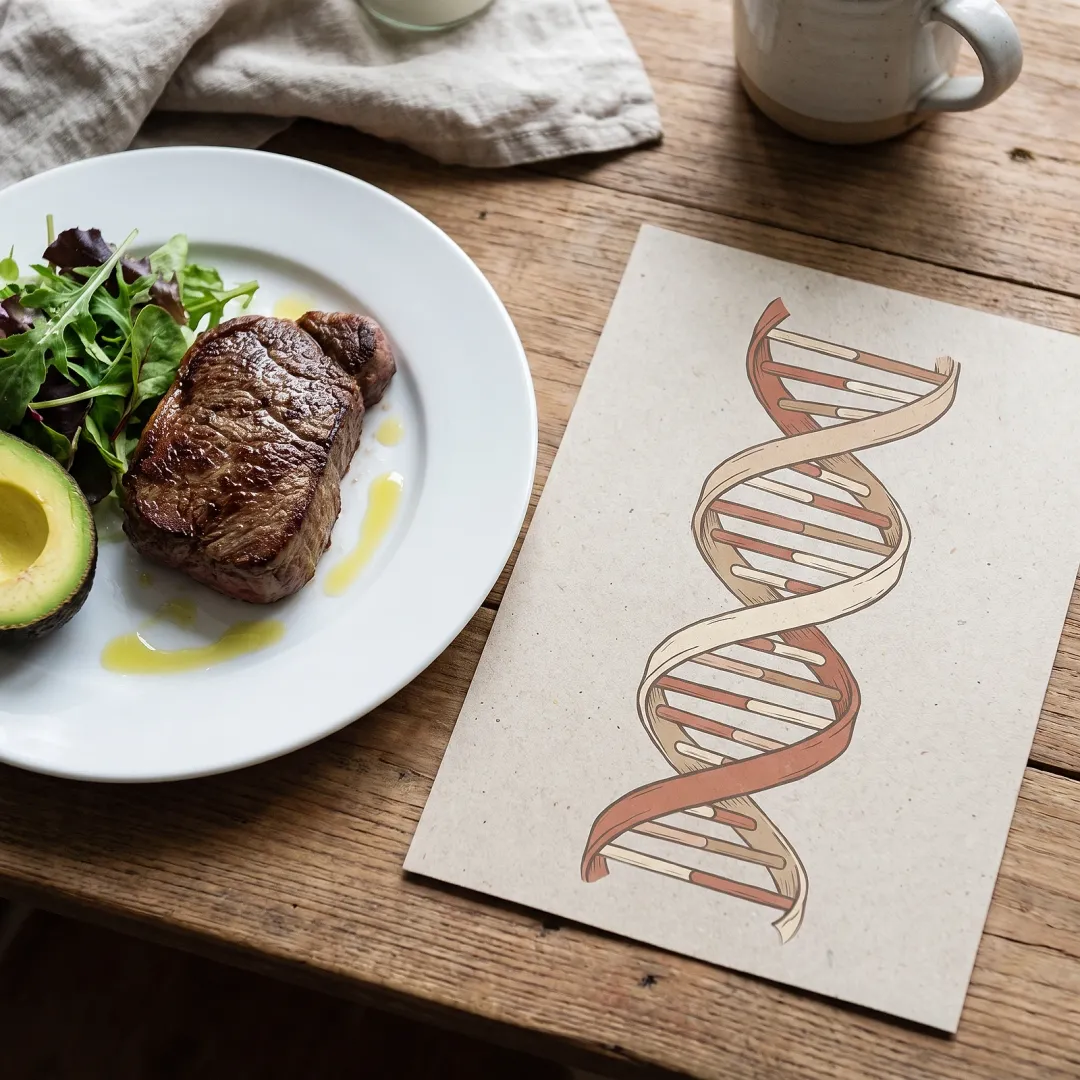

Real food is not one-size-fits-all, and it took me a while to accept that. I know. That kind of stings to hear when you finally cleaned up your diet, went low-carb, ditched the processed junk, and felt amazing for three months, only to get your bloodwork back and see your LDL sitting somewhere alarming. You did everything right, and your doctor is staring at the number like you've been eating drive-through every day. What is going on?
A new study just gave us a really important piece of the puzzle. And I think every single person eating a low-carb or paleo-style diet needs to hear it.
What the Research Actually Found
Researchers recently published findings showing that a low-carb diet may cause LDL cholesterol to spike far more dramatically in people who carry a genetic predisposition to high cholesterol, particularly when they are eating a lot of saturated fat. And not just a little spike. We're talking a significantly sharper rise compared to people without that genetic background who eat the same way.
According to the study covered by ScienceDaily, this could help explain something that has puzzled both practitioners and patients for years: why two people can follow seemingly identical diets and get completely different results. One person thrives on a high-fat, low-carb approach. The other one's LDL climbs and climbs with no clear explanation.
The answer, at least in part, may be written in their DNA.
This Is Not an Attack on Low-Carb Eating
Before anyone panics, let me be really clear about what this research does and does not say.
It does NOT say low-carb eating is bad. It does NOT say saturated fat causes heart disease across the board. The blanket demonization of saturated fat was built on deeply flawed science, and decades of research since then has complicated that story considerably. I've covered what the data actually shows about full-fat real food, and I'm not walking any of that back.
What this study IS saying is that your individual genetic makeup may change how your body handles dietary fat, specifically in ways that affect how much LDL your liver produces and clears. That is a bio-individual response, not a universal condemnation of the food itself.
The functional medicine lens I work from has always said this: there is no magic template that works perfectly for every single human body. The ancestral, real-food framework is the foundation. But what you build on that foundation has to be tuned to you.
What Genes Are We Actually Talking About?
The research points specifically to people with a genetic predisposition to high cholesterol. Familial hypercholesterolemia (FH) is one of the most common hereditary conditions in this space, affecting roughly 1 in 250 people according to the American Heart Association. Many of them have no idea they carry it.
There's also the APOE gene variant, particularly the APOE4 allele, which is associated with how the body processes fats and cholesterol and has been studied in relation to cardiovascular risk and cognitive health. People carrying APOE4 may respond more dramatically to dietary saturated fat, with larger LDL increases than those with other variants.
Here's the thing. Most people have never been told any of this. Their doctor ran a standard lipid panel, saw a number, and handed them a statin. Nobody asked whether their body might be genetically wired to respond differently to the food they're eating. Nobody offered to look upstream.
That, right there, is the gap that functional medicine was built to fill.
Why This Matters in a Real-Food Context
If you're eating paleo or low-carb and your LDL is elevated, I want you to think about a few things before you spiral.
First, standard LDL numbers are not the whole story. A basic lipid panel gives you total LDL, but it doesn't tell you particle size, and particle size matters. Small, dense LDL particles are considered more problematic than large, fluffy ones. A high LDL number on a standard panel could mean very different things depending on what KIND of LDL you're carrying. An advanced lipid panel, like an NMR LipoProfile, gives you that breakdown. If your doctor hasn't offered that, ask for it.
Second, inflammation markers matter just as much. Highly sensitive C-reactive protein (hs-CRP), for example, gives you a window into systemic inflammation, which is a much more textured picture of cardiovascular risk than LDL in isolation.
Third, context is everything. Are you eating ultra-processed seed oils or real animal fats from clean sources? Are you eating real food or low-carb packaged products loaded with industrial ingredients? Are you sleeping? Managing stress? Moving your body? All of those variables interact with how your body handles dietary fat.
If you have a genetic predisposition like FH or APOE4, that adds another layer to pay attention to. It does not mean real food failed you. It means you need a more precise approach for your body.
What I'd Actually Tell a Client
If someone came to me as a functional medicine health coach and said, "Krista, I went low-carb, I'm eating clean, and my LDL is through the roof," here is the conversation I would want to have with them.
I'd ask about their family history first. Has anyone in your family had early cardiovascular disease? Have you ever been tested for familial hypercholesterolemia or done any genetic health screening? Because if there's a hereditary pattern there, that context changes the way you interpret that number.
I'd ask what fats they're eating and in what amounts. There's a difference between cooking with grass-fed butter and olive oil versus eating a pound of bacon every single day with very little variety.
I'd encourage them to ask their practitioner for advanced lipid testing, not just a standard panel. And I'd also encourage them to get an hs-CRP and a fasting insulin, because those tell you things about cardiovascular and metabolic risk that a single LDL number just doesn't.
I am NOT telling anyone to stop eating real food. I am telling you that if your numbers are persistently moving in a direction that concerns you and your practitioner, it is worth digging into WHY instead of just swapping your diet for a low-fat template that is almost certainly going to make other things worse.
This is not a problem that more processed food is going to fix.
The Deeper Issue: Personalized Medicine Is Not a Luxury
Here's what actually frustrates me about how this kind of research gets reported. The headline version of this study could easily become: "Low-carb diets raise cholesterol, dangerous, go back to your whole grains." That is not what the data says, and that kind of oversimplification does real harm.
The actual takeaway is that genetics plays a meaningful role in how individuals respond to macronutrient composition, and that blanket dietary advice issued to an entire population of genetically diverse humans has always been an imperfect tool. That is a case for personalization, not for running back to the low-fat, high-carb guidance that drove a metabolic health crisis in this country for four decades.
We are all biochemically individual. That is not a fringe idea. It is basic biology. The fact that our medical system still largely operates on population-level averages and one-size-fits-all guidelines is part of why so many people fall through the cracks, eating exactly what they've been told to eat and still getting sicker.
Your body is a gift. It is worth understanding, not just managing with the same prescription everyone else got.
If this research does anything, I hope it pushes more people to ask better questions of their practitioners and to seek out testing that actually tells them something specific about their own biology. That is what root-cause thinking looks like in practice.
Practical Next Steps
You don't need to overhaul your whole approach based on one study. But if this resonates with something you've been wondering about, here are some genuinely useful things you can do.
Ask your doctor for an advanced lipid panel (NMR LipoProfile or similar) instead of or in addition to a standard panel. That gives you LDL particle number and particle size, which is far more informative.
Ask about your hs-CRP and fasting insulin at your next visit. Together with lipids, those give you a much more complete picture of your metabolic and cardiovascular risk than total cholesterol alone.
If you have a family history of early heart disease or high cholesterol, ask whether you've been screened for familial hypercholesterolemia. It's underdiagnosed and underidentified.
Consider genetic testing through a reputable service. Some functional medicine practitioners can order and interpret nutrigenomic panels that give you information about how your body handles things like saturated fat, folate, vitamin D, and more. This is the kind of data that lets you actually personalize your approach rather than guessing.
And finally: don't let one concerning lab number send you back to processed food. Work with a practitioner who is willing to look at the whole picture. You deserve that.
This article is for general informational purposes only and is not medical advice. Always consult a qualified healthcare professional before making changes to your diet or health routine.
Key Takeaways
- A new study found that low-carb diets may raise LDL cholesterol significantly more in people with a genetic predisposition to high cholesterol, especially with high saturated fat intake.
- This is not a reason to abandon real food. It's a case for bio-individual assessment, not a return to low-fat, high-carb dietary advice.
- Genetic variants like familial hypercholesterolemia (FH) and APOE4 may affect how your body responds to dietary fat. Many people carry these and don't know it.
- Standard LDL numbers don't tell the whole story. Advanced lipid panels, hs-CRP, and fasting insulin give a much more complete picture of cardiovascular risk.
- The takeaway is personalization: understanding your own biology so you can tune your real-food approach to your actual body, not the population average.
Frequently Asked Questions
Why did my LDL go up on a low-carb or keto diet?
There are several possible reasons, and genetics is one that often gets overlooked. New research suggests that people with genetic variants like familial hypercholesterolemia (FH) or the APOE4 gene may see significantly larger LDL increases on a low-carb, high-saturated-fat diet compared to people without those variants. Beyond genetics, the type of fats you're eating, your overall food quality, sleep, and stress levels all interact with how your body handles dietary fat. A standard LDL number also doesn't give you the full picture. Ask your practitioner about advanced lipid testing to understand particle size and other markers that provide more context.
Does a high LDL on a low-carb diet mean I should stop eating low-carb?
Not necessarily, and that decision should be made with a qualified healthcare practitioner based on your full health picture, not a single number. A standard LDL result doesn't tell you particle size, which matters a great deal for cardiovascular risk assessment. An advanced lipid panel, along with markers like hs-CRP and fasting insulin, gives you a much more complete picture. If you have a genetic predisposition to high cholesterol, you may need to adjust the amount and types of saturated fat in your approach. That's personalization, not a failure of real-food eating.
What is familial hypercholesterolemia and how do I know if I have it?
Familial hypercholesterolemia (FH) is a hereditary condition that affects how the body processes and clears LDL cholesterol. It affects roughly 1 in 250 people and is significantly underdiagnosed. Signs that might point toward FH include persistently high LDL (especially total cholesterol above 300), a strong family history of early cardiovascular disease (heart attacks before age 55 in men or 65 in women), or cholesterol deposits under the skin or in the tendons. If you suspect it, ask your doctor about genetic testing or referral to a lipid specialist.
What tests should I ask for if I'm concerned about cholesterol on a low-carb diet?
Ask your practitioner for an advanced lipid panel (such as an NMR LipoProfile) that breaks down LDL particle number and particle size, rather than just total LDL. Also ask about highly sensitive C-reactive protein (hs-CRP) as a marker of systemic inflammation, and fasting insulin as a window into metabolic health. Together, these give a far richer picture of cardiovascular risk than total LDL alone. If you have a family history of early heart disease, ask about screening for familial hypercholesterolemia specifically.
Sources
- ScienceDaily: Your genes may decide whether a low-carb diet sends cholesterol soaring
- American Heart Association: Familial Hypercholesterolemia (FH)
This article is for general informational purposes only and is not medical advice. Always consult a qualified healthcare professional before making changes to your diet or health routine.




Join the conversation
What do you think?
Free members can comment, reply and like. It takes ten seconds.