
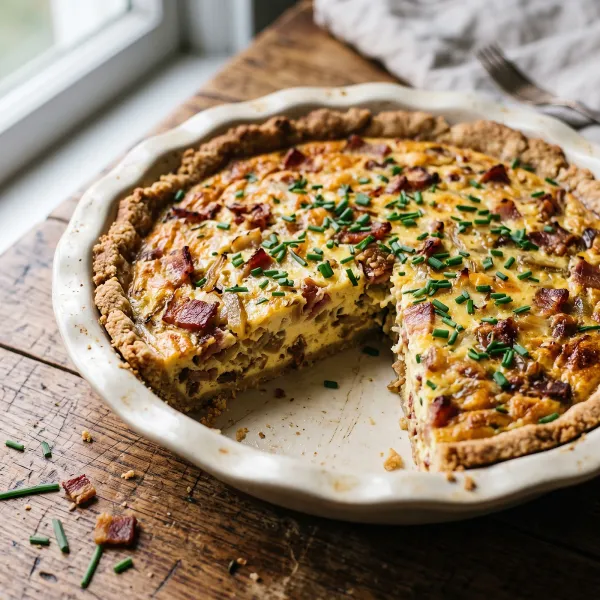
Classic quiche Lorraine has three things that don't fly paleo: a wheat pastry crust, heavy cream, and Gruyère cheese. Those are not small things, they ARE the dish. So when I set out to make a version that actually holds up, I wasn't going to slap some egg mixture in a bare pie dish and call it a day. That's a frittata. Not the same. Here's what I did instead. The crust is almond flour and tapioca with melted ghee and an egg, it blind-bakes into something genuinely short and buttery that holds a clean slice without crumbling into your lap. Full-fat coconut milk stands in for the heavy cream in the custard. It brings the same richness and silkiness, and once the nutmeg, mustard powder, and a little nutritional yeast go in, you are not sitting there thinking about what's missing. The nutritional yeast does the job the Gruyère was hired for: that faint savory, almost funky depth that makes quiche taste like quiche and not just baked eggs. You can skip it if you want strict paleo, but I'd try it first. The bacon and slow-cooked onion? Those stay exactly the same. Lorraine was always about those two things anyway. Everything else was just the vehicle, and we built a better one.
Nutritional Benefits
Eggs: The whole-food protein powerhouse
- Six whole eggs in one quiche means each slice delivers roughly 18 grams of complete protein with all essential amino acids.
- Egg yolks are rich in choline, a nutrient most people don't get nearly enough of, and one that's critical for brain function and liver health.
- Fat-soluble vitamins A, D, E, and K2 are found in the yolk. If you can get pasture-raised eggs, that nutrient profile gets even better.
Bacon: Pick the right kind and don't feel bad about it
- Pasture-raised, uncured bacon with no added nitrates or sugar is a real-food fat and protein source, not a guilty pleasure.
- Bacon fat is primarily oleic acid (the same fat in olive oil) plus saturated fats that support hormone production.
- The key is sourcing. Factory bacon loaded with additives is a different food from clean, heritage-breed pork belly. Read the label.
Almond flour crust: More than just a grain-free swap
- Blanched almond flour is naturally low-carb and delivers vitamin E, magnesium, and healthy monounsaturated fats in every slice.
- Because almond flour is higher in fat and protein than wheat flour, this crust keeps you full significantly longer than a traditional pastry.
- No blood sugar spike. Grain-free baking done with whole nut flours keeps the glycemic load low, which matters at breakfast especially.
Full-fat coconut milk: Real fat, real satiety
- Coconut milk contains medium-chain triglycerides (MCTs), fats the body preferentially uses for energy rather than storing.
- The fat content in coconut milk helps the body absorb the fat-soluble vitamins in the egg yolks, fat and fat-soluble nutrients belong together.
- Full-fat, canned coconut milk (not the refrigerated watery kind) is what gives this custard its body and richness. Don't sub it out.
FAQs
Can I make this quiche ahead of time?
Yes, and it actually holds up really well. Bake it fully, let it cool completely, then cover and refrigerate for up to 4 days. Reheat individual slices in a 325°F oven for about 10 minutes or just eat it at room temperature, both work.
My crust always slides down the sides of the pie dish when I blind-bake it. Help.
Press it firmly and make sure it's chilled before it goes in. After you press the dough in, stick the whole dish in the fridge for 10 minutes before blind-baking. That sets the fat in the dough so it holds its shape. Also don't skip poking the bottom with a fork.
Can I use a different fat instead of ghee in the crust?
Refined coconut oil works and keeps it fully dairy-free. The flavor will be very slightly different but the texture will still be good. Lard also works beautifully here if you have it.
I can't do nutritional yeast. Will it still taste like quiche Lorraine?
It will still taste really good. The nutmeg, mustard powder, and well-seasoned custard carry a lot of the flavor. The nutritional yeast just adds a layer of savory depth. A small splash of coconut aminos (about a teaspoon) in the custard can fill some of that role.
Is the center supposed to be a little wobbly when I take it out?
Yes. A slight jiggle in the very center is exactly right. The residual heat will finish it off during the 10-minute rest. If it's completely firm with no movement when you pull it from the oven, it's probably a touch overdone, though it'll still taste fine.
Can I freeze this quiche?
You can. Slice it first, wrap each slice tightly, and freeze for up to 2 months. Reheat from frozen in a 350°F oven for 15 to 20 minutes. The texture of the custard will be very slightly less silky after freezing but it's still a solid meal-prep option.
If you made this, I genuinely want to know how it went. Drop a comment below and tell me if you tried it with or without the nutritional yeast, because I'm still curious which way people prefer it. And if you're new here and just stumbled on this through a quiche search, welcome. There's a lot more real-food cooking where this came from.
Ingredients
Instructions
Nutrition Facts
| Nutrient | Amount per Serving |
|---|