

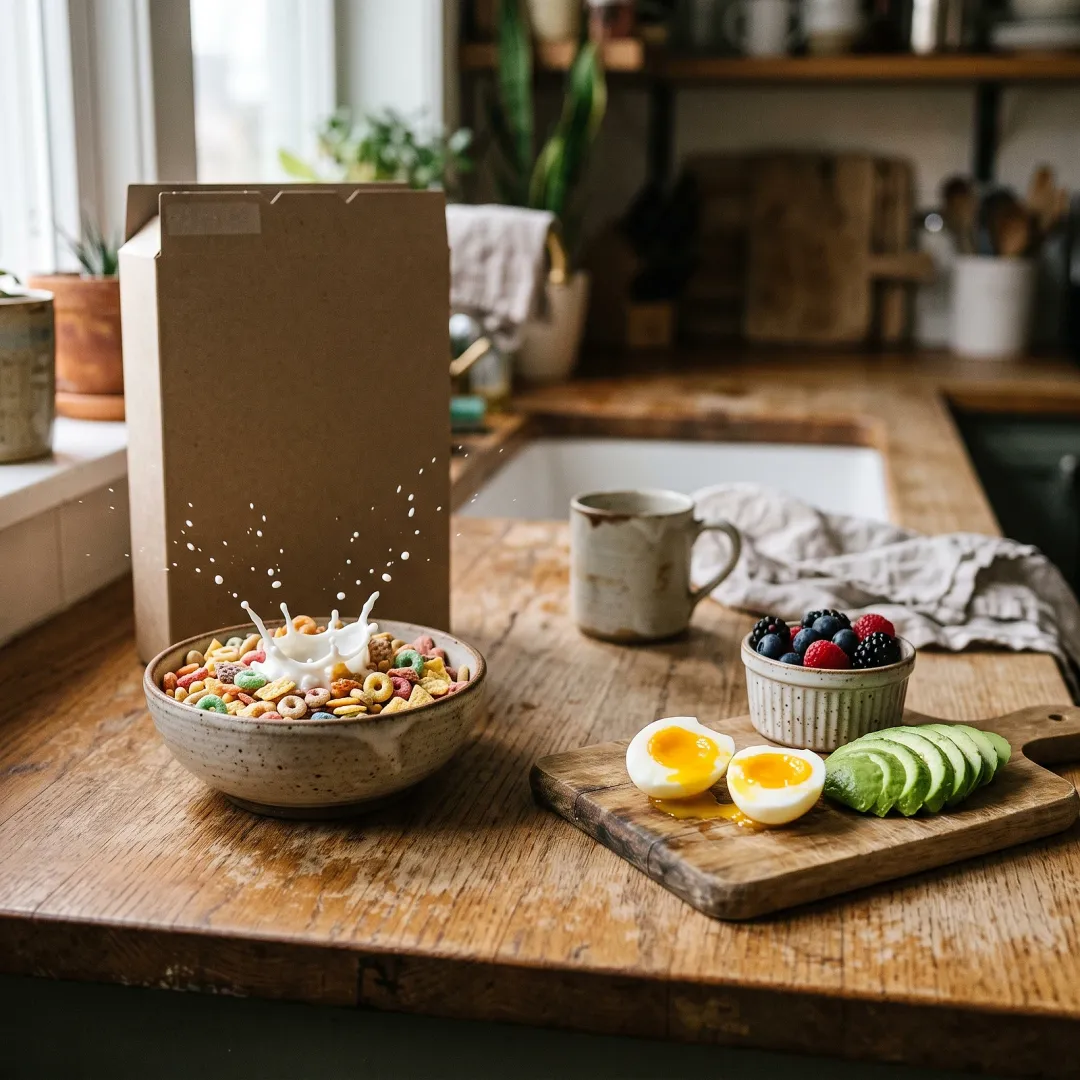

The cereal box has been running the morning for about 80 years, and the pitch has barely changed: quick, convenient, fortified. What they leave off the front of the box is that most breakfast cereals are closer to dessert than food. A single serving of a popular whole-grain cereal can pack more added sugar than a glazed doughnut, and the serving size printed there (usually three-quarters of a cup) is not the bowl anyone actually pours. The average American eats roughly double that. So you are not imagining it when you are starving by 10 a.m.
What's Actually in the Box
Most mainstream cereals, including ones with words like 'heart healthy' or 'whole grain' on the front, are made from refined grains, added sugar, synthetic vitamins sprayed on after processing, and seed oils. The vitamins are the tell: real food does not need to be fortified. When the natural nutrition gets cooked and extruded out of a grain at high heat and pressure, manufacturers add it back in powder form and call it enriched. A 2021 analysis from the Environmental Working Group found that many children's cereals contain more than 40% of their calories from added sugar. Adult cereals are not much better. The front of the box is marketing. The back panel is the truth.
Swap 1: Sugary Cereal + Skim Milk → Soft-Boiled Eggs + Avocado
Two soft-boiled eggs with half an avocado gives you real fat, real protein, and zero added sugar. Total active time is about eight minutes, and most of that is waiting for water to boil. Taste and texture trade-off: you lose the sweet crunch, which is real, but you gain satiety that actually lasts. This is the swap most worth making if you are hungry every morning by mid-morning. Eggs are one of the most nutrient-dense foods available, and a Harvard T.H. Chan review supports them as a healthy protein source for most people. Cost is comparable or lower than name-brand cereal per serving.
Swap 2: Granola + Yogurt Parfait → Full-Fat Yogurt + Berries + Pumpkin Seeds
Store-bought granola is almost always held together with sugar, honey, or syrup, and the serving size is a quarter cup nobody respects. The parfait looks clean but can clock 40-plus grams of sugar before you leave the house. Keep the full-fat plain yogurt (it is more satisfying and the fat slows glucose absorption), skip the granola, and add a handful of fresh or frozen berries and a tablespoon of pumpkin seeds for crunch and zinc. Honest trade-off: you lose the sweetness and the satisfying cluster texture. If you need that sweetness, drizzle half a teaspoon of raw honey. That is still a completely different breakfast from a parfait cup from a chain.
Swap 3: Instant Oatmeal Packets → Steel-Cut Oats or Leftover Bison and Roasted Sweet Potato
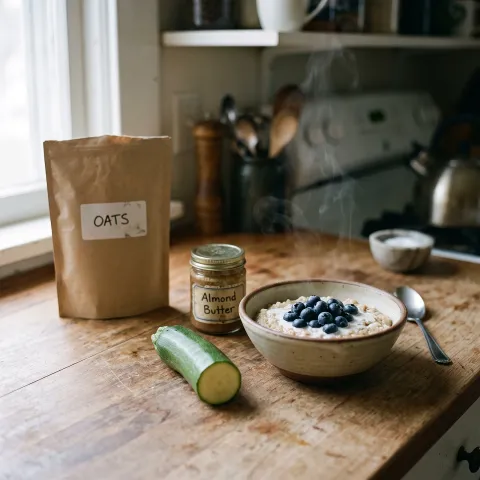
Flavored instant oatmeal packets are essentially flavored sugar delivery with a bit of oat dust. Plain steel-cut oats are a legitimate real-food swap: they are less processed, digest more slowly, and actually taste like something. Cook a big pot Sunday, portion into jars, reheat in 90 seconds. Same convenience, completely different nutrition profile. If you want to go further, a savory breakfast of leftover ground bison and roasted sweet potato is one of the most underrated morning meals I know. It sounds weird until you try it. No blood sugar spike, no 10 a.m. crash, and it keeps you full until actual lunch. According to USDA data, bison is a lean, protein-dense red meat with meaningful iron and B12 in a single serving. Honest trade-off: cost and prep are higher than a 99-cent packet. Worth it if mornings are hard for you.
Swap 4: Cereal Bar 'On the Go' → Medjool Date + Almond Butter + Hard-Boiled Egg
Cereal bars are cereal in a different shape. The wrapper says grab-and-go, the ingredient list says corn syrup, soy protein isolate, and palm oil. A Medjool date stuffed with almond butter and one hard-boiled egg (prep both the night before) travels in a bag, costs less than most bars, and has actual food in it. The date is sweet and sticky enough that you do not feel like you are giving up your morning treat. Taste trade-off: if you love the uniform texture of a cereal bar, this is messier. That's the honest version.
When the Swap Is Not Worth It
Plain rolled oats with nothing added, or a low-sugar muesli with real ingredients and under 6 grams of added sugar per serving, are not your enemy. If a bowl of plain oats with banana and cinnamon is the breakfast that actually happens instead of a drive-through biscuit, that is a win. Not every cereal is a disaster. The ones worth ditching are the ones that read like a chemistry experiment. Read the back panel. If sugar is in the first three ingredients, or there are more than five ingredients you cannot picture, that is your cue.
---
This article is for general informational purposes only and is not medical advice. Always consult a qualified healthcare professional before making changes to your diet or health routine.
Key Takeaways
- Most breakfast cereals are highly processed, heavily sweetened, and synthetically fortified, real food does not need to be fortified after the fact.
- Swapping cereal for protein and fat in the morning (eggs, bison, full-fat yogurt) can help you stay full longer and reduce mid-morning hunger.
- Plain steel-cut oats or a low-sugar muesli are legitimate real-food options if the more involved swaps are not realistic for your morning.
- Cereal bars are not a shortcut, they are cereal in bar form. Read the label.
- No swap is worth making if it never actually happens. Pick the one that fits your real morning and start there.
Frequently Asked Questions
Is breakfast cereal actually bad for you?
Most mainstream breakfast cereals are highly processed, contain significant amounts of added sugar, and are made from refined grains that digest quickly. That said, not every cereal is equally problematic. Plain rolled oats or a low-sugar muesli with real ingredients are different animals from a frosted corn flake. Read the ingredient list: if sugar is in the first three ingredients or there are more than five items you cannot picture as food, it is worth reconsidering.
What is the quickest real-food swap for cereal on a busy morning?
Two soft-boiled eggs with half an avocado takes under eight minutes. If even that feels like a stretch, prep hard-boiled eggs on Sunday and pair one with a Medjool date and a spoonful of almond butter as you walk out the door. It travels, it's real food, and it actually keeps you full.
Are granola and granola bars a healthy alternative to cereal?
Most store-bought granola and cereal bars are not meaningfully different from the cereal they claim to replace. Granola is typically bound with sugar, honey, or syrup, and cereal bars often contain corn syrup, soy protein isolate, and industrial oils. A plain full-fat yogurt with berries and pumpkin seeds, or a homemade version with oats and minimal sweetener, is a much cleaner option.
Can I still eat oatmeal on a paleo-style diet?
Traditional strict paleo excludes grains, including oats. That said, many people in the real-food community eat plain, minimally processed oats and tolerate them well. Steel-cut or rolled oats with no added sugar are a far cry from flavored instant oatmeal packets. If you do well with oats and they help you eat real food in the morning, that is more important than a label.
Sources
- Environmental Working Group: Children's Cereals Still Full of Sugar
- Harvard T.H. Chan School of Public Health: Eggs, The Nutrition Source
- USDA FoodData Central: Bison, ground, raw, Nutrient Data
This article is for general informational purposes only and is not medical advice. Always consult a qualified healthcare professional before making changes to your diet or health routine.



Join the conversation
What do you think?
Free members can comment, reply and like. It takes ten seconds.