

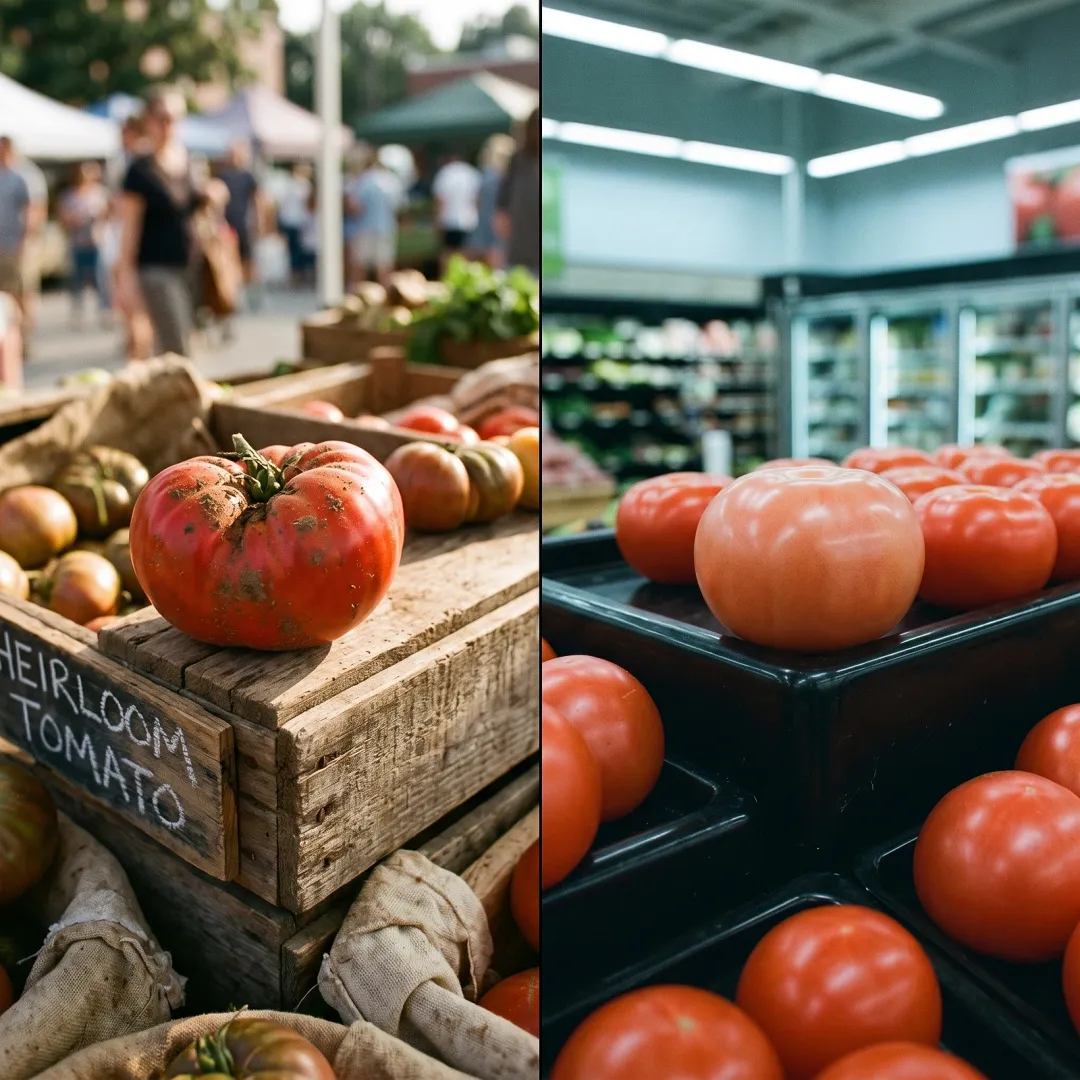

That tomato you bought in January looked perfect. Red, round, not a bruise on it. Then you bit into it and got... nothing. No sweetness. No acid. Not even a smell. You put it on a salad hoping the dressing would save it, and honestly, the dressing was doing all the work.
This is not in your head. That tomato was engineered to look good and survive a truck ride, not to taste like a tomato. And the reason it has no flavor is not one thing. It is a chain of events, each one stripping something out, that starts weeks before the fruit ever lands in your grocery cart.
I want to walk you through it, because once you understand what actually happens inside out-of-season produce, you will never look at a February strawberry the same way again. Flavor is information. When it is gone, so is a lot else.
First, What Makes Produce Taste Like Anything at All
Flavor in a fruit or vegetable is the product of a specific, timed chemistry experiment. Sugars, organic acids, and hundreds of volatile aromatic compounds have to be present in the right ratios at the right moment. That moment is ripeness on the plant.
Volatile compounds are the ones responsible for smell, and smell is almost everything we call taste. A ripe July tomato off the vine contains more than 400 different volatile compounds, according to USDA Agricultural Research Service scientists who have studied tomato flavor chemistry for years. Those compounds only reach their full concentration through a process called "on-vine ripening," where the fruit stays connected to the parent plant and keeps drawing energy, water, and signals through natural senescence.
Take the fruit off the vine before that process completes, and the clock stops. Not most of it. All of it. The plant cannot finish what it started.
Step One: The Early Harvest Decision
Most supermarket produce destined for long-distance shipping is picked at what the industry calls "mature green" stage. The fruit is technically mature enough not to rot immediately, but it has not ripened. For a tomato, that means the sugars and volatile aromatics are still locked inside starch and precursor compounds that require the final, on-vine stage to convert.
Why harvest so early? Simple math. A tomato allowed to ripen on the vine is fragile. It bruises, it splits, it has a shelf life measured in days. A mature-green tomato can travel thousands of miles in a refrigerated truck and still look red and whole by the time it hits the produce aisle. The USDA grades and standards system for fresh tomatoes is built around appearance, firmness, and freedom from defects. Flavor is not a grading criterion. That tells you everything you need to know about how this system was designed and for whom.
This is where the flavor story starts going wrong. But it is only the beginning.
Step Two: Ethylene Gas, the Fake Ripening Signal
Here is the part that genuinely bothered me when I first learned it. After those mature-green tomatoes (or bananas, or avocados, or peaches) are harvested and shipped, many of them are exposed to controlled doses of ethylene gas at the destination warehouse. Ethylene is a real plant hormone, one fruits naturally produce themselves to trigger ripening. So applying it externally is not entirely unnatural in the molecular sense.
But natural ripening is not just ethylene flipping a color switch. It is a coordinated cascade: ethylene production, sugar accumulation, cell wall softening, acid changes, and volatile compound synthesis all happen together in a sequence that takes time and requires the fruit to be metabolically active in a specific way. When you dose a harvested, immature fruit with external ethylene, you can trigger color change and softening. You cannot fully replicate the complete biochemical cascade that builds flavor.
A review published in Postharvest Biology and Technology makes the point clearly: ethylene-treated, prematurely harvested tomatoes show dramatically lower levels of key flavor volatiles than vine-ripened fruit, even when the external color and texture look identical. The tomato turns red. The flavor chemistry does not catch up. You are eating the appearance of a ripe tomato.
Step Three: Cold Storage Kills the Volatile Compounds
Refrigeration is necessary to slow spoilage during transport, but it does real damage to flavor chemistry, particularly in tomatoes, stone fruits, and herbs.
Researchers at the University of Florida found that chilling tomatoes below 54 degrees Fahrenheit suppresses the expression of genes responsible for producing key flavor volatiles. The cold does not just pause the process. It actively degrades the enzyme activity needed to make those compounds. When the fruit warms back up at the store, it cannot recover what was lost during cold storage. That window is closed.
This is why a tomato stored in your fridge tastes worse than one left on your counter, and it is the same reason supermarket tomatoes are pale shadows of farmers market ones. The cold storage happened long before the tomato got to you. You inherited the damage.
Basil is another vivid example. Fresh-cut basil hits the cold chain and loses its essential oils almost immediately. By the time pre-packaged basil reaches a supermarket shelf after days of refrigerated transport, a meaningful portion of the aromatics that make it smell like basil are already gone.
Step Four: Long Transit, Long Shelf Life, Less Nutrition
Flavor is not the only thing losing ground here. Nutrient density follows a similar arc.
A landmark study from the University of California, Davis found that some vegetables can lose 15 to 55 percent of their vitamin C content within a week of harvest, with losses accelerating under warm temperatures or light exposure. Spinach can lose the majority of its folate within a few days. The nutrients are not stable forever, and the longer the produce spends in transit and on a shelf, the more degradation accumulates.
This matters practically. When produce travels an average of 1,500 miles from farm to plate (a figure cited by USDA Economic Research Service data on the U.S. food system), and when it might sit in a distribution center and a store for days or a week after that, the product you are eating is nutritionally different from what was harvested. The label says "fresh." Fresh compared to what, exactly?
From a functional medicine perspective, this is worth sitting with. We talk a lot about eating nutrient-dense food, but nutrient density is not a fixed property. It is a moving target that starts declining the moment something is picked, and it declines faster than most people realize.
Step Five: Breeding for Shelf Life, Not Flavor
There is one more layer underneath all of this, and it is the one that most people do not hear about. The tomatoes and strawberries and apples that dominate supermarket shelves were not bred to taste good. They were bred to be uniform, firm, high-yield, and slow to bruise or rot.
For tomatoes specifically, researchers identified a mutation called "uniform ripening" (the "u" gene) that was widely adopted by commercial breeders decades ago because it produces tomatoes that ripen evenly without green shoulders. Looks great on the shelf. But a 2012 study in Science magazine showed that this same mutation suppresses the activity of a transcription factor that regulates sugar content and the production of flavor volatiles. Commercial tomatoes were, quite literally, bred to be less flavorful in exchange for looking prettier and lasting longer.
When you combine that genetic starting point with premature harvest, ethylene treatment, cold storage, and long transit, you end up with the January tomato in your salad. Each stage compounds the last. The tomato never had a chance.
What Your Taste Buds Are Actually Telling You
Here is how I think about this, and it is something I come back to a lot in my coaching: flavor is not a luxury. Flavor is biological feedback.
The sweetness in a ripe peach is the plant telling you it is ready and its sugars are bioavailable. The sharp, grassy smell of fresh herbs is the volatile compounds, many of which are also the phytochemicals that do things in your body. The acid-sweet balance in a real tomato is not just delicious; it reflects the presence of lycopene, vitamin C, and potassium in concentrations that actually do something.
When the flavor is gone, you are not just missing out on pleasure. You are missing part of the picture. That does not mean out-of-season produce is worthless. Frozen vegetables, picked and processed at peak ripeness, often retain more nutrients than their fresh-but-shipped counterparts, according to research published in the Journal of Food Composition and Analysis. A bag of frozen peas in February may genuinely be a better nutritional choice than fresh peas trucked in from another continent.
Seasonal eating is not a trend or a food-snob preference. It is just how produce actually works. An August tomato from a local farm, allowed to ripen on the vine and driven twenty miles to a market, is a different food from a February tomato that has been through five of the stages I just described. Your taste buds know it. Now you know why.
Practical Ways to Work With This (Not Against It)
I am not going to tell you to only eat what is in season in your zip code and grow everything else yourself. That is not real life. But knowing this, you can make smarter, lower-frustration choices.
Buy frozen produce without guilt. Frozen spinach, frozen peas, frozen green beans, frozen berries. These are picked at peak ripeness and processed quickly. For dishes where texture does not matter (soups, sauces, smoothies, stir-fries), frozen is often nutritionally superior and always cheaper.
Learn your local seasons. Even a rough sense of when things are actually growing near you helps. Most of the country has tomatoes from July through September, stone fruit in summer, winter squash through fall and into winter. Working with that rhythm even loosely makes a real difference.
Buy local when you can, especially for fragile things. Tomatoes, strawberries, peaches, corn. These are the fruits and vegetables most damaged by the long-distance supply chain because they are the most volatile-compound-dependent. A locally grown strawberry in June and a long-haul February strawberry are barely the same food.
Pair chicken with what is actually in season. I will give you a simple example. A roast chicken thigh in July with a handful of cherry tomatoes and fresh basil straight from the garden? Every element is doing something. That same chicken thigh with mealy, flavorless tomatoes and grocery-store basil that smells like faint memory? You are doing all the work with the seasoning. Real, seasonal produce pulls its weight in a dish.
For things you want year-round, learn to preserve. A batch of crushed tomatoes put up in August, a bag of blanched and frozen summer squash, a jar of herb-infused oil. Preservation lets you capture peak-season quality and use it when the growing season has moved on.
None of this is about perfection. It is about understanding what you are working with and making choices that fit your actual life. A tasteless tomato is a small grievance. But it is also a signal worth paying attention to.
This article is for general informational purposes only and is not medical advice. Always consult a qualified healthcare professional before making changes to your diet or health routine.
Key Takeaways
- Produce picked before full vine-ripeness never completes the flavor chemistry that makes it taste like anything.
- Ethylene gas treatment can change color and texture, but it cannot replicate the full volatile compound development of natural on-vine ripening.
- Cold storage below certain temperatures actively degrades the gene activity that produces flavor and aroma compounds, and the damage is permanent.
- Commercial breeding selected for uniformity and shelf life, in some cases directly at the expense of sugar content and flavor volatile production.
- Nutrient losses accumulate over transit and shelf time, so 'fresh' long-haul produce is often less nutrient-dense than frozen produce picked and processed at peak ripeness.
- Frozen produce and locally grown seasonal food are practical, nutritionally sound alternatives to out-of-season supermarket produce.
Frequently Asked Questions
Why does supermarket produce have no flavor compared to farmers market produce?
Supermarket produce, especially items shipped long distances, is typically harvested before it fully ripens so it survives transit. The sugars, acids, and volatile aromatic compounds that create flavor only fully develop during on-vine or on-plant ripening. Once fruit is picked early, that process cannot complete properly, even if the produce is later treated with ethylene gas to change its color and texture. Farmers market produce is often grown closer to the point of sale and picked closer to peak ripeness, so more of the flavor chemistry has time to develop.
Does refrigerating produce make it lose flavor and nutrients?
For many fruits and vegetables, yes. Cold temperatures below certain thresholds can suppress the enzymatic activity responsible for producing volatile aromatic compounds (the chemicals behind smell and taste). University of Florida research found that chilling tomatoes below 54 degrees Fahrenheit permanently damages the gene expression involved in flavor volatile production. A similar principle applies to some other produce. This is why tomatoes stored on the counter taste better than refrigerated ones, and why cold-chain transport over long distances can degrade both flavor and some nutrients before the produce even reaches you.
Is frozen produce actually healthier than fresh out-of-season produce?
It can be, yes. Frozen fruits and vegetables are typically harvested at or near peak ripeness and processed quickly, which preserves more of their vitamin and phytonutrient content. Research published in the Journal of Food Composition and Analysis found that frozen produce often retains comparable or superior nutrient levels compared to fresh produce that has traveled long distances and spent time on store shelves. For dishes where texture is not critical, such as soups, smoothies, stir-fries, and sauces, frozen is often a smart and budget-friendly choice.
What is ethylene gas and why is it used on produce?
Ethylene is a natural plant hormone that fruits produce themselves to trigger ripening. It signals the plant to begin converting starches to sugars, softening cell walls, and changing color. Commercially, food distributors apply controlled doses of external ethylene gas to prematurely harvested produce (tomatoes, bananas, avocados) to initiate color change and softening so the produce appears ripe by the time it reaches stores. The problem is that external ethylene treatment does not fully replicate the complete, coordinated biochemical cascade of natural on-vine ripening. Research has shown that key flavor volatile compounds remain significantly lower in ethylene-treated early-harvest tomatoes compared to vine-ripened fruit, even when the external appearance looks identical.
Sources
- USDA Agricultural Research Service: Tomato Flavor Volatile Compounds Research
- USDA Agricultural Marketing Service: United States Standards for Grades of Fresh Tomatoes
- Postharvest Biology and Technology (ScienceDirect): Flavor volatile development in tomatoes: effects of ethylene and pre-harvest handling
- Proceedings of the National Academy of Sciences: Chilling-induced tomato flavor loss is associated with altered volatile synthesis and transient changes in DNA methylation
- UC Davis Postharvest Technology Center: Postharvest Handling for Fresh Market Tomatoes: Nutrient Retention
- USDA Economic Research Service: A Revised and Expanded Food Dollar Series: A Better Understanding of Our Food Costs
- Science Magazine: A Pentatricopeptide Repeat Protein Controls Uniform Ripening in Tomato
- Journal of Food Composition and Analysis (ScienceDirect): Nutritional comparison of fresh, frozen, and canned fruits and vegetables
This article is for general informational purposes only and is not medical advice. Always consult a qualified healthcare professional before making changes to your diet or health routine.

Join the conversation
What do you think?
Free members can comment, reply and like. It takes ten seconds.