


The antidepressant didn't fix it. The therapy helped some, but the dread would still hit you at 2 a.m. for no obvious reason. You've tried breathing apps, journaling, cutting coffee. And you still feel like your nervous system is running on a live wire. Sound familiar? A lot of my clients come to me exactly here. And what I've learned, through functional medicine training and watching real people get real results, is that for a whole lot of us, anxiety is not a brain malfunction. It's a signal. And it very often starts in the gut.
The Gut-Brain Axis Is Not a Metaphor
People hear 'gut feeling' and think it's poetic language. It isn't. The gut and brain are in constant, literal, two-way communication through a network called the gut-brain axis, and it runs primarily through the vagus nerve. Your gut sends signals up to your brain far more than your brain sends signals down to your gut. Researchers estimate that about 90% of the fibers in the vagus nerve carry information from the gut to the brain, not the other way around.
That's not a small detail. That's the whole picture. Your gut is essentially narrating your emotional state to your brain all day long. And if the gut is inflamed, dysbiotic, or operating on junk inputs, the signal it sends upstream is going to reflect that.
On top of the vagus nerve, your gut microbiome produces or influences the production of most of your body's serotonin. We're talking an estimated 90 to 95 percent of serotonin synthesized in the gastrointestinal tract. Not your brain. Your gut. So the idea that anxiety is a brain chemistry problem you fix with a pill is, at minimum, an incomplete picture.
What Your Body Is Actually Signaling
This is the coaching part I love, because the body is not subtle once you know the language. Here's what I want you to think about as you read this.
Digestion that swings between extremes. Bloating, constipation, loose stools, that queasy feeling before a stressful event. These are not separate from anxiety. They are anxiety, playing out in the gut. The gut-brain axis runs both directions, and chronic gut inflammation can absolutely drive anxious mood patterns.
Energy that crashes hard in the afternoon. This often points to blood sugar instability layered on top of a stressed nervous system. A gut that isn't absorbing nutrients efficiently is a gut that can't fuel steady energy, and low energy feeds the anxious brain.
Skin flares. Eczema, acne, rosacea, sudden rashes. The skin-gut connection is real, and skin flares during stressful periods are often your immune system broadcasting gut inflammation outward.
Cycle disruption. If your PMS has gotten worse, your cycle has gotten shorter or more irregular, or your mood in the luteal phase is what I'd describe as 'not yourself,' your gut microbiome's ability to metabolize and recirculate estrogen is worth examining. The gut plays a direct role in estrogen clearance through a collection of bacteria called the estrobolome, and dysbiosis can throw that process sideways.
That low-grade 'something is wrong' feeling with no obvious cause. This one is the hardest to name and the most common. It often shows up as hypervigilance, a tight chest at rest, or a general sense that the world is louder than it should be. Functionally, this can reflect vagal tone issues, chronic low-level inflammation, or a gut microbiome that's out of balance and signaling threat even when there isn't one.
What the Labs Can (and Can't) Tell You
I want to be honest about what conventional labs show here: not much, at first glance. A standard anxiety workup usually skips the gut entirely. But here are the markers I'd want to look at through a functional lens.
Inflammatory markers like hs-CRP. Low-grade systemic inflammation is consistently associated with anxiety and depression in the research. A high-sensitivity CRP that's creeping up is worth a conversation with your provider, especially paired with gut symptoms.
Thyroid panel, not just TSH. A sluggish thyroid mimics anxiety almost perfectly: heart palpitations, racing thoughts, sleep disruption, irritability. If you've only had a TSH run, ask for a full panel including Free T3, Free T4, and thyroid antibodies.
Vitamin D. Low vitamin D is linked to mood dysregulation, and it's one of the most common deficiencies I see in clients who are dealing with chronic anxiety. It's also inexpensive to test.
Organic acids or comprehensive stool testing. These are functional medicine tools, not standard care, but they can reveal dysbiosis, yeast overgrowth, and nutrient malabsorption patterns that conventional labs miss entirely. If you've done the standard workup and still feel unwell, it may be worth asking a functional medicine provider about these.
None of these are diagnoses. They're clues. The goal in functional medicine is to read the pattern, not just chase a single number.
Where the Food Fits In
I'm not going to hand you a rigid protocol, because that's not how I coach. But here's what I'd be shifting if a client came to me with anxiety and a gut that wasn't right.
Feed the microbiome first. A diverse, fiber-rich, real-food plate is the foundation. Varied vegetables, quality proteins, whole food fats. Monoculture eating, the same five foods on rotation, starves microbial diversity.
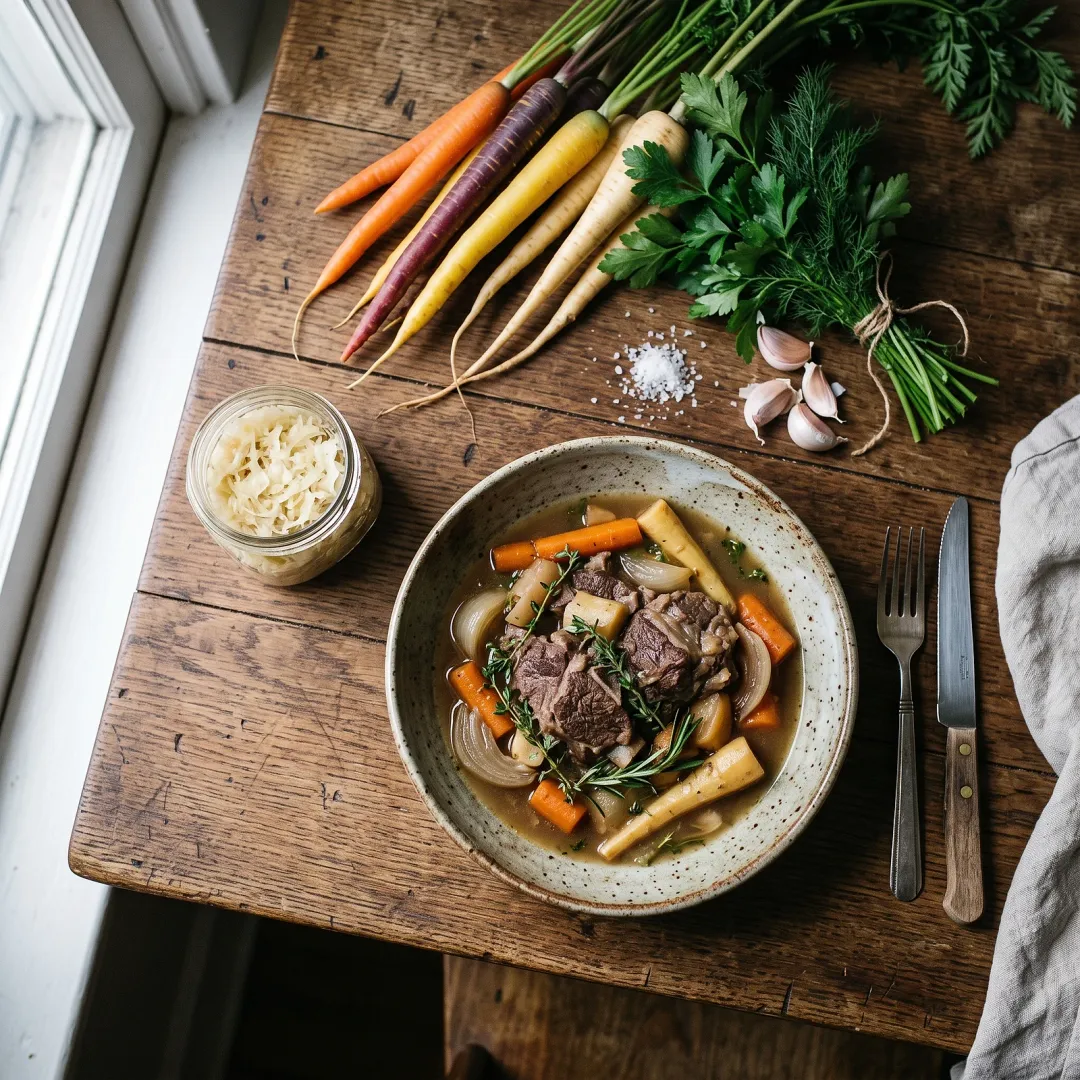
Mineral-rich proteins matter more than people think. I had a client who'd cut red meat entirely because she thought it was inflammatory. Her iron, zinc, and B12 were low, her gut motility was slow, and her anxiety was significant. We brought in slow-cooked lamb, which she found easier to digest than beef, and it made a noticeable difference. Lamb is rich in zinc, which plays a direct role in GABAergic signaling, the very system that helps the brain regulate anxiety. It's also a great source of B12 and iron, both of which affect neurotransmitter production. A braised lamb shoulder with root vegetables, cooked low and slow, is not a complicated intervention. It's nourishment.
Back off the ultra-processed foods, not because they're 'bad' in some moral sense, but because they actively disrupt the gut lining and the microbial balance your nervous system depends on. A 2021 study in Molecular Psychiatry found significant associations between ultra-processed food intake and symptoms of anxiety and depression. The mechanism runs through the gut.
Fermented foods, consistently and without drama. A little sauerkraut, some coconut milk kefir, a spoonful of kimchi with dinner. Not a 90-day protocol. Just regular, modest inclusion in a diverse diet.
Polyphenols. Berries, olive oil, dark leafy greens, herbs and spices. These feed beneficial bacteria and help dampen the inflammatory signaling that feeds anxious mood.
The Habits Nobody Wants to Talk About
Food gets most of the conversation, but the gut-brain axis is also profoundly sensitive to lifestyle inputs. I'd be remiss not to name these.
Chronic stress is a gut disruptor, full stop. When your body is in sympathetic overdrive, digestion slows, the gut lining becomes more permeable, and the microbial balance shifts. You cannot supplement your way out of a stress-saturated life. You have to address the nervous system regulation piece.
Sleep debt is inflammatory. Poor sleep increases systemic inflammation, which increases gut permeability, which degrades the quality of the gut-brain signal, which makes anxiety worse. You can see how this becomes a loop you can't easily step out of from any single entry point.
Movement. Regular, non-punishing movement supports vagal tone, and a well-toned vagus nerve is more resilient to anxiety signals. This doesn't mean running yourself into the ground. A walk, some functional strength work, dancing in your kitchen. Whatever moves your body without adding more cortisol to the pile.
Sunlight and circadian rhythm. Morning light exposure helps regulate cortisol, which affects gut motility, which affects the whole downstream chain. This is free, and most people skip it entirely.
The Mindset Piece I'd Want You to Hold
I believe the body is designed with intelligence, and anxiety, at its root, is a signal worth listening to. Not a flaw. Not a character weakness. Not proof that your brain is broken.
When I work with someone dealing with anxiety, I try to help them get curious about the signal instead of just trying to silence it. What is the gut telling the brain? What inputs are feeding the nervous system right now? Where is the body asking for something it isn't getting?
That's a very different posture than 'my brain is misfiring and I need to fix it.' One posture creates agency. The other creates helplessness.
You were made with a body that's trying to communicate with you. Learning the language of that communication, through the lab values, the symptoms, the digestion patterns, the energy swings, is one of the most powerful things you can do for yourself. And it doesn't require a perfect diet or a complicated protocol. It requires paying attention and starting somewhere real.
This article is for general informational purposes only and is not medical advice. Always consult a qualified healthcare professional before making changes to your diet or health routine.
Key Takeaways
- The gut sends signals to the brain through the vagus nerve far more than the brain sends signals to the gut, making gut health central to anxious mood patterns.
- An estimated 90-95% of the body's serotonin is produced in the gut, not the brain.
- Key body signals linked to gut-driven anxiety include digestive swings, afternoon energy crashes, skin flares, cycle disruption, and low-grade hypervigilance.
- Labs to explore through a functional lens include hs-CRP, a full thyroid panel, vitamin D, and potentially organic acids or stool testing.
- Diverse real food, mineral-rich proteins like lamb, fermented foods, and polyphenols support a healthier gut-brain signal.
- Chronic stress, sleep debt, and lack of movement actively degrade gut-brain axis function and compound anxiety.
- Anxiety is a signal worth reading, not just a malfunction to suppress.
Frequently Asked Questions
Can gut problems actually cause anxiety?
Yes, and the research supports it. The gut and brain communicate constantly through the vagus nerve and the gut-brain axis, and the gut produces the majority of the body's serotonin. When the gut is inflamed, imbalanced, or not absorbing nutrients properly, the signal it sends to the brain can contribute to anxious mood patterns. This doesn't mean every case of anxiety is gut-driven, but it's a root-cause area that's consistently underexplored in conventional care.
What is the gut-brain axis, in plain terms?
It's the two-way communication network between your gut and your brain, running primarily through the vagus nerve. The gut sends signals to the brain more than the brain sends signals to the gut. Those signals are influenced by your gut bacteria, your gut lining, inflammation levels, and what you've been eating. Think of your gut as continuously narrating your internal state to your brain.
What labs should I ask for if I think my anxiety has a gut-related root cause?
From a functional medicine lens, markers worth discussing with your provider include high-sensitivity CRP (a measure of systemic inflammation), a full thyroid panel (not just TSH), vitamin D levels, and potentially a comprehensive stool test or organic acids panel to assess microbiome health and nutrient absorption. These aren't diagnostic tools for anxiety specifically, but they can reveal patterns that inform a root-cause approach. Always work with a qualified healthcare provider to interpret results.
What foods help support the gut-brain axis?
Diversity is the foundation. A wide range of vegetables, quality proteins, whole food fats, and polyphenol-rich foods (berries, olive oil, herbs) all support a healthy and diverse gut microbiome. Fermented foods like sauerkraut and coconut milk kefir can help consistently. Mineral-rich proteins like slow-cooked lamb provide zinc and B12, both of which play roles in neurotransmitter production. Reducing ultra-processed foods matters too, as research links them to gut disruption and increased anxiety and depression symptoms.
Sources
- NIH / PubMed Central: The Gut-Brain Axis: How the Microbiome Influences Anxiety and Depression
- NIH / PubMed Central: Serotonin, Tryptophan Metabolism and the Brain-Gut-Microbiome Axis
- NIH / PubMed Central: The Estrobolome: The Gut Microbiome's Role in Estrogen Metabolism
- Molecular Psychiatry / Nature: Ultra-processed food intake and risk of anxiety and depression: a systematic review and meta-analysis
This article is for general informational purposes only and is not medical advice. Always consult a qualified healthcare professional before making changes to your diet or health routine.




Join the conversation
What do you think?
Free members can comment, reply and like. It takes ten seconds.