
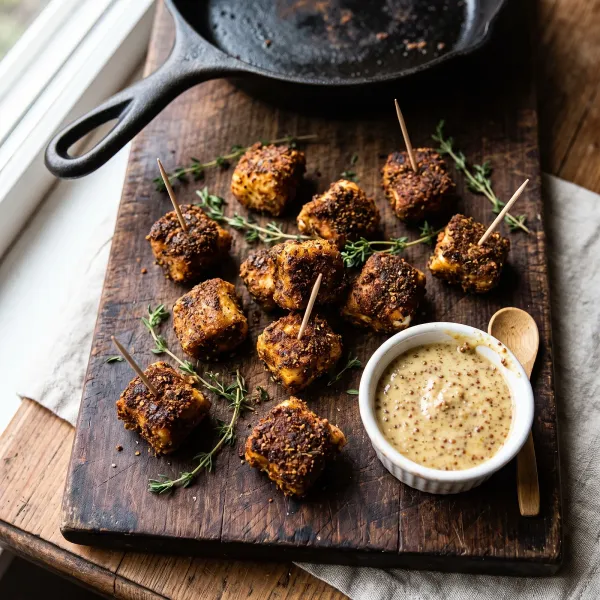
Goat gets overlooked in American kitchens, and honestly, that bothers me. It is one of the most widely eaten meats on the planet, it is leaner than beef, it has a mineral-rich depth of flavor that holds up beautifully to bold spice, and it takes to a cast iron sear like it was born for it. Add a full Cajun rub and a tangy Creole mustard dipping sauce, and you have a snack plate that will absolutely stop conversation at a table. I started cooking goat after my functional medicine deep-dive into nutrient density. When you start reading about the real difference between conventional feedlot protein and pastured, heritage meat, you start looking at what the rest of the world has known forever. Goat is not a weird choice. It is actually the default for most of humanity. We are the outliers for ignoring it. This recipe is built around a cast iron sear, a spice blend that means business, and a dipping sauce you are going to want on everything. These bites take about 35 minutes start to finish, they are completely grain-free and dairy-free, and they are the kind of snack that makes people ask what they just ate in the best possible way.
Nutritional Benefits
Goat Meat: The Nutrient-Dense Protein You Are Probably Skipping
- Goat is one of the leanest red meats available, with less total fat than beef, pork, or even chicken thighs, while still delivering around 25 to 28 grams of protein per 3-ounce serving.
- It is a rich source of iron, zinc, and vitamin B12, all critical for energy production, immune function, and neurological health.
- Pasture-raised goat contains conjugated linoleic acid (CLA) and a favorable omega-3 to omega-6 ratio, unlike grain-fed conventional meats.
- Because goat is almost always pasture-raised by default (it is difficult to factory-farm effectively), you are more likely to get a genuinely clean, well-raised animal compared to conventional beef or pork.
Cajun Spice Blend: More Than Just Heat
- Smoked paprika provides capsaicin compounds linked to anti-inflammatory activity and metabolic support.
- Thyme and oregano are both rich in volatile oils like thymol and carvacrol, which have well-documented antimicrobial properties.
- Garlic powder retains many of the same sulfur compounds as fresh garlic, including allicin precursors that support cardiovascular and immune health.
- Cayenne pepper stimulates circulation and has been studied for its role in supporting a healthy metabolism and reducing inflammation.
Avocado Oil: The Right Fat for High-Heat Cooking
- Avocado oil has a smoke point above 500°F, making it one of the only oils that stays stable under the high heat needed for a proper cast iron sear.
- It is high in monounsaturated fat (oleic acid), the same fat that makes olive oil heart-supportive, without the instability at high temperatures.
- It contains fat-soluble vitamins E and K, and supports the absorption of fat-soluble nutrients from the spices and the meat itself.
Raw Honey in the Dipping Sauce: A Little Goes a Long Way
- Raw honey (unlike processed honey) retains trace enzymes, antioxidants, and antimicrobial compounds that are destroyed by heating.
- Used in a small amount here as a flavor balancer, not a sweetener, it adds depth without spiking your blood sugar the way refined sugar would.
- Combined with apple cider vinegar, it supports a balanced gut environment and adds a probiotic-adjacent tang to the dipping sauce.
FAQs
Where do I find goat meat?
Check your local halal butcher first. That is genuinely the best and most reliable source for fresh, high-quality goat. Middle Eastern, Caribbean, and Latin grocery stores also carry it regularly. If you are in a rural area, look for local farms that raise Boer or Kiko goats and sell direct. Online sources like Mosaic Foods or local farm co-ops are another option. Do not give up if the first grocery store you check does not carry it.
What cut of goat works best for this recipe?
Boneless leg or shoulder is ideal for searing. The leg is leaner and gets that crispy exterior fast without much fuss. Shoulder has a little more fat and connective tissue, which adds flavor but benefits from not being overcooked. Both work well. Avoid goat ribs or chops for this particular preparation since the bite-sized chunk format is what makes these work as a snack.
Is goat meat safe to eat at medium doneness?
The USDA recommends cooking whole muscle goat to an internal temperature of 145°F with a 3-minute rest, same as beef and pork. For these seared bites cut from the shoulder or leg, you want at least 145°F to be safe and keep the texture right. Because goat is so lean, pushing past 160°F will dry it out fast, so use a meat thermometer and pull it right on time.
Can I make these ahead of time?
You can marinate the goat in the spice rub up to 24 hours in advance in the fridge, tightly covered. The dipping sauce keeps for up to a week refrigerated. Searing is best done fresh right before serving so you keep that crust. If you need to reheat, do it in a hot skillet for a minute or two rather than a microwave, which will steam the crust off.
Is this Whole30 compliant?
Almost, but not quite as written because of the raw honey in the dipping sauce. Whole30 does not allow honey. To make it fully Whole30-compliant, skip the honey in the sauce and add a small squeeze of fresh orange juice plus a pinch of extra salt for balance. The goat bites themselves are completely Whole30 compliant.
How spicy is this?
With 3/4 teaspoon of cayenne across 1.5 pounds of meat, it is a medium heat with a real presence. Not scream-into-a-pillow hot, but you will feel it. If you are sensitive to heat or making this for kids, pull the cayenne back to 1/4 teaspoon. If you want more fire, add a pinch to the dipping sauce too.
If you made these, I genuinely want to know what happened at your table when you said 'it is goat.' Tag me so I can see it. And if you have been sleeping on goat meat, please go find a halal butcher this week and fix that. Your body will thank you and your taste buds definitely will.
Ingredients
Instructions
Nutrition Facts
| Nutrient | Amount per Serving |
|---|