


On this page
Your DNA is not a verdict. That is genuinely good news, and it is also one of the most misunderstood and most commercially exploited ideas in modern nutrition. The word 'epigenetics' gets plastered on supplement bottles and used to sell $400 meal plans, and most of the time it's noise. But the actual science underneath it is real, fascinating, and directly relevant to why real food matters in a way that goes deeper than calories or macros.
What Epigenetics Actually Is (No PhD Required)
Your genome is the complete instruction manual your body was born with. Every cell carries the same DNA. But not every gene is active in every cell, or at every moment in your life. That's where epigenetics comes in.
Epigenetics is the study of changes in gene expression that do not involve changes to the underlying DNA sequence itself. Think of your genome as the hardware. Epigenetics is more like the software running on top of it, deciding which programs open, which stay closed, and how loud they run.
The two most studied mechanisms are DNA methylation (where methyl groups attach to DNA and generally quiet a gene down) and histone modification (where proteins that DNA wraps around get chemically tagged, affecting how tightly or loosely the DNA is packaged, which influences whether genes are readable). A 2019 review in Nature Reviews Genetics lays out the core mechanisms clearly: these are not permanent mutations, but they are real, measurable changes in how your genetic code is read.
The critical point for our purposes: some of these epigenetic marks are influenced by the environment, and diet is one of the most studied environmental inputs. What you eat provides the raw chemical materials that your epigenetic machinery uses to do its job.
Why Food Is Deeply Involved in This Process
This is where it gets practical. Certain nutrients are directly required for DNA methylation to happen at all. The methyl groups that get attached to DNA have to come from somewhere, and they come from your food.
Folate, B12, choline, and methionine are the key players in what researchers call the one-carbon metabolism pathway. This is essentially the methylation assembly line. Without adequate dietary methyl donors, the process can stall or go sideways. A 2012 paper in the Journal of Nutritional Biochemistry detailed how dietary methyl donor availability directly affects epigenetic patterns in animal models, and research in humans has continued to build that picture.
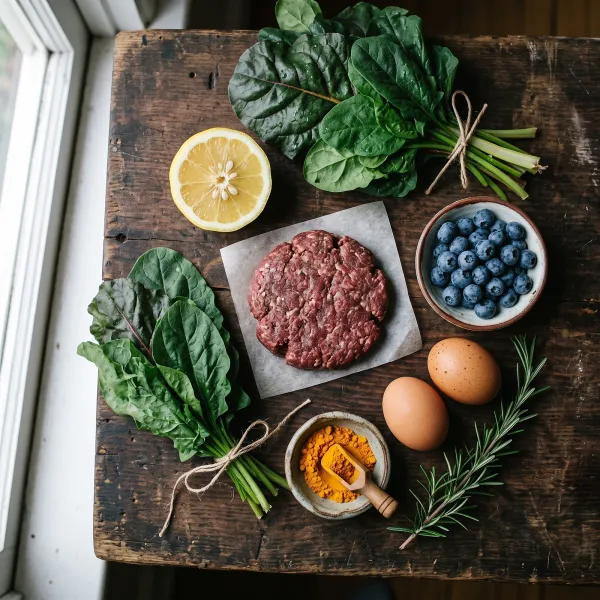
Where do you find those nutrients in real food? Liver is the gold standard for folate and B12 (which is exactly why I keep talking about it). Egg yolks are a powerhouse source of choline. Bison and other quality red meats deliver methionine and B12 in highly bioavailable form. Dark leafy greens contribute folate. This is not coincidental. These are the same whole, dense, nutrient-rich foods that traditional eating patterns centered on for thousands of years.
Beyond methylation, polyphenols, the compounds that give colorful plants their pigment and their bite, have been shown to influence histone modification and other epigenetic mechanisms. Quercetin in onions, resveratrol in grapes, curcumin in turmeric: a 2021 review in Nutrients summarized evidence that dietary polyphenols can modulate epigenetic marks linked to inflammatory gene expression. The research is early in humans, and effect sizes matter, but the mechanism is biologically plausible and actively studied.
And then there is the omega-3 to omega-6 ratio. The modern industrial diet runs a ratio of somewhere between 15:1 and 20:1 in favor of omega-6 fatty acids. Traditional diets ran closer to 4:1 or less. That ratio affects the fatty acid composition of cell membranes, which in turn affects how receptors and signaling molecules interact with DNA. A 2016 review in Prostaglandins, Leukotrienes and Essential Fatty Acids explored how omega-3 fatty acids may influence gene expression through epigenetic pathways. Eating real food, particularly grass-fed and wild-raised animals, shifts that ratio in a meaningful way.
What You Cannot Control (And Why That Honesty Matters)
Here is where I have to be the person who tells you the part the wellness industry skips.
You cannot eat your way out of your genetic sequence. If a gene variant exists in your DNA, it exists. Food cannot rewrite the code itself. Epigenetics affects expression, not the underlying blueprint. If you carry a BRCA variant, eating more bison and blueberries is not going to delete it. Full stop.
You also cannot fully control the epigenetic marks you inherited. This is a field called transgenerational epigenetics, and it is both fascinating and humbling. Some epigenetic patterns from a parent's or even grandparent's environment can be passed down. The Dutch Hunger Winter cohort studies are the landmark example: children conceived during the 1944 famine showed measurable epigenetic differences from siblings conceived before or after, and some of those patterns appeared in grandchildren. A landmark analysis published in PNAS documented this. You did not choose what your ancestors experienced, and their biology shaped part of yours.
You cannot control the timing of developmental windows. Epigenetic programming is most plastic, meaning most responsive to environmental influence, during fetal development and early childhood. The diet choices an adult makes today have real effects, but they are not the same magnitude as what happens in utero or in the first years of life. That is not a reason to give up. It is a reason to be honest about scale.
And you cannot override a genuinely broken gene with food. Phenylketonuria (PKU) requires strict medical dietary management, not real-food coaching. Certain inborn metabolic errors require clinical intervention. There is a meaningful difference between supporting gene expression through nutrition and pretending food is medicine for every genetic condition. It is not, and anyone who tells you otherwise is selling you something.
The Real-Food Lens: Why This Science Confirms What We Already Believed
None of this is a reason to feel helpless. Quite the opposite. What the epigenetics research keeps circling back to is that the inputs we give our bodies on a daily basis genuinely matter at a cellular level, not just at a weight-on-the-scale or energy-in-the-afternoon level.
I came to real food the same way a lot of people do: something was wrong, conventional answers were not cutting it, and eventually I found a framework that made sense of the whole picture. The functional medicine lens starts with food as the most consistent, daily, repeated signal you send to your biology. You eat three times a day. You don't get a genetic test three times a day. That repetition is exactly what epigenetic research suggests matters: consistency of the dietary signal over time.
A bison burger on a bed of sauteed greens is not just protein and iron. It is a package of B12, zinc, methionine, and heme iron that your methylation cycle needs to function. The greens are not just fiber. They are folate donors and polyphenol sources that may interact with gene regulatory systems. That does not make dinner a pharmacy, but it does mean that the traditional paleo argument, that whole ancestral foods provide the full complement of what the body was designed to use, has some serious molecular support.
The body was designed with a plan behind it. I believe that, deeply. And this science is one of the places where that conviction stops being abstract and starts showing up in the data.
Who Should Be Thoughtful About the Hype
Epigenetics is one of the most hyped words in commercial wellness right now. Here is who specifically needs to keep their guard up.
People being sold 'epigenetic' supplements. The word on a label means almost nothing without knowing what nutrient, at what dose, studied in what population, showing what outcome. Methylated B vitamins are a legitimate consideration for people with MTHFR variants who may not convert standard folate efficiently. A random 'epigenetic support' blend with 12 botanicals and no clinical data is marketing.
People doing at-home DNA tests expecting dietary prescriptions. Direct-to-consumer genetic testing can be interesting, but the leap from 'you have this SNP' to 'therefore you must eat exactly this' is often not well-supported by the research. A 2019 editorial in JAMA Internal Medicine raised important cautions about the overinterpretation of consumer genetic data for dietary guidance.
Anyone pregnant or hoping to become pregnant. This is genuinely the window where dietary inputs for methylation, choline in particular, matter most. Adequate folate and choline during early pregnancy are among the better-supported nutritional interventions in the epigenetics space. This is a conversation to have with your care provider, not something to optimize with a wellness blog alone.
People using epigenetics to justify doing nothing. 'My genes are bad so food won't help anyway' is as much a misreading of the science as 'food will fix my genes.' The research suggests meaningful influence, not futility and not omnipotence. Sit with that nuance.
How to Actually Use This in Your Kitchen
The practical takeaway is not complicated, and it does not require a genetic test.
Prioritize methyl-donor-rich foods consistently. Ground bison cooked with onions and served over spinach hits B12, methionine, folate, and quercetin in one bowl. Egg yolks at breakfast are one of the best choline sources on the planet. Liver, even once a week, covers B12 and folate in a way that almost nothing else can.
Eat color, genuinely and widely. The polyphenol data is preliminary in humans, but the risk of eating more colorful vegetables is approximately zero and the potential upside includes epigenetic influence on inflammatory signaling. Beets, purple cabbage, blueberries, dark leafy greens: these are not garnishes.
Reduce the processed food load. Ultra-processed foods are not just empty calories. They tend to be low in the very methyl-donor nutrients the body needs for proper epigenetic maintenance, while simultaneously delivering refined carbohydrates and seed oils that research increasingly links to unfavorable shifts in inflammatory gene expression.
Do not chase perfection in one meal. The epigenetic effect of diet is cumulative and chronic. It is the pattern over months and years, not the kale in Tuesday's salad, that builds or disrupts the nutritional environment your genes are swimming in every day.
This article is for general informational purposes only and is not medical advice. Always consult a qualified healthcare professional before making changes to your diet or health routine.
Key Takeaways
- Epigenetics is the study of how gene expression is regulated without changing the DNA sequence itself. Food is one of the most significant environmental inputs into that system.
- Nutrients like folate, B12, choline, and methionine are direct raw materials for DNA methylation. Real, whole foods such as bison, egg yolks, liver, and dark greens are the best dietary sources.
- What you cannot control: your inherited DNA sequence, epigenetic marks passed down from ancestors, or critical developmental windows that happened before you were making food choices.
- The wellness industry has heavily hyped 'epigenetic' supplements and genetic-diet testing. Much of it outpaces the actual science. Be skeptical of anything that promises to 'reprogram your genes.'
- The practical message is not magical: eat nutrient-dense whole foods consistently, reduce processed food, eat color widely, and let the cumulative pattern do the work over time.
Frequently Asked Questions
Can what you eat actually change your genes?
Food cannot change your underlying DNA sequence. What it can influence is gene expression, meaning which genes are active and how loudly they signal, through a process called epigenetics. Specific nutrients like folate, B12, choline, and methionine are required for DNA methylation, one of the key mechanisms that regulates gene expression. So diet genuinely matters at a molecular level, but it is not rewriting your genetic code.
What foods support healthy DNA methylation?
The best dietary sources of methyl-donor nutrients are liver (folate and B12), egg yolks (choline), quality red meats like bison (B12 and methionine), and dark leafy greens (folate). These are also among the foods most consistently emphasized in traditional and ancestral eating patterns, which is not a coincidence. Colorful vegetables and fruits also contribute polyphenols that may interact with epigenetic regulatory systems, though the human research there is still developing.
What is the MTHFR gene and does it affect how I should eat?
MTHFR is a gene that encodes an enzyme involved in processing folate for use in methylation. Certain common variants of this gene can reduce that enzyme's efficiency. People with these variants may benefit from getting folate in its pre-converted (methylated) form, either through diet or a methylated supplement, rather than relying on synthetic folic acid. This is worth discussing with a functional medicine practitioner who can look at your full picture, not just a raw genetic report.
Are direct-to-consumer DNA tests worth using for dietary guidance?
They can be interesting as a starting point, but the science connecting most genetic variants to specific dietary recommendations is less settled than the marketing suggests. A 2019 editorial in JAMA Internal Medicine raised concerns about overinterpretation of consumer genetic data for health and dietary decisions. The results can generate useful questions to explore with a qualified practitioner, but they should not be treated as precise dietary prescriptions on their own.
Sources
- Nature Reviews Genetics: The epigenome and the environment
- Journal of Nutritional Biochemistry: Dietary methyl donors and epigenetic programming
- Nutrients: Dietary Polyphenols and Epigenetic Modulation
- Prostaglandins, Leukotrienes and Essential Fatty Acids: Omega-3 fatty acids and gene expression via epigenetic pathways
- Proceedings of the National Academy of Sciences (PNAS): Transgenerational epigenetic effects: the Dutch Hunger Winter cohort
- JAMA Internal Medicine: Direct-to-Consumer Genetic Testing and Dietary Guidance: Cautions on Overinterpretation
This article is for general informational purposes only and is not medical advice. Always consult a qualified healthcare professional before making changes to your diet or health routine.