

On this page
Your pots and pans are not neutral. That scratched nonstick skillet sitting on your stove right now? It is doing something every time you cook in it. Most people know, somewhere in the back of their minds, that they should upgrade their cookware. But then they look at the price tags, get overwhelmed, and do nothing. The trick is not to replace everything at once. You replace things in order, starting with the one that is hurting you the most, and you build from there. That is it. That is the whole plan.
Why Cookware Actually Matters (And Why This Is Not Fearmongering)
Before we get into the sequence, let me give you the short, honest version of why this is worth your time and money.
Conventional nonstick cookware is coated with PTFE (polytetrafluoroethylene), the stuff that makes the surface slippery. When that coating is scratched, chipped, or overheated above roughly 500 degrees Fahrenheit, it can begin to break down and release particles and fumes. The EPA has flagged PFAS compounds, a broader family that includes the chemicals historically used to make PTFE-based coatings, as chemicals of concern, and research published in journals like Environmental Science and Technology has associated PFAS exposure with various health concerns including effects on the immune and endocrine systems. The science is still developing, and this is not a reason to panic. It is a reason to be thoughtful.
The good news: you do not have to throw everything out at once. You prioritize, you replace strategically, and your kitchen gets safer one pan at a time.
This article is for general informational purposes only and is not medical advice. Always consult a qualified healthcare professional before making changes to your diet or health routine.
Step 1: Audit What You Actually Have Before You Buy Anything
Do not spend a single dollar yet. Pull every pan out of your cabinet and look at it. Really look.
You are checking for three things:
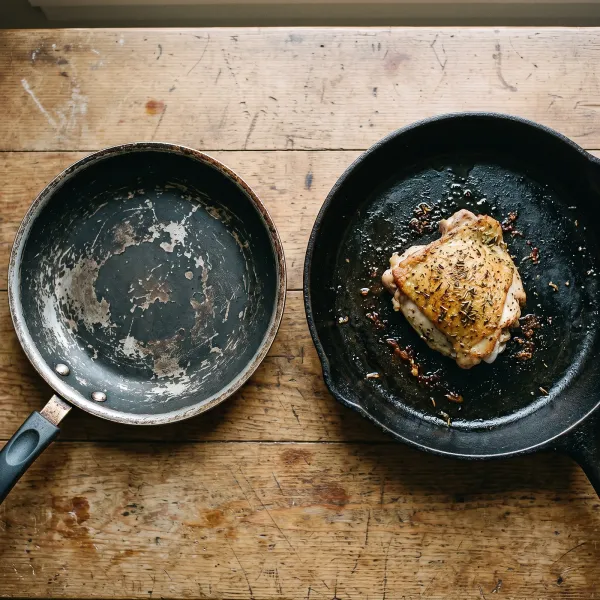
- Scratches, chips, or peeling on the cooking surface. Any nonstick pan with visible damage to its coating goes in the replace pile immediately. A scratched nonstick surface is not a minor cosmetic issue. Those particles go somewhere, and that somewhere is your food.
- The age of your nonstick pans. Even undamaged nonstick has a lifespan. Most manufacturers suggest replacing them every two to five years. Consumer Reports notes that coating integrity declines with repeated use and high-heat cooking. If you cannot remember when you bought it, assume it is time.
- What you actually use. The pan you reach for every single day is the one that matters most. A rarely-used specialty pan is a low priority. Your daily skillet is a high one.
Do the audit first. The order of replacement follows from what you find.
Step 2: Replace Your Daily Skillet First (This Is the One That Matters Most)
The skillet you use every morning for eggs, every evening for chicken thighs, every time something needs to be seared or sauteed, that is the highest-exposure pan in your kitchen. It gets the most heat, the most use, and the most contact with your food.
This is the pan to replace first. Full stop.
What to replace it with depends on your cooking style:
Cast iron is the real-food kitchen workhorse. It is nearly indestructible, gets better with age and use, and costs far less than most people expect. A well-seasoned cast iron skillet creates a naturally non-stick surface without any synthetic coating. Lodge makes a solid 10-inch skillet that costs around $30. It will outlast you. The slight learning curve is that it requires proper seasoning and drying, but that is genuinely not hard once you do it twice.
Carbon steel is cast iron's lighter, more agile cousin. It heats faster, responds to temperature changes more quickly, and is easier to maneuver. Professional kitchens use it heavily. If cast iron feels intimidating or heavy, carbon steel is worth a look.
Stainless steel is another solid option. No coating, no concerns about degradation, and extremely durable. The trick is learning to cook with it properly (preheat the pan, add fat, let the food release naturally) and it performs beautifully. Great for chicken, vegetables, and anything you want a real sear on.
Get your daily skillet sorted first. This single swap makes the biggest practical difference in your kitchen.
Step 3: Replace Any Damaged or Chipped Enamel Cookware Next
If you have enameled cast iron, Dutch ovens, or any pot with a vitreous enamel coating, check the inside surface carefully. Chips or cracks in enamel can expose the underlying cast iron to food and acidic liquids, and a damaged enamel surface is no longer doing its job.
Enameled cookware that is in good condition is generally considered a safe choice for most cooking. Brands like Le Creuset and Lodge both make quality enameled Dutch ovens, and when cared for properly they last for decades. But chipped enamel is a different story. If the interior of your Dutch oven looks like a parking lot in February, it is time.
This sits at Step 3 rather than Step 2 for a practical reason: enameled cookware tends to be used less frequently than a daily skillet, and replacing a Dutch oven is a bigger financial commitment. Prioritize the damaged ones. Perfectly intact enameled pieces can stay in rotation.
Step 4: Tackle Your Sauce Pans and Stock Pots
Most people's sauce pans and stock pots are either stainless steel (great, keep them) or older nonstick (check them like you checked the skillet in Step 2).
Stainless steel sauce pans are workhorses. If yours are stainless and in good shape, they do not need replacing. Wash them, use them, move on.
Old nonstick sauce pans get less scrutiny than skillets because the high-heat searing that degrades coatings fastest is less common in sauce pans. But if yours are scratched, chipped, or simply ancient, they go on the list.
For a stock pot, stainless is almost always the right answer. A big stainless pot for bone broth, soups, and batch cooking is a one-time purchase that lasts forever. If you are still working with a beat-up nonstick stock pot, that one moves up the priority list because large-volume simmering means more food is in contact with more surface area for longer.
Stock pots and sauce pans are usually the most affordable pieces to replace, which makes this step easier on your budget once you have handled Steps 2 and 3.
Step 5: Look at Your Baking Sheets and Baking Pans Last
Baking sheets are the most overlooked piece of cookware in the entire toxic-pan conversation, and they probably should not be. A lot of baking sheets are coated with nonstick, and a lot of those coatings are in rough shape from repeated high-heat oven use.
The reason these come last in the sequence is not because they are unimportant. It is because food contact time is often shorter, the heat is more even and controlled than stovetop cooking, and the replacement options are slightly more variable.
For baking sheets, uncoated aluminum or stainless steel are the practical go-tos. Uncoated aluminum is what professional bakeries use. It is inexpensive, conducts heat evenly, and has no coating to degrade. You can line it with parchment paper if you want easy cleanup.
For baking dishes (the ones you use for roasting chicken thighs or making casseroles), glass or ceramic are excellent, food-safe options. Pyrex glass baking dishes and ceramic bakeware have been kitchen staples for generations for a reason.
The American Cancer Society notes that while the risk from normal use of PTFE-coated bakeware is considered low, avoiding scratched or degraded nonstick surfaces is a reasonable precaution. Swap damaged baking pans when you can, but this is the lower-urgency end of your list.
A Word on Budget: You Do Not Have to Do This All at Once
The sequence matters precisely because most of us cannot walk into a kitchen store and replace everything in one afternoon. That is fine. That is the whole point of doing it in order.
Replace the daily skillet first. That single swap handles the highest-exposure piece and costs you $25 to $50 for a solid cast iron pan. Live with it for a month or two. Get comfortable with it. Then replace the next piece.
If you are on a genuinely tight budget, look for Lodge cast iron at a hardware store, stainless steel sauce pans at a restaurant supply store (often significantly cheaper than kitchen boutiques), and basic glass baking dishes at a discount home goods store. You do not need designer brands to cook clean.
And if you are gifting or registering for anything, this is the list to pull from. Cookware is one of those purchases where buying well once is almost always cheaper over a lifetime than buying cheap repeatedly.
God designed us to be good stewards of what we have been given, and that includes the tools we use to prepare the food we feed our families. This is not about perfection. It is about intentionality, one pan at a time.
Key Takeaways
- Audit every pan before you buy anything: look for scratches, chips, peeling, and age.
- Replace your most-used daily skillet first; cast iron, carbon steel, or stainless steel are the best swaps.
- Replace any chipped or visibly damaged enamel cookware next, especially Dutch ovens used for long simmering.
- Check sauce pans and stock pots; stainless steel versions need no replacing, damaged nonstick ones do.
- Baking sheets and baking pans are last on the list; swap to uncoated aluminum, stainless, glass, or ceramic.
- You do not need to do this all at once. The sequence is designed for a real budget and a real life.
Frequently Asked Questions
Which pan should I replace first to reduce toxin exposure?
Start with the pan you use most often, which for most people is the everyday skillet. If it has any scratches, chips, or peeling on a nonstick coating, it is the highest-priority replacement in your kitchen. Cast iron, carbon steel, or stainless steel are the most practical safer alternatives.
Is scratched nonstick cookware actually dangerous?
The research is still developing, but scratched or degraded PTFE-based nonstick coatings can release particles and, at high heat, fumes that have raised concern among researchers. The American Cancer Society and EPA both flag PFAS-related compounds as chemicals of concern. While the risk from occasional use of slightly scratched nonstick is considered low by some agencies, replacing visibly damaged pans is a reasonable, practical precaution.
What is the safest cookware to replace nonstick with?
Cast iron, carbon steel, and stainless steel are the three most widely used and well-regarded alternatives. All three have no synthetic coating to degrade. For baking, uncoated aluminum, stainless steel, glass, and ceramic are solid options. The best choice depends on your cooking style and budget.
Do I have to replace all my pans at once?
No, and trying to do it all at once is actually what stops most people from doing anything. Replace in order: daily skillet first, damaged enamel second, sauce pans and stock pots third, and baking sheets last. A cast iron skillet costs around $25 to $50 and is a great first swap that makes an immediate difference.
Sources
- Environmental Science and Technology (ACS Publications): Environmental Science and Technology Journal
- Consumer Reports: How Long Should Nonstick Pans Last?
- American Cancer Society: Teflon and Perfluorooctanoic Acid (PFOA)
This article is for general informational purposes only and is not medical advice. Always consult a qualified healthcare professional before making changes to your diet or health routine.