


Most people who want to change their health do the same thing: they wait until they feel ready. They wait for a Monday, a new month, a diagnosis, a scary number on the scale, or some internal fire to ignite. And when that fire eventually flickers out, as it always does, they decide the problem is them. They say they just don't have enough discipline. That's not what's happening. The strategy is broken, not the person.
The Mistake: Building Your Habit on Motivation
The single most common habit-building mistake I see is this: treating motivation as the foundation instead of treating it like the weather.
Motivation is real. It's useful. It shows up, it feels powerful, and it makes you reorganize your pantry at 10 p.m. on a Sunday. But it is not reliable, and it was never designed to be your engine. Neuroscience has been clear on this for years. Research on habit formation shows that the brain's basal ganglia, the region responsible for automatic behavior, encodes habits through repetition and reward, not through intention or excitement. A 2012 paper in the Annual Review of Psychology on habit and self-control found that well-formed habits operate largely outside of conscious deliberate motivation. Meaning: once a behavior is truly habitual, you don't need to want to do it. You just do it, the way you buckle your seatbelt without thinking.
The mistake, then, is spending all your energy trying to stay motivated rather than spending it building the conditions that make the behavior automatic. Those are two completely different jobs.
Why This Trap Is So Easy to Fall Into
Nobody accidentally stumbles into this mistake. We are literally marketed into it.
Every January campaign, every wellness influencer, every before-and-after story is built on the same emotional arc: someone got fed up, got inspired, changed everything, and now they glow. The story starts with a feeling. So of course we think the feeling is the prerequisite.
Add to that the cultural story about willpower, that people who eat well and move their bodies simply want it more, and you have a recipe for shame every time motivation dips. When the fire goes out, we don't think 'my system failed me.' We think 'I failed me.' And then we wait for motivation to come back before we try again.
That cycle is exhausting. And it's based on a false premise.
What the Research Actually Says About Sticking with Something
Here's what behavioral science has found, and it's actually encouraging once you hear it.
Habits are formed by cue-routine-reward loops, a framework popularized by habit researchers and grounded in decades of behavioral psychology. The brain is essentially pattern-hungry. When a behavior is consistently triggered by the same cue and followed by some form of reward, the brain begins to automate it, reducing the cognitive load required to perform it. This is why you don't have to decide to brush your teeth every morning. The cue (waking up, entering the bathroom) has been paired with the routine so many times that it runs on its own track.
A 2010 study published in the European Journal of Social Psychology by Phillippa Lally and colleagues at University College London found that it took participants between 18 and 254 days to form a new habit, with the average landing around 66 days. That range matters. It means some behaviors lock in faster than others, and some people's nervous systems just take longer. Neither is a character flaw.
What the study also found is that missing one day did not significantly derail habit formation. That detail gets buried every time someone recycles the '21 days to a habit' myth (which has no solid research behind it, by the way). Missing a day is not the problem. Missing the structure is.
So the fix is not more willpower. The fix is better design.
The Fix: Design the Environment Before You Try to Change the Behavior
This is the coaching shift that actually moves the needle: stop trying to change yourself and start changing your environment first.
BJ Fogg, a behavior scientist at Stanford, calls this 'designing for the behavior you want.' His research, detailed through the Fogg Behavior Model, shows that behavior happens when motivation, ability, and a prompt all converge at the same moment. Most habit plans only focus on motivation. The ones that work focus on ability (making the behavior easy) and prompts (making the cue unavoidable).
In practical terms, this looks like:
Shrinking the starting action to something almost embarrassingly small. You don't start with 'I'll prep all my meals on Sunday.' You start with 'I'll pull out the cutting board.' That's it. The board being out is the cue that cooking can happen. It sounds too simple to work, and that is exactly why it works. When the barrier is low enough, motivation doesn't have to show up at all.
Anchoring new behavior to something you already do reliably. This is called habit stacking, and it leverages the cue-routine loop that your brain already has in place. Fogg calls these 'anchor habits.' After I pour my morning coffee, I take my vitamins. After I close my laptop for lunch, I go outside for ten minutes. The existing habit becomes the cue for the new one. No alarm required, no reminder on your phone, no relying on feeling like it.
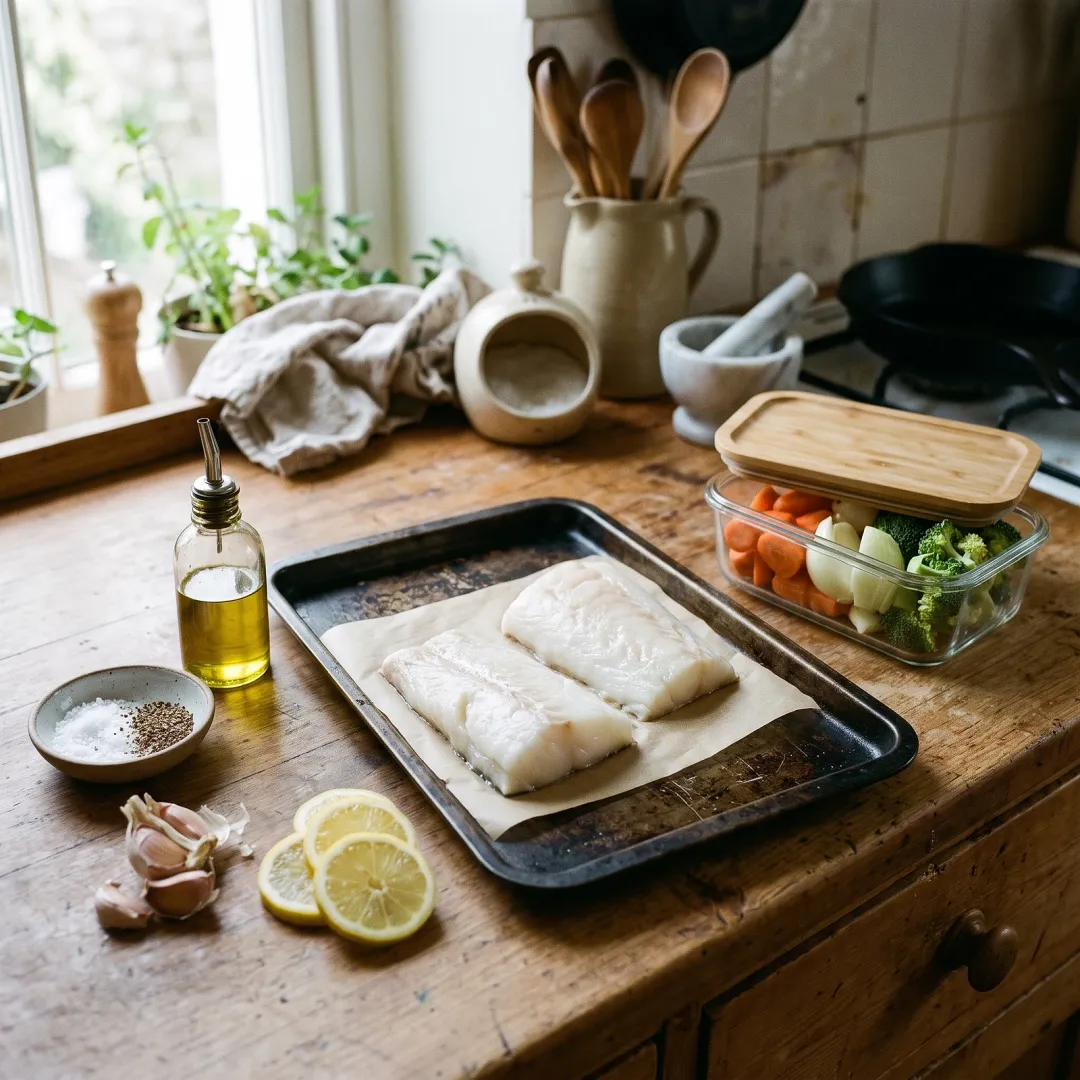
Removing friction from the behaviors you want and adding it to the ones you don't. If you want to eat more real food during the week, prep something on Sunday that makes real food the path of least resistance. I love prepping a simple white fish like cod or tilapia ahead of time, nothing fancy, just baked with olive oil and lemon, stored in the fridge, ready to go on top of greens or alongside roasted vegetables. When the fish is already cooked and the vegetables are already cut, reaching for a bag of crackers takes more thought than eating a real meal. That is design working in your favor.
Celebrating immediately, even when the win is tiny. Fogg's research consistently points to immediate positive emotion as the signal that tells the brain 'this is worth repeating.' Not a reward you get later, an actual feeling you create right now. This can be as simple as saying 'yes' out loud, doing a small fist pump, or just pausing for two seconds to notice that you followed through. It sounds silly. It is also how the brain actually works.
The Mindset Piece Nobody Talks About Enough
Here's what I want to say to anyone who has restarted the same habit seventeen times: you are not broken. You were just handed a flawed strategy and told your failure to execute it was a character issue. That is not true.
I think about this through the lens of stewardship. We are designed to care for these bodies. We are not designed to white-knuckle our way through every good choice for the rest of our lives. The goal is to build a life where the right choices are the natural ones, where real food is just what's in the kitchen, where moving feels normal, where rest is protected. That's not an Instagram vision board. That's what a well-designed environment and a consistent small practice can actually produce over time.
The functional-medicine lens I work from is always asking: what's making this hard, and can we change that variable? Willpower is not a variable you can reliably control. Your pantry is. Your morning routine is. The cut of fish you have ready in the fridge is.
One honest word on expectations: this process is slower than motivation makes it feel. The 66-day average from the Lally study is not a warning, it's permission. It's permission to still be in the building phase at week five and not interpret that as evidence you're failing. You're not failing. You're forming.
What This Looks Like in Real Life
Put it together practically. Say your goal is to eat a real, protein-centered lunch instead of grabbing whatever's fast and processed.
The motivation-first approach says: 'I need to care more, want it more, and be more disciplined.' Then lunch hits and you're hungry and rushed and discipline doesn't show up.
The design-first approach says:
- Sunday: bake a tray of white fish (cod is cheap and easy) with garlic, olive oil, salt, and lemon. It takes twenty minutes, mostly hands-off.
- Monday morning: cut up whatever vegetables are in the fridge and put them in a container at eye level.
- Lunchtime: the fish and vegetables are already there. The path of least resistance is now a real meal.
You didn't need to feel inspired at noon. You needed past-you to remove the friction.
Do that consistently, and around week eight or ten, you'll notice you're doing it without thinking about it much. That's not discipline. That's a habit. And habits outlast motivation every single time.
This article is for general informational purposes only and is not medical advice. Always consult a qualified healthcare professional before making changes to your diet or health routine.
Key Takeaways
- Motivation is unreliable as a habit foundation. The brain automates behavior through repetition and reward loops, not intention.
- Research from University College London found habits take an average of 66 days to form, and missing one day does not derail the process.
- The most effective fix is designing your environment to make the right behavior the easiest choice, not trying to want it more.
- Habit stacking (anchoring new behaviors to existing ones) uses your brain's existing cue-routine patterns to your advantage.
- Immediate positive emotion, even a small internal 'yes,' signals to the brain that a behavior is worth repeating.
- Prep-ahead real food, like a simple baked white fish, is one of the lowest-friction ways to make a real-food habit stick during the week.
Frequently Asked Questions
How long does it actually take to build a habit?
The commonly cited '21 days' figure has very little research behind it. A 2010 study from University College London found that habit formation took anywhere from 18 to 254 days depending on the person and the behavior, with the average landing around 66 days. Missing a single day did not significantly slow the process, so a slip is not a reason to restart from zero.
What is habit stacking and does it really work?
Habit stacking is the practice of anchoring a new behavior to an existing one you already do reliably, so the established habit becomes the cue for the new one. For example: 'After I pour my morning coffee, I prep my vitamins.' Because the brain's cue-routine system is already running for the first behavior, attaching a second one to it reduces the activation energy needed to start. Research on habit loops supports this as one of the more reliable ways to introduce a new routine without depending on motivation.
Why do I keep starting over with healthy habits?
The most common reason is building the habit on motivation rather than on environmental design. Motivation is a feeling, and feelings shift. When motivation fades, a habit that depended on it will collapse. The fix is to change your environment so the behavior you want is the easiest available option, reducing the need for motivation to show up at all.
What does 'designing your environment' mean for healthy eating habits?
It means arranging your physical space so the right choice has the least friction. This might look like prepping a simple protein on Sunday so lunch is already handled on Tuesday, keeping cut vegetables at eye level in the fridge, or putting the cutting board on the counter so cooking feels like less of a production. The goal is to make the real-food choice the path of least resistance, not the harder one.
Sources
- Annual Review of Psychology: Habits in Everyday Life: Thought, Emotion, and Action
- European Journal of Social Psychology: How Are Habits Formed: Modeling Habit Formation in the Real World (Lally et al., 2010)
- Fogg Behavior Model (Stanford Behavior Design Lab): Fogg Behavior Model
This article is for general informational purposes only and is not medical advice. Always consult a qualified healthcare professional before making changes to your diet or health routine.



Join the conversation
What do you think?
Free members can comment, reply and like. It takes ten seconds.