
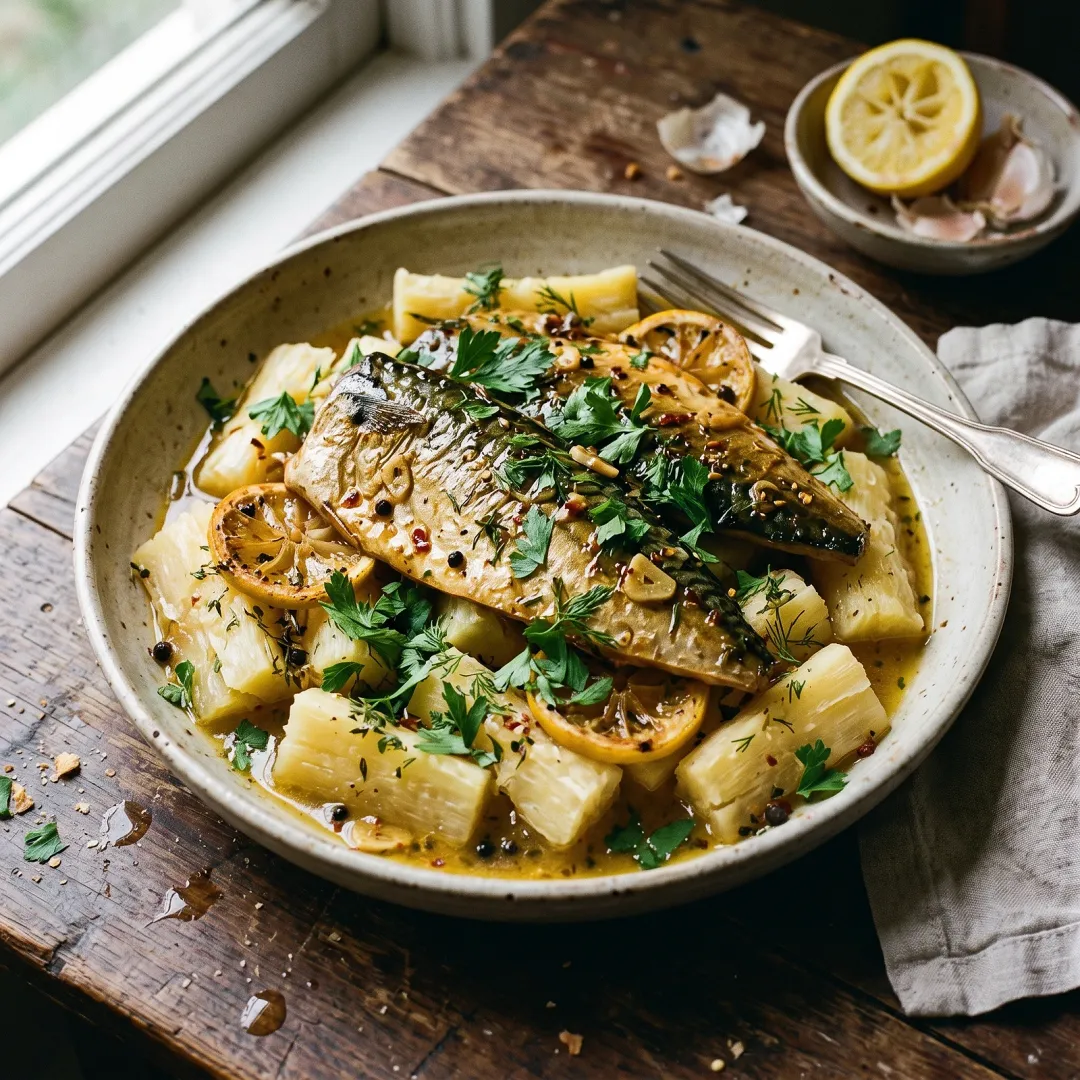

Mackerel gets overlooked, and that bothers me. It sits right there in the fish case, dark-fleshed, shining, priced honestly, and stacked with every nutrient you could want for a struggling immune system. People walk past it and grab the salmon. I get it. Mackerel has a reputation. But braise it low and slow in garlic, lemon, and an anchovy-deepened broth with a handful of wild capers, and it transforms. The aggressive edge mellows into something rich and round and deeply savory, exactly what a long braise is supposed to do. This dish leans Italian the way a nonna from the Sicilian coast would recognize: good olive oil, garlic coaxed until sweet, anchovies dissolved into the base until you can't see them but you can absolutely taste them, capers for a salty, briny punch, fresh rosemary, and flat-leaf parsley thrown on at the end. Yuca underneath, boiled until it falls apart at the edge. A platter that looks like a meal and eats like one. If you are eating AIP right now, this is the kind of dinner that proves you are not deprived. You are eating better than most people at any table.
Nutritional Benefits
Mackerel: One of the Richest Omega-3 Sources You Can Find
- Atlantic mackerel is one of the highest omega-3 fatty acid fish available, with a single fillet providing over 1,000mg of EPA and DHA. These fatty acids are well-documented for their role in reducing systemic inflammation, which is at the root of most autoimmune conditions.
- Mackerel is a top dietary source of vitamin B12, with a single serving delivering several times the daily requirement. B12 is critical for nerve function, red blood cell production, and the methylation pathways that are frequently compromised in people with autoimmune disease.
- Selenium, found in abundance in mackerel, acts as a cofactor for several antioxidant enzymes, including glutathione peroxidase. For anyone navigating thyroid autoimmunity like Hashimoto's, selenium is not optional; it is essential.
- Mackerel provides a meaningful amount of vitamin D, a nutrient with well-established immune-modulating effects. Low vitamin D levels are consistently associated with higher rates of autoimmune disease onset and flares.
Yuca: Starchy, Filling, and Genuinely AIP-Safe
- Yuca (cassava) is one of the few dense, satisfying starches that is completely compliant with the AIP elimination phase. It provides resistant starch that feeds beneficial gut bacteria, supporting the kind of microbiome diversity that matters enormously for autoimmune regulation.
- The complex carbohydrates in yuca provide sustained energy without the glucose spikes associated with refined starches or grains. For people managing autoimmune fatigue, stable blood sugar is not a small thing.
- Yuca contains vitamin C and potassium, and its mild, neutral flavor makes it an ideal base for bold, sauce-forward preparations like this braise.
Garlic and Anchovies: The Anti-Inflammatory Backbone of the Broth
- Garlic contains allicin and related sulfur compounds with documented antimicrobial and anti-inflammatory activity. Slow cooking mellows the sharp bite while preserving much of the functional benefit.
- Anchovies dissolve into the broth and bring more than umami. They contribute additional omega-3 fatty acids, iodine, and calcium in a form the body absorbs readily, all from a tiny fish with a massive nutritional footprint.
- Olive oil provides monounsaturated fats and polyphenols, particularly oleocanthal, which has been studied for its anti-inflammatory properties. Using high-quality extra-virgin olive oil both in the braise and as a finishing drizzle matters here.
Capers, Lemon, and Fresh Herbs: Small Additions, Real Benefits
- Capers are a concentrated source of quercetin, a flavonoid with antihistamine and anti-inflammatory properties that may be particularly relevant for people managing autoimmune-related histamine sensitivity.
- Lemon juice and zest provide vitamin C and limonene, compounds that support detoxification pathways in the liver.
- Fresh flat-leaf parsley is genuinely rich in vitamin K, vitamin C, and chlorophyll, and it is not just a garnish. A generous handful adds a real nutritional contribution to the finished dish.
FAQs
Can I use a different oily fish if I cannot find fresh mackerel?
Yes. Sardine fillets or fresh herring fillets work well with this exact method and broth. Both are oily, bold-flavored fish that hold up beautifully to a gentle braise. If you use smaller sardines, reduce the braising time to about 8 to 10 minutes. Avoid lean, flaky white fish here; they will fall apart and do not have the fat content to carry the strong flavors in the broth.
Is this dish really fully AIP compliant?
Yes, as written it meets all AIP elimination phase requirements. There are no grains, legumes, dairy, eggs, seeds, nightshades, or seed-based spices. The anchovies and capers are AIP-compliant as long as you use anchovies packed in olive oil or salt-packed (rinsed) and check your capers for additives. Always read labels, particularly on broth, because some commercial fish stocks contain non-compliant ingredients.
My mackerel smells very strong. Is that normal, and how do I manage it?
Fresh mackerel has a stronger scent than mild white fish, which is completely normal and not a sign of spoilage. The smell should be clean and oceanic, not sour or ammonia-like. The braise itself, especially the lemon and garlic, tames that intensity significantly during cooking. Soaking the fillets in cold water with a tablespoon of apple cider vinegar for 15 minutes before cooking can also reduce the scent if you are sensitive to it.
How do I know the yuca is ready?
Yuca is done when you can pierce the center of the largest chunk easily with a fork and it meets almost no resistance. It takes longer than potato, usually 25 to 30 minutes at a full boil. After draining, pull out the thin, woody cord that runs through the center of each piece; it is tough and inedible, and removing it makes the eating experience much better.
Can I make any part of this ahead of time?
The yuca can be boiled, drained, and held covered at room temperature for up to an hour before serving, or refrigerated and gently reheated in a low oven. The braising broth base, through the step where the anchovies dissolve and the broth simmers, can be made up to a day ahead and refrigerated. Finish the braise with fresh mackerel right before serving; the fish is best cooked and eaten immediately.
What if I cannot find oil-packed anchovy fillets?
Salt-packed anchovies work perfectly here. Rinse them very well under cold water and pat them dry before adding to the oil. If anchovies are completely inaccessible, you can add an extra tablespoon of capers and a small strip of dried seaweed (like kombu) to the broth for depth, though the flavor will be different.
If you made this, tell me in the comments how your people reacted to mackerel. I want to know. And if you are on an AIP journey right now, whether it is for Hashimoto's or rheumatoid arthritis or something else you are still figuring out, this kind of meal is proof that healing food can be the kind of food you actually want to sit down to. Save this one. Make it on a weeknight when you need something that feels like real cooking but does not wreck you. You deserve a dinner with this much flavor on your plate.
 That Paleo Chick
Real food that heals
That Paleo Chick
Real food that heals
RecipePaleoDinnerGluten-Free

Fits these needs
Checked ingredient by ingredient. Tap one to see every recipe that fits.
Health needs
New to these? Read our condition guidesDiet
Always check labels on packaged ingredients (gluten-free certification, hidden additives) and follow your clinician's advice.
Ingredients
Instructions
Nutrition Facts Amount per serving
Estimated from the ingredients. Values vary with brands and portions.

Join the conversation
Made it? Tell us how it went.
Free members can comment, reply and like. It takes ten seconds.