

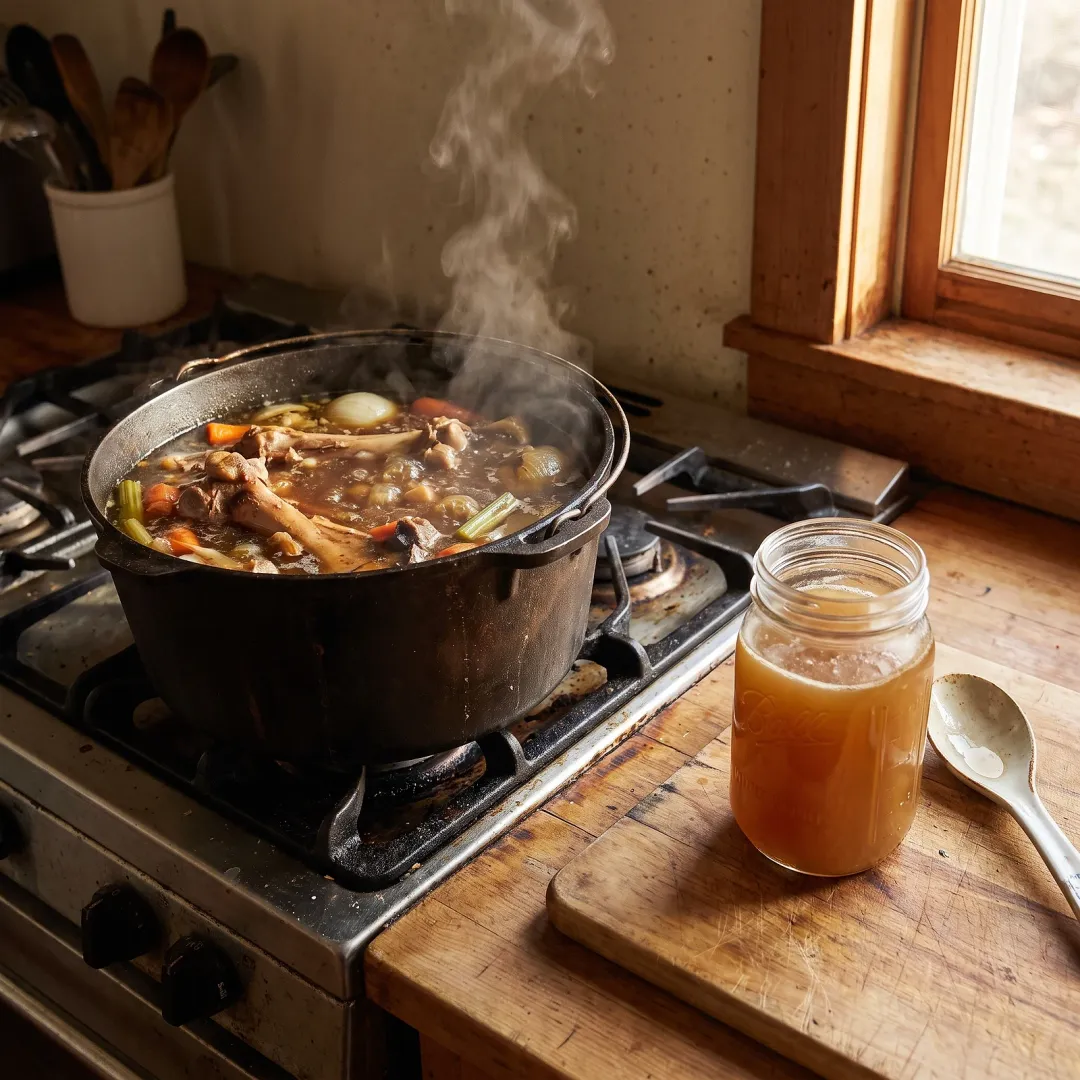

Bone broth is having a moment right now, and I am genuinely here for it. Not because it is trendy, but because it is one of the oldest, most humble foods humans have ever made. Our great-grandmothers threw bones in a pot without thinking twice about it. We stopped doing that somewhere along the way, and I think we lost something real. Let me tell you what bone broth actually is, what is inside it, what the research says it may do, and how to start using it if you haven't already.
What Is Bone Broth, Exactly?
Bone broth is a liquid made by simmering animal bones, and usually the connective tissue and cartilage attached to them, in water for a long period of time. We're talking anywhere from 4 hours to 24 hours or more, depending on the animal and the method. That long simmer is the whole point. It pulls collagen, gelatin, minerals, and amino acids out of the bones and into the liquid.
This is different from regular stock or broth. Regular chicken stock might simmer for an hour or two. Bone broth goes much longer, which is why it often gels in the fridge. That gel is the collagen becoming gelatin, and it's a good sign you made something worth drinking.
You can make it from just about any animal bones: chicken, beef, pork, lamb, turkey, fish. The bones from knuckles, feet, necks, and backs tend to yield the most gelatin because those areas have the most connective tissue. You can roast the bones first for a richer, deeper flavor, or skip that step for a lighter broth.
What Is Actually in Bone Broth Nutritionally?
Here's the thing about bone broth: its nutrition profile is not like a piece of steak or a bag of spinach. You can't perfectly predict what's in it because so much depends on the bones you use, the animal, how long you simmer it, and whether you add vegetables or acid (like apple cider vinegar, which helps pull minerals from the bones).
That said, here's what you generally find in a well-made bone broth:
Gelatin and collagen-derived peptides. When collagen cooks down, it becomes gelatin. Gelatin is rich in the amino acids glycine, proline, and hydroxyproline, which are not abundant in muscle meat. Most of us eat plenty of muscle meat and not nearly enough of the connective-tissue parts our ancestors ate without thinking.
Glycine. This amino acid does a lot of quiet work in the body. It's involved in collagen synthesis, is a component of glutathione (one of the body's major antioxidants), and plays a role in sleep quality and liver function. A 2013 study published in Frontiers in Neurology found that glycine supplementation improved self-reported sleep quality in participants who had difficulty sleeping, though more research is needed to confirm the effect from food sources alone.
Minerals. Bone broth can contain calcium, magnesium, phosphorus, and potassium. The amounts vary widely, and adding a splash of apple cider vinegar to your simmer may help pull more minerals into the liquid, though the research on exactly how much is limited.
Proline and hydroxyproline. These amino acids are foundational to the body's ability to make and maintain its own collagen structures.
Small amounts of protein overall. Bone broth is not a high-protein food the way chicken breast is. A cup might have 6 to 10 grams of protein, depending on concentration. It's more of a supportive, nutrient-dense food than a primary protein source.
What May Bone Broth Support? What the Research Actually Says
I want to be real with you here: bone broth is not a magic liquid. The research on bone broth as a food specifically is still pretty limited. A lot of what we know comes from studies on the individual components, like collagen peptides, gelatin, and glycine, rather than on bone broth itself. That matters.
With that caveat front and center, here's what the science suggests:
Joint health and connective tissue. Collagen is the most abundant protein in the body and is a major structural component of cartilage, tendons, ligaments, and skin. A 2019 review in the British Journal of Sports Medicine found that collagen supplementation combined with activity may support tendon and ligament health, though again this was on hydrolyzed collagen supplements rather than bone broth directly. The connection is plausible, but we should not overstate it.
Skin. Multiple reviews have found that collagen peptides are associated with improvements in skin elasticity and hydration. A 2019 systematic review and meta-analysis in the Journal of Drugs in Dermatology found that oral collagen supplementation showed promising results for skin aging. Bone broth delivers collagen in a similar hydrolyzed peptide form once digested, so there's reason to think it may offer a comparable benefit, but the direct studies on broth itself are sparse.
Digestive comfort. Gelatin has long been used to support the gut lining, and some practitioners use it as a soothing food for people with digestive issues. The amino acid glutamine (found in bone broth) has been studied for its role in maintaining the intestinal barrier. A 2017 review in the journal Nutrients highlighted glutamine's role in supporting gut barrier integrity. Again, the studies are mostly on isolated glutamine supplementation, not bone broth per se. But as part of a broader real-food approach, it fits.
Glycine and liver support. Glycine is used in the liver to produce bile salts and is involved in detoxification pathways. Getting adequate glycine from food sources like bone broth is one way to support that process.
The bottom line: bone broth is not going to single-handedly fix any one thing, and I won't tell you otherwise. But as a regular part of a real, whole-food diet, it gives your body a steady stream of amino acids and building blocks that most modern diets are missing entirely.
Is Bone Broth Paleo?
Yes. Emphatically, yes. This is as ancestral as food gets. Our ancestors used every part of the animal, including the bones, cartilage, and marrow. Nose-to-tail eating was not a trend; it was survival and wisdom. The modern habit of buying boneless, skinless everything and throwing everything else out is new, and I think our bodies feel the absence of what we used to get from the rest of the animal.
Bone broth fits cleanly within a paleo framework. No grains, no legumes, no dairy (unless you add butter or cream, which is your call). It's just bones, water, time, and whatever vegetables and herbs you want to add.
Store-Bought vs. Homemade: What You Need to Know
I'm going to be honest: store-bought bone broth is convenient and some of it is genuinely good. But not all of it is created equal, and the label can fool you.
Things to look for if you're buying it:
- Ingredients you can actually read. Bones, water, vegetables, salt. That's it. If there's a long list of flavor additives or yeast extract, put it back.
- Does it gel? A quality bone broth should gel when refrigerated. If it stays liquid, it probably wasn't simmered long enough to extract meaningful gelatin.
- Source matters. Look for grass-fed beef bones or pasture-raised chicken. The quality of the animal affects the quality of the broth.
- Protein content. Check the label. A well-made broth should show at least 8 to 10 grams of protein per cup.
Homemade is my preference. It's cheaper, you control every variable, and there's something deeply satisfying about making it. I save my chicken carcasses in a zip-lock bag in the freezer until I have enough to fill a pot. Throw them in with some onion, garlic, a couple of carrots, a splash of apple cider vinegar, cover with cold water, and let it go on low for at least 12 hours. Done. Your house will smell incredible.
Who Should Be Cautious?
Bone broth is a whole food and most people do well with it. But there are a few things worth knowing:
Histamine sensitivity. The longer broth simmers, the more histamine it can develop. People who are sensitive to histamine (which can show up as headaches, skin flushing, digestive distress, or anxiety after eating fermented or long-cooked foods) may react to long-simmered bone broth. If that's you, try a shorter cook time or a pressure cooker, which builds less histamine.
Lead content. This comes up sometimes, and it's worth addressing. A 2017 study published in Food and Nutrition Research found detectable but low levels of lead in some chicken bone broths. The levels were low and the authors did not suggest broth was dangerous, but sourcing from high-quality, organic, pasture-raised animals is one way to minimize risk. This is another good reason to care about where your bones come from.
High in sodium. If you're sensitive to sodium or managing blood pressure, check the label on commercial broths or control the salt yourself when making it at home.
Gout. Bone broth is relatively high in purines. If you have gout, talk to your doctor or a qualified healthcare provider before making it a daily staple.
For most healthy people eating a real-food diet, bone broth is a deeply nourishing, low-risk food with a long history of traditional use across cultures worldwide.
This article is for general informational purposes only and is not medical advice. Always consult a qualified healthcare professional before making changes to your diet or health routine.
How to Use Bone Broth in Your Kitchen
You don't have to drink it from a mug every morning, though I do sometimes and I love it. Here are some real, practical ways to use it:
Sip it plain. Warm it up, add a pinch of sea salt, maybe a little fat like a pat of grass-fed butter or a drizzle of olive oil. It's surprisingly satisfying, especially in the morning or between meals.
Use it as a cooking liquid. Anywhere a recipe calls for water or regular broth: rice (if you eat it), soups, stews, braises, sauces. You're just quietly adding more nutrition to food you were already making.
Simmer your vegetables in it. Instead of steaming or boiling in water, simmer cauliflower, zucchini, or whatever you're working with in a little broth. More flavor, more nutrition.
Make a quick soup base. Heat a couple of cups, throw in leftover roasted vegetables, some shredded chicken, whatever herbs you have. You have a real meal in ten minutes.
Freeze it in ice cube trays. This is one of my favorite kitchen tricks. Pop the cubes out and store them in a bag. Then you can grab a cube or two whenever you need a small amount for cooking.
Key Takeaways
- Bone broth is made by simmering animal bones and connective tissue for an extended period, extracting gelatin, collagen-derived amino acids, and minerals.
- It is rich in glycine, proline, and hydroxyproline, amino acids that are scarce in muscle meat but important for connective tissue, skin, and liver function.
- Research on individual components like collagen peptides and glutamine is promising, but direct clinical research on bone broth itself as a food is still limited.
- It fits cleanly within a paleo framework and is one of the most ancestral foods you can add to your real-food kitchen.
- People with histamine sensitivity or gout should use caution, and sourcing from high-quality, pasture-raised animals is always worth the effort.
- Homemade is ideal: simmer bones with vegetables and a splash of apple cider vinegar for at least 12 hours. A good broth will gel in the refrigerator.
Frequently Asked Questions
What is the difference between bone broth and regular chicken broth?
Regular chicken broth or stock is typically simmered for a shorter time, usually one to two hours, and may not include bones with much connective tissue. Bone broth is simmered much longer, often 12 to 24 hours, specifically to extract gelatin, collagen-derived amino acids, and minerals from the bones and connective tissue. A good bone broth will gel when refrigerated; regular stock usually stays liquid.
Is bone broth actually good for you?
Bone broth contains gelatin, amino acids like glycine and proline, and small amounts of minerals that most people don't get enough of from muscle meat alone. Research on the individual compounds in bone broth (particularly collagen peptides and glutamine) is promising for skin, joints, and gut barrier health. However, direct clinical studies on bone broth as a food are still limited, so it's best understood as a nourishing, supportive part of a real-food diet rather than a standalone fix.
Can people with histamine intolerance drink bone broth?
This is a real consideration. The longer bone broth simmers, the more histamine it can develop. People who are sensitive to histamine may experience headaches, skin flushing, or digestive discomfort after drinking long-simmered broth. If you're histamine sensitive, try a shorter cook time (4 to 6 hours) or use an Instant Pot, which may build less histamine due to the faster cooking process.
How do I know if my bone broth is good quality?
The best test is the gel test: put a cup of your broth in the refrigerator and see if it sets like jello. If it does, you extracted meaningful gelatin from the bones, which is exactly what you're after. If it stays liquid, the bones didn't have enough connective tissue or weren't simmered long enough. For store-bought broth, look for short ingredient lists, a protein content of at least 8 to 10 grams per cup, and sourcing from grass-fed or pasture-raised animals.
Sources
- Frontiers in Neurology: The effects of glycine on subjective daytime performance in partially sleep-restricted healthy volunteers
- Amino Acids: The effects of collagen peptide supplementation on body composition, collagen synthesis, and recovery from joint injury and exercise
- Journal of Drugs in Dermatology: Oral Collagen Supplementation: A Systematic Review of Dermatological Applications
- Current Opinion in Clinical Nutrition and Metabolic Care: Glutamine and the regulation of intestinal permeability: from bench to bedside
- Medical Hypotheses: The risk of lead contamination in bone broth diets
This article is for general informational purposes only and is not medical advice. Always consult a qualified healthcare professional before making changes to your diet or health routine.



Join the conversation
What do you think?
Free members can comment, reply and like. It takes ten seconds.