

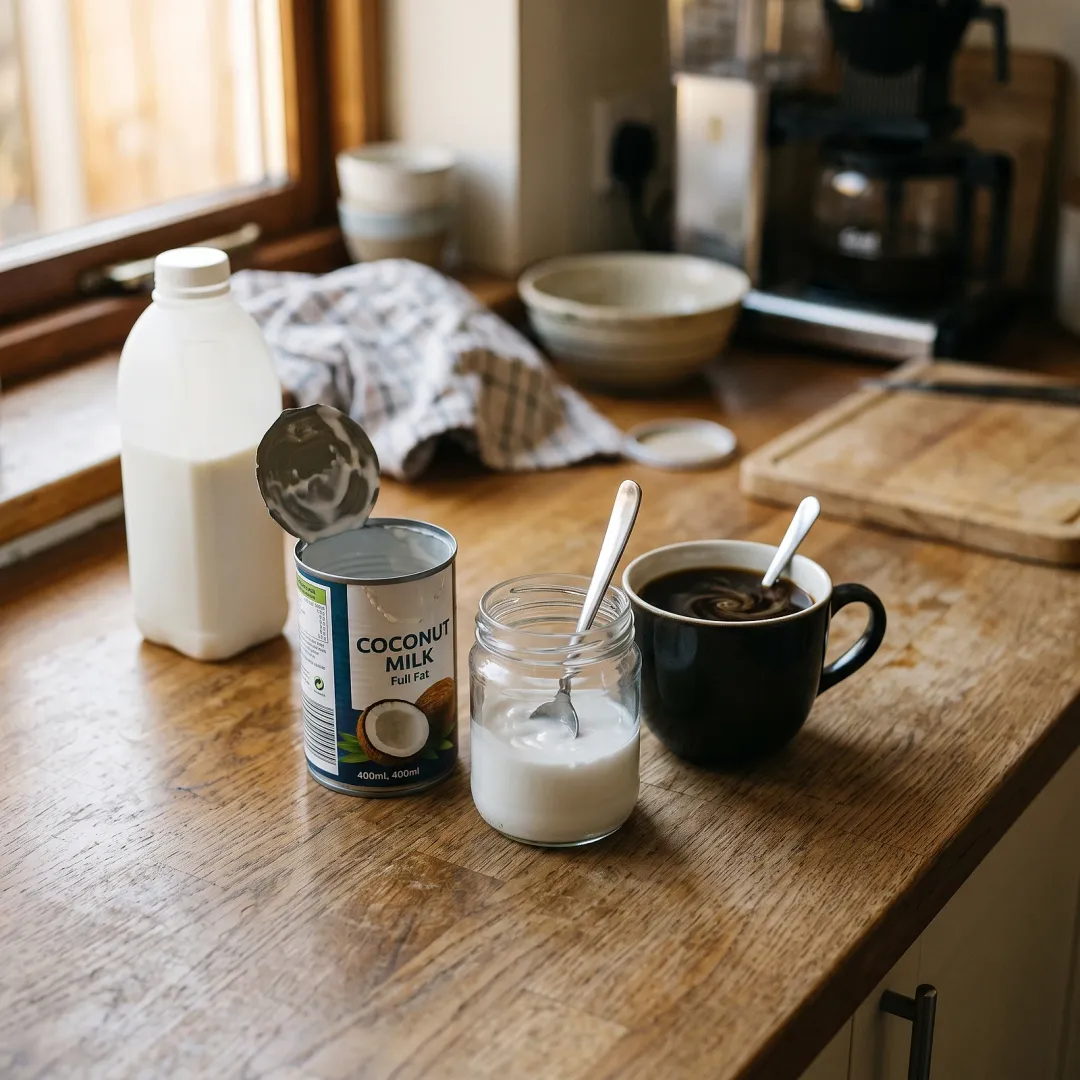

That little bottle of creamer sitting by your coffee maker probably has fifteen ingredients. A cup of whole coffee with good fat in it needs maybe two. That gap is worth knowing about.
What You're Actually Pouring In
Most conventional coffee creamers, including the popular flavored liquid ones, are built on a base of water, sugar or corn syrup, and partially hydrogenated vegetable oil or a blend of seed oils like soybean and canola. Then come the stabilizers: carrageenan, dipotassium phosphate, mono- and diglycerides. Then the artificial flavors. Then a preservative or two.
The FDA has acknowledged that partially hydrogenated oils are no longer considered generally recognized as safe, and while many brands reformulated after that ruling, plenty of them just swapped in other highly refined oils. Carrageenan shows up constantly in these products, and while regulators consider it safe in food, some researchers have raised questions about its effects on the gut lining, particularly in animal studies. A review published in the journal Food and Chemical Toxicology noted those findings and called for more human research.
None of this is catastrophic. But it is a long way from food.
What Coconut Milk Brings Instead
Full-fat canned coconut milk is made from pressed coconut flesh and water. A clean version has two ingredients. That's it.
The fat in coconut milk is primarily saturated fat, mostly in the form of medium-chain triglycerides, or MCTs. Research suggests MCTs are metabolized differently than long-chain fats, going more directly to the liver rather than being stored in the same way. A study in the Journal of the Academy of Nutrition and Dietetics01453-0/abstract) found that MCT-containing oils may support satiety compared to other fat sources, though the effect is modest and individual responses vary.
Coconut milk also contains a small amount of naturally occurring minerals, including manganese and copper, according to USDA FoodData Central. It doesn't come loaded with added sugar, artificial flavor, or stabilizers. What you see is what you get.
What Honestly Changes
The taste is different, and I'm not going to pretend otherwise. Flavored creamer is sweet. Coconut milk is rich, slightly coconut-y, and not sweet at all unless you add something to it. If your coffee routine leans heavily on that vanilla-caramel situation, full-fat coconut milk straight from the can is going to taste like a completely different drink at first. That's okay. Your palate adjusts faster than you think.
Texture-wise, full-fat coconut milk is actually creamier than most creamers. It clouds the coffee beautifully, holds up in hot liquid, and gives it a round, full mouthfeel. Shake or stir the can first because the fat and liquid separate on the shelf.
Cost depends on your brand and where you shop, but a quality can of coconut milk from the grocery store runs somewhere between two and three dollars and will last several days of morning coffee stored in a jar in the fridge. A flavored creamer bottle in the same range might feel cheaper per ounce, but you're also getting a lot of filler for that price.
The one real inconvenience: coconut milk is not shelf-stable once opened. You're opening a can, pouring some into a jar, and refrigerating it. That takes about thirty seconds more effort than squeezing a bottle. If that sounds annoying, I get it. Use a dedicated small jar with a lid and it becomes automatic within a week.
When This Swap Isn't Worth It
If the sweetness in your coffee is genuinely what makes the morning bearable, and you have no interest in retraining that preference, swapping to plain coconut milk without adjusting anything else will just leave you with coffee you don't enjoy. That's not a win. A better move in that case might be to use coconut milk plus a small drizzle of raw honey or a half-teaspoon of pure maple syrup, and cut the amount of sweetener slowly over a few weeks.
Also, if you have a tree-nut or coconut sensitivity, this isn't your swap. And if you're watching saturated fat for a specific medical reason your doctor has outlined, talk to them before making the switch. This is a real-food upgrade, not a prescription.
How to Make It Stick
Buy one can this week. Pour some into a small jar after you open it. Try it in your coffee for three or four days before you decide anything. Most people find that the first cup is the biggest adjustment, and by day three it just tastes like coffee again, a richer version of it.
If you want to lean into the flavor rather than fight it, a pinch of cinnamon or a drop of vanilla extract in the coffee itself goes a long way. You're not stuck with bland. You're just working with real ingredients now, which means you control what goes in.
Your morning coffee is something you do every single day. The creamer you pour into it is a small thing that compounds. Making it a real-food moment costs almost nothing extra.
Key Takeaways
- Conventional coffee creamers often contain refined oils, added sugars, artificial flavors, and stabilizers like carrageenan.
- Full-fat canned coconut milk is a two-ingredient real-food swap with naturally occurring MCTs and no added sugar.
- The texture upgrade is real. Coconut milk is creamier than most creamers.
- The taste difference is also real. It's not sweet, so adjust your expectations and give it a few days.
- Once opened, coconut milk needs refrigeration and lasts about four to five days in a sealed jar.
- If the sweetness is non-negotiable, add a small amount of raw honey or maple syrup and taper it down over time.
- This swap isn't right for everyone. If you have a coconut sensitivity or a specific doctor's guidance on fat intake, check before switching.
Frequently Asked Questions
Can I use coconut milk from the carton instead of canned coconut milk in coffee?
You can, but carton coconut milk is much more diluted than canned full-fat coconut milk. It's thinner and won't give you that rich, creamy texture that makes the swap feel like an upgrade. For coffee, full-fat canned coconut milk is the one worth reaching for. Check the ingredient list on the carton version too: many brands add carrageenan or gums to stabilize it.
Does coconut milk curdle in hot coffee?
It can, especially if the coffee is very acidic or very hot when the cold coconut milk hits it. To reduce curdling, let the coffee cool for thirty seconds, or warm the coconut milk slightly before adding it. Shaking or stirring the can before pouring also helps since the fat and liquid separate when it sits.
How long does opened canned coconut milk last in the fridge?
Generally four to five days in a sealed container. Pour what you open into a clean glass jar with a lid and use it up within that window. If it smells sour or the texture changes noticeably, toss it.
Is coconut milk coffee creamer the same as full-fat canned coconut milk?
Not always. There are coconut-based coffee creamers sold in bottles that are marketed as a cleaner option, but many still contain added sugars, natural flavors, and gums. Read the label. Full-fat canned coconut milk with two ingredients (coconut and water) is the cleanest version of this swap.
Sources
- U.S. Food and Drug Administration: Trans Fat: Partially Hydrogenated Oils
- Food and Chemical Toxicology (ScienceDirect): Carrageenan and the gastrointestinal tract: a review of the evidence
- Journal of the Academy of Nutrition and Dietetics: MCT oil and satiety: findings from a controlled study
- USDA FoodData Central: Coconut milk, canned, full-fat: nutrient profile
This article is for general informational purposes only and is not medical advice. Always consult a qualified healthcare professional before making changes to your diet or health routine.




Join the conversation
What do you think?
Free members can comment, reply and like. It takes ten seconds.