
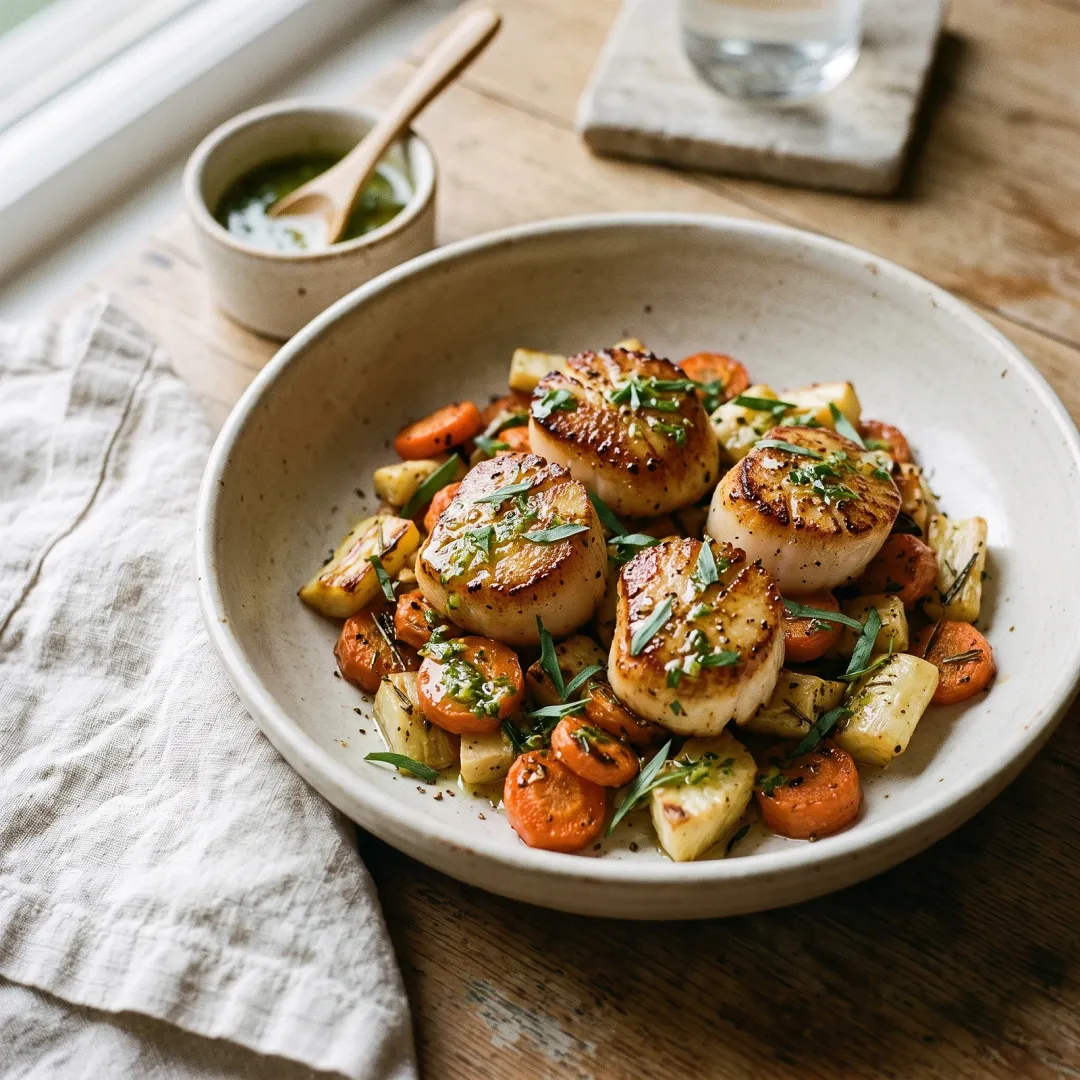

Scallops get intimidating, and I understand why. You pay good money for them, you want that golden crust, and then you hover over the pan second-guessing every second. But here is the truth: a dry scallop, a screaming-hot pan, and the discipline to not touch it are all you need. Once you nail that, this whole bowl comes together in under 45 minutes and tastes like something you would order in a small bistro in Lyon. The French lean on this one is not an accident. Tarragon is one of the most underused herbs in real-food cooking, and it has this slightly anise-forward brightness that does something beautiful next to a sweet, caramelized scallop. Paired with roasted carrots and parsnips, which get almost jammy and nutty after 25 minutes in a hot oven, you get a bowl that is genuinely filling without being heavy. No grains. No dairy. No seed-based spices. Nothing your immune system needs to fight. I built this one specifically for AIP elimination phase, so if you are in the middle of a Hashimoto's or rheumatoid arthritis elimination protocol, this bowl has your name on it. It is also just a really good lunch, full stop, whether you are doing AIP or not.
Nutritional Benefits
Sea Scallops
- Sea scallops are one of the cleanest, leanest animal proteins available, delivering roughly 20 grams of protein per three-ounce serving with very little fat.
- They are a notable source of vitamin B12, which supports neurological function and red blood cell production, two things that often take a hit in autoimmune conditions.
- Scallops also provide zinc and selenium, both critical for thyroid hormone conversion and a balanced immune response.
- Their magnesium content supports muscle function and helps regulate the inflammatory pathways that autoimmune conditions tend to push into overdrive.
Carrots
- Carrots are rich in beta-carotene, the precursor to vitamin A, which plays a central role in gut lining integrity and immune regulation, two cornerstones of the AIP approach.
- The natural sugars in carrots caramelize beautifully during roasting, which also concentrates their antioxidant content.
- Carrots provide a gentle source of soluble fiber that feeds beneficial gut bacteria without irritating a sensitive digestive tract.
Parsnips
- Parsnips offer a more complex, slightly sweet and earthy flavor than their carrot cousins, along with a solid dose of folate and vitamin C.
- They are a good source of prebiotic fiber, specifically inulin, which helps nourish the microbiome during gut-healing protocols.
- Parsnips also contain potassium, which supports healthy blood pressure and cardiovascular function.
Fresh Tarragon and Lemon
- Tarragon is rich in antioxidants including rutin and chlorogenic acid, which have demonstrated anti-inflammatory properties in research.
- Fresh lemon juice provides vitamin C and supports the liver's detoxification pathways, which are often under extra pressure during chronic illness.
- The aromatic compounds in fresh herbs like tarragon and parsley have been studied for their antimicrobial and gut-supportive effects.
Extra-Virgin Olive Oil
- Extra-virgin olive oil is the backbone of the Mediterranean diet and one of the most studied anti-inflammatory fats in the world.
- Its oleocanthal content works similarly to ibuprofen in terms of inhibiting inflammatory enzymes, without the gut-damaging side effects.
- Olive oil supports the absorption of fat-soluble vitamins, including the beta-carotene from the carrots in this bowl.
FAQs
What does 'dry-packed' scallops mean and why does it matter?
Dry-packed scallops have not been treated with sodium tripolyphosphate, a chemical solution that causes scallops to absorb extra water and weight. Wet-packed scallops steam in the pan instead of searing because all that stored moisture releases immediately. Dry-packed scallops go straight to a golden-brown crust. Ask your fishmonger specifically, or look for the phrase 'dry' or 'chemical-free' on the packaging. The difference in your final result is enormous.
Can I use frozen scallops?
Yes, with one condition: thaw them completely in the refrigerator overnight and then press them between layers of paper towels for at least 15 minutes before cooking. Frozen scallops often hold more surface moisture, so extra drying time is non-negotiable. Do not thaw them in water or on the counter.
My scallops stuck to the pan. What happened?
Two likely culprits. First, the pan was not hot enough. You need it genuinely ripping hot before the scallops go in. Second, the scallops were not dry enough. Surface moisture creates steam and prevents the crust from forming, which means the scallop bonds to the pan instead of releasing cleanly. A properly seared scallop will release on its own when the crust has formed.
Is this recipe truly AIP elimination phase compliant?
Yes, it is built specifically for AIP elimination phase. There are no grains, legumes, dairy, eggs, nuts, seeds, seed-based spices, nightshades, alcohol, or refined sugars. All ingredients used, including the avocado oil, are compliant with AIP elimination guidelines. That said, always verify with your own practitioner, especially if you are managing a specific diagnosis.
Can I make the tarragon citrus drizzle ahead of time?
Absolutely. The drizzle can be made up to 24 hours in advance and stored in a small jar in the refrigerator. The garlic will mellow slightly and the flavors will deepen. Bring it to room temperature before drizzling and give it a quick stir, as the olive oil may solidify slightly in the fridge.
What can I substitute for fresh tarragon if I cannot find it?
Fresh tarragon is worth seeking out here because it is the defining flavor of the drizzle. Check a specialty grocery store or farmers market. In a pinch, fresh chervil is the closest AIP-compliant substitute and is also used in French cooking. Fresh dill will give you a different but still delicious result. Do not use dried tarragon in place of fresh, the flavor is dramatically weaker and slightly medicinal in a drizzle.
How do I know when the scallops are done?
Look at the sides of the scallop as it cooks. When the opaque white color creeps about two-thirds of the way up the side and the top still looks slightly translucent, flip it. After the second side sears for 60 to 90 seconds, the scallop should be opaque but still have a slight give when you press it gently. Firm all the way through means overcooked. Pull them off heat a little early and let carryover do the rest.
If this bowl surprised you with how much flavor AIP cooking can actually deliver, pin it, share it with a friend who is navigating AIP eating, and leave a comment below telling me how your scallop sear turned out. And if you are new here and wondering where to start, the AIP-Friendly tag on this site has everything built specifically for the elimination phase. You do not have to eat sad food to eat well. I promise.
Grilled Scallop Bowl with Roasted Carrots, Parsnips, and Tarragon Citrus Drizzle
Seared sea scallops rest over a warm bed of oven-roasted carrot and parsnip rounds, finished with a bright tarragon, lemon, and extra-virgin olive oil drizzle. Clean French flavors, AIP-compliant, and satisfying enough to anchor a real midday meal.
Ingredients
- 1 lb large dry-packed sea scallops, side muscle removed, patted very dry
- 3 medium carrots, peeled and sliced into 1/2-inch rounds
- 2 medium parsnips, peeled and sliced into 1/2-inch rounds
- 3 tablespoons extra-virgin olive oil, divided
- 1/2 teaspoon fine sea salt, divided
- 2 cloves garlic, minced
- 2 tablespoons fresh lemon juice
- 1 teaspoon lemon zest
- 2 tablespoons fresh tarragon leaves, roughly chopped, plus more for garnish
- 1 tablespoon fresh flat-leaf parsley, finely chopped
- 1 tablespoon avocado oil (for searing the scallops)
- Flaky sea salt, for finishing
Instructions
- Preheat your oven to 425°F and line a large rimmed baking sheet with parchment paper.
- Toss the sliced carrots and parsnips with 1 1/2 tablespoons of the olive oil and 1/4 teaspoon of the sea salt. Spread them in a single layer on the prepared baking sheet, making sure they are not overlapping.
- Roast the carrots and parsnips for 25 to 28 minutes, flipping once halfway through, until the rounds are tender in the center and beginning to caramelize at the edges. Remove from the oven and keep warm.
- While the vegetables roast, make the tarragon citrus drizzle. In a small bowl, whisk together the remaining 1 1/2 tablespoons of olive oil, the minced garlic, lemon juice, lemon zest, chopped tarragon, and chopped parsley. Season with the remaining 1/4 teaspoon of sea salt. Set aside and let the flavors meld.
- Pat the scallops dry once more with paper towels. This step is critical for a proper sear; any surface moisture will steam the scallop instead of caramelizing it.
- Heat a cast-iron skillet or heavy stainless pan over high heat until it is very hot, about 2 minutes. Add the avocado oil and swirl to coat.
- Place the scallops in the pan in a single layer, leaving space between each one. Do not move them. Sear for 2 minutes undisturbed, until a deep golden-brown crust forms on the bottom.
- Flip each scallop and sear for 1 to 1 1/2 minutes more, just until the sides are opaque and the center is barely translucent. Pull them off the heat immediately; scallops overcook fast.
- To assemble the bowls, divide the warm roasted carrot and parsnip rounds between two bowls. Arrange the seared scallops on top.
- Spoon the tarragon citrus drizzle generously over the scallops and vegetables. Finish with a pinch of flaky sea salt and a few extra tarragon leaves. Serve immediately.
Nutrition per serving
- Calories: 370
- Total Fat: 16g
- Carbohydrates: 28g
- Protein: 32g
- Dietary Fiber: 6g
- Sugar: 8g
 That Paleo Chick
Real food that heals
RecipePaleoLunchGluten-Free

Fits these needs
Checked ingredient by ingredient. Tap one to see every recipe that fits.
Ingredients
Instructions
Nutrition Facts Amount per serving
Estimated from the ingredients. Values vary with brands and portions.

Join the conversation
Made it? Tell us how it went.
Free members can comment, reply and like. It takes ten seconds.