

On this page
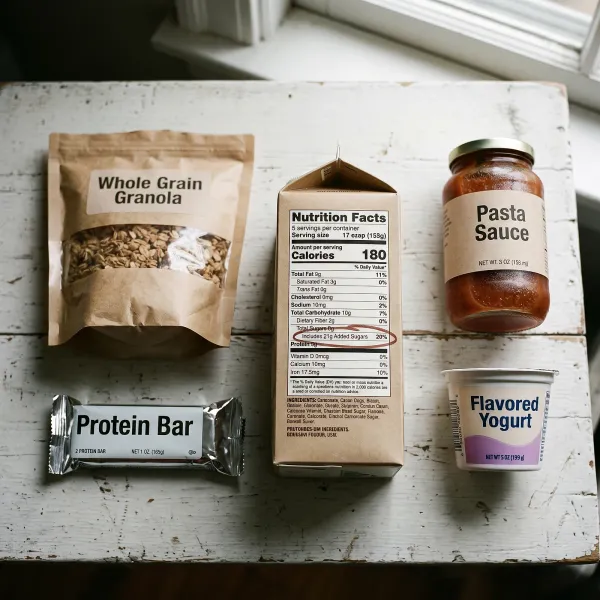
Organic granola. "Lightly sweetened" oat milk. A protein bar with a green leaf and the word "natural" in the logo. You picked all of them because they looked healthy. Then you flipped them over, and the sugar content was somewhere between a Snickers bar and a can of Coke. You put them back, grabbed something else, and still weren't sure if that one was better. Sound familiar? The label is not your friend. It is a marketing document with a small nutrition panel stapled to the back, and the people who designed it know exactly how fast you are scanning. This is a five-minute aisle skill set. You do not need a chemistry degree. You just need to know what to look for.
Why This Even Matters (Fast Version)
The FDA requires every added sugar to be listed in grams on the Nutrition Facts panel, a rule that went fully into effect in 2020. But that rule only tells you the total grams. It does not tell you how many different forms of sugar are hiding inside, or that a single product can legally list four separate sweeteners and push each one far enough down the ingredient list to keep any of them out of the top three spots.
The American Heart Association puts the recommended daily ceiling at 25 grams for women and 36 grams for men. One 12-ounce bottle of a popular "green tea" drink can carry 32 grams. A single serving of mainstream flavored yogurt regularly lands between 18 and 26 grams. A protein bar? Some of them top 20 grams while advertising high protein on the front. The math is not in your favor if you are reading only what the front of the package wants you to read.
Start Here: The Nutrition Facts Panel
Flip the package. Find "Total Sugars" and directly below it, "Added Sugars." The FDA now requires the added sugars line to include both grams and a percent Daily Value (%DV), based on a 50-gram daily reference amount.
A few fast rules:
1. Do the gram math, not the %DV math. The 50-gram DV is generous. For most real-food eaters trying to limit refined sugar, 25 to 30 grams a day is a more useful personal ceiling. Use grams, not percentages.
2. Check the serving size first, always. This is where manufacturers earn their money. A bag of flavored nuts might list 6 grams of added sugar per serving, but the serving size is 1 ounce, and you eat the whole 3-ounce bag. That is 18 grams, and you never saw it coming. The FDA's guidance on serving sizes mandates that serving sizes reflect amounts people actually eat, but "people actually eat" is a flexible phrase when the manufacturer sets it.
3. Total sugars vs. added sugars is not the same number for a reason. A plain whole apple has naturally occurring sugars with no added sugars line. A flavored applesauce might show 18 total sugars and 12 added sugars. The 12 is what was poured in at the factory. That gap is the number to pay attention to.
The Full List: 60+ Names Sugar Hides Behind
This is the part manufacturers are banking on you not knowing. Sugar has over 60 names in the food supply, and they are not random. Some are chosen specifically because they sound wholesome, scientific, or obscure enough to scan past.
The University of California San Francisco's SugarScience project identified 61 names for added sugar found in packaged food. Here is how to group them so they are actually memorable:
The "sounds natural" group: Honey, agave nectar, agave syrup, maple syrup, coconut sugar, coconut palm sugar, date sugar, date syrup, molasses, blackstrap molasses, fruit juice concentrate, apple juice concentrate, grape juice concentrate, evaporated cane juice, raw cane sugar, turbinado sugar, muscovado sugar, demerara sugar, sucanat. These are still sugar. Your liver does not file honey under "healthy."
The straight-up syrups: Corn syrup, high-fructose corn syrup (HFCS), brown rice syrup, rice syrup, malt syrup, barley malt syrup, oat syrup, tapioca syrup, chicory syrup, carob syrup, refiner's syrup, sorghum syrup.
The "-ose" family (anything ending in -ose is a sugar): Glucose, fructose, sucrose, dextrose, maltose, lactose, galactose, trehalose, xylose. If you see a word ending in -ose, it is a form of sugar, full stop.
The scientific-sounding ones: Dextrin, maltodextrin, dextran, ethyl maltol, disaccharides, polydextrose, D-ribose, glucitol, panocha.
The "nectars and crystals" group: Fruit nectar, cane crystals, crystallized cane juice, beet sugar, palm sugar, invert sugar, invert syrup.
You do not need to memorize all 60. If you remember the -ose rule and the syrup rule, you will catch the vast majority of them in under ten seconds.
The Ingredient-Order Trick (And How Companies Game It)
Ingredients are listed by weight, heaviest first. So if sugar is the second ingredient, there is more sugar than most other things in that product. Manufacturers have known this for decades, and the work-around is simple: use five different sugars in smaller quantities so none of them individually ranks in the top three, while collectively they dwarf the oats, almonds, or whatever "whole food" ingredient is getting the front-label real estate.
A 2016 study published in BMJ Open analyzed more than 56,000 US packaged foods and found that more than 68% contained added sweeteners, and that multiple sweetener types were commonly used together in a single product. The researchers specifically noted that this practice of using multiple smaller amounts of different sugars makes it harder for consumers to recognize total sugar load from the ingredient list alone.
The fix is to add up everything on the -ose and syrup lists whenever you see multiple sweeteners. If you count three or more sugar aliases in the ingredient list, put it down.
The Sneakiest Product Categories (Where I Always Double-Check)
Some categories are notorious for hiding sugar in plain sight behind health-forward branding. These are the ones I scan every single time, no matter how clean the packaging looks.
"Low-fat" or "fat-free" anything. When manufacturers remove fat, food tastes like cardboard. They add sugar to compensate. This trade-off was documented as far back as the 1990s, and a Harvard T.H. Chan School of Public Health analysis notes that low-fat products often contain more added sugar than their full-fat counterparts. Fat-free salad dressing, reduced-fat peanut butter, low-fat flavored yogurt: check them all.
"Protein" bars and snacks. The word protein sells. Sugar makes it palatable. Many mainstream protein bars land at 15 to 25 grams of added sugar, which puts them squarely in candy-bar territory nutritionally, no matter how many grams of whey are in there.
Plant-based milks. Original and flavored oat milks, almond milks, and coconut milks can carry 7 to 15 grams of added sugar per cup. Always buy unsweetened and add your own sweetener if you need it. That way you control the amount.
Savory foods: sauces, dressings, and condiments. Pasta sauce, teriyaki sauce, BBQ sauce, ketchup, store-bought marinades, and even some hot sauces regularly contain cane sugar, HFCS, or honey in significant amounts. You are not thinking about sugar when you reach for the pasta sauce. That is exactly the point.
Granola and "grain-free" granola. Some grain-free granolas marketed directly at paleo and keto audiences still hit 8 to 12 grams of added sugar per half-cup serving, often from honey, maple syrup, or coconut sugar. Natural source, same metabolic result in quantity.
"No sugar added" claims. This label means no sugar was added during manufacturing. It does not mean the product is low in sugar. Fruit-based products can carry enormous amounts of naturally occurring sugar while wearing a "no added sugar" badge completely legally. Check total sugars.
A Fast 60-Second Label Audit You Can Do in Any Aisle
You do not need to stand there reading for ten minutes. This is a four-step scan you can run in under a minute:
Step 1: Flip it over. Front label is marketing. Back label is data.
Step 2: Find Added Sugars in grams. Multiply the serving size by how many servings you will realistically eat. That is your actual number.
Step 3: Scan the ingredient list for the -ose rule and the syrup rule. Any word ending in -ose is a sugar. Any syrup is a sugar. Count how many you see.
Step 4: If you see 3 or more sugar aliases, or more than 5 to 6 grams of added sugar per serving of a "health" food, question it. That is not a hard cutoff for every food you own, but it is a useful flag in the aisle.
That is it. Four steps, one minute, and you have more information than most people ever get from a label.
What Actually Works in Real Life
The most honest thing I can tell you is that label reading is a skill you build over time, and the first few weeks of doing it feel slow and annoying. Then it gets fast, and eventually you just know which categories to check and which ones you trust.
A few things that made it easier for me:
Shop with a short roster of brands you have already vetted. The label audit is a one-time cost per product. Once you know Primal Kitchen's ranch is clean and a particular granola brand is sugar-loaded, you do not have to re-read every time.
Default to ingredients you recognize. The more an ingredient list reads like a recipe, the better. "Almonds, coconut, honey, vanilla" is one thing. "Almonds, tapioca syrup, rice syrup, dextrose, natural flavors" is another.
Unsweetened is almost always available. Oat milk, almond milk, coconut milk, nut butters, tomato sauce, canned fruit in water, plain yogurt. Every major sweetened product has an unsweetened version. You add your own sweetness on your own terms.
And honestly? The more you cook from whole ingredients, the less label reading you have to do, because whole foods do not have ingredient lists. That is still the most efficient shortcut I know.
This article is for general informational purposes only and is not medical advice. Always consult a qualified healthcare professional before making changes to your diet or health routine.
Key Takeaways
- Check Added Sugars in grams on the Nutrition Facts panel, then multiply by how many servings you will actually eat.
- Sugar has 60+ names; remember the -ose rule (glucose, fructose, dextrose) and the syrup rule to catch most of them fast.
- If a product lists three or more sugar aliases in the ingredient list, manufacturers are likely splitting the load to bury them lower.
- Low-fat products, protein bars, plant-based milks, and savory sauces are the sneakiest sugar sources in a grocery store.
- "No added sugar" does not mean low in sugar. Check total sugars for fruit-based and naturally sweet products.
- Buying unsweetened versions of staple products and adding your own sweetener gives you full control over how much sugar you actually consume.
Frequently Asked Questions
How many names does sugar have on food labels?
The UCSF SugarScience project identified at least 61 names for added sugar used in packaged food in the US. The easiest way to catch most of them without memorizing the full list is to use the -ose rule (any ingredient ending in -ose is a form of sugar) and the syrup rule (any syrup is a form of sugar).
What does 'no added sugar' actually mean on a label?
"No added sugar" means no sugar was added during manufacturing or processing. It does not mean the product is low in sugar overall. Foods made with fruit or fruit juice can be very high in naturally occurring sugars and still carry a "no added sugar" claim legally. Always check the Total Sugars line on the Nutrition Facts panel alongside the Added Sugars line.
Is coconut sugar or honey better than regular sugar on a food label?
From a metabolic standpoint, all concentrated sweeteners, including honey, maple syrup, coconut sugar, and agave, are still forms of added sugar. They count toward your added sugar total on the Nutrition Facts panel and are processed by the body similarly to cane sugar. Some have slightly different glycemic responses or trace minerals, but in the quantities used in packaged food, the practical difference is small. They are not a free pass.
What is the trick manufacturers use to hide sugar in the ingredient list?
Ingredients are listed by weight from most to least. To keep sugar from appearing at the top of the list, manufacturers use several different types of sweeteners in smaller individual quantities. Each one ranks lower than it would if all the sugar came from a single source, even though the combined total is significant. Seeing three or more sugar aliases in one ingredient list is a strong signal this strategy is in play.
Sources
- American Heart Association: Added Sugars
- U.S. Food and Drug Administration: How to Understand and Use the Nutrition Facts Label
- UCSF SugarScience: Hidden in Plain Sight: The Many Names of Added Sugar
- BMJ Open: Prevalence of added sugar in US packaged foods (2016)
- Harvard T.H. Chan School of Public Health, The Nutrition Source: Full-Fat Dairy and the Low-Fat Trade-Off
This article is for general informational purposes only and is not medical advice. Always consult a qualified healthcare professional before making changes to your diet or health routine.