

On this page
The bread basket lands on the table before you've even opened the menu. Your coworker ordered the pasta and is already side-eyeing you. The server is hovering. And you're trying to remember whether that sauce has soy in it. Eating paleo at home is one thing. Doing it in the wild, in a restaurant, with a normal human social life still intact, that's the real skill. And it's absolutely learnable.
Why Dining Out Feels Like a Paleo Minefield (And Why It Doesn't Have to Be)
Most restaurant food is built on a foundation of seed oils, refined grains, added sugars, and cheap fillers, not because chefs are evil, but because those ingredients are inexpensive, shelf-stable, and crowd-pleasing. A 2020 analysis published in the Journal of the Academy of Nutrition and Dietetics31480-6/fulltext) found that restaurant meals, on average, exceed recommended limits for calories, sodium, and saturated fat, and they rarely disclose cooking oils. That's just the baseline.
So yes, the deck is stacked. But here's the thing I've come to after years of doing this: eating paleo in a restaurant is mostly about knowing what questions to ask and what to look for. You don't need a special menu. You don't need to call ahead every single time. You need a framework, and that's what this is.
Before You Even Walk In the Door
1. Look at the menu online before you go.
This sounds obvious, but most people skip it and then panic at the table. Spend two minutes before you leave the house. Find two or three things that are already close to paleo, or that could be with a simple swap. When you walk in knowing your order, the bread basket and the dessert specials lose most of their power.
2. Choose the restaurant when you can.
If you're the one organizing the dinner, steer toward steak houses, seafood spots, Mexican restaurants, Thai or Vietnamese places, or any cuisine built around a protein-and-vegetable base. Pasta-centric Italian and American bar-food spots are the hardest terrain. Not impossible, but harder. Use your social capital strategically.
3. Eat a small snack first if it's a long dinner.
Showing up ravenous is how the bread basket wins. A handful of macadamia nuts or a boiled egg before you head out takes the edge off. You'll order from your values instead of your hunger.
How to Read Any Menu Like a Paleo Eater
4. Anchor to the protein first.
Every menu has a protein section. That's your starting point. Grilled, roasted, or baked is almost always better than fried (most frying is done in soybean or canola oil). Ask. Servers know what oil the kitchen uses. The question "what oil do you cook that in?" is completely normal and is asked every day in restaurants.
5. Look for dishes that are already 80% there.
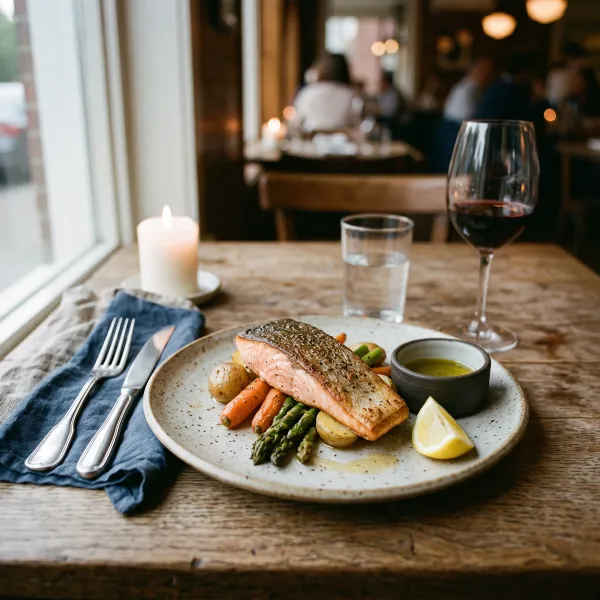
A grilled salmon with roasted vegetables? Order it, ask for the sauce on the side, and you're done. A steak with a baked potato? Skip the potato, ask for a double side of whatever vegetable they have. A burger? Order it lettuce-wrapped or ask for a gluten-free bun if they have one, or just eat the thing without the bun. Nobody at the table will care as much as you think they will.
6. Decode the menu language.
Words that are usually fine: grilled, roasted, baked, seared, braised (check the braising liquid), steamed, poached.
Words that deserve a follow-up question: crispy (often battered or fried in seed oil), glazed (often sugar-heavy), marinated (sometimes contains soy or sugar), house sauce (mystery).
Words that are almost always a no: breaded, battered, tempura, creamy (usually flour-thickened or made with non-dairy creamers), and anything described as "smothered."
The Art of Ordering Without Making It Weird
7. Make one or two clean substitutions, not seven.
This is where paleo eaters sometimes lose the table. Asking for six modifications in a row turns a dinner into a negotiation. Pick the dish that needs the least surgery and make one or two changes. "Can I get the chicken without the sauce, and swap the rice for a double order of the roasted vegetables?" That's clean. That's totally doable. That's a request every good kitchen will honor without blinking.
8. Use allergy language sparingly but strategically.
Some people in the paleo community use "I have a gluten allergy" as a blanket override. I'm not going to tell you what to do, but I'll be straight: if you actually have celiac disease, that language matters, and cross-contamination is a real safety issue. If you don't, you might be watering down the urgency for people who genuinely need it. Instead, just be direct: "I avoid gluten, grains, and dairy, can you help me find something that works?" Restaurants get that. More than you think.
9. Ask for oil and vinegar on the side instead of dressing.
This is the single easiest paleo dining-out move there is. Almost every restaurant salad dressing is made with soybean oil, added sugar, or both. A review in the journal Nutrients noted that extra-virgin olive oil is consistently associated with better cardiovascular and metabolic outcomes compared to refined vegetable oils. Asking for olive oil and lemon or vinegar costs you nothing and eliminates a major hidden-ingredient landmine.
The Trickiest Cuisines and How to Handle Them
10. Know your cuisine-specific workarounds.
Some spots are genuinely easy. Some take more navigation. Here's a quick-reference breakdown:
Steak houses: Your happiest paleo hunting ground. Stick to simply prepared cuts, ask about the butter (some use seed-oil blends), and load up on vegetables. Skip the bread and the potatoes. Order a side salad with oil and vinegar.
Mexican: Skip the chips, the tortillas, and the rice. Order a fajita platter or a protein bowl without the beans and rice, or ask for extra guacamole and salsa instead. Carnitas, grilled chicken, and steak are usually cooked in lard or simple oils, ask to confirm.
Thai and Vietnamese: Both cuisines use a lot of fish sauce, coconut milk, and fresh herbs, which are paleo-friendly. The danger zones are the peanut sauces (legumes), the sticky rice, and the noodle dishes. Order curries with coconut milk, pho with just the broth and protein (skip the hoisin and sriracha if you want to avoid added sugar), and spring rolls without the wrapper.
Chinese: Hardest terrain. Most sauces contain soy, cornstarch, and sugar. Steamed dishes with sauce on the side are your best bet. Ask what oil is used for stir-frying, most Chinese restaurants use vegetable or soybean oil. This one may be a "do your best and don't stress" situation depending on how strict you're being.
Italian: It's mostly pasta and bread, which means you're leaning hard on protein and vegetable sides. Grilled fish or chicken, antipasto platters (minus the cured meats with fillers), and simply prepared vegetable dishes are workable. Ask about cream sauces, some are just cream and cheese, which is fine if you do dairy; others have flour.
Budget Moves for Eating Paleo at Restaurants Without Overspending
11. Order strategically to keep the cost down.
Eating out paleo can get expensive fast if you're adding protein upgrades and extra side dishes on every order. A few moves that help:
Order an appetizer-sized protein plus a side salad instead of a full entree. Many restaurants serve six-ounce portions as starters, which is plenty if you're eating real food.
Skip the drinks. Sparkling water with lemon is free or near-free, and cocktails and sodas add $10 to $15 to a check without adding anything to your meal.
Look at the lunch menu. Many restaurants use the same kitchen and the same proteins for a significantly lower price during lunch service.
Share an entree if portions are large (and they usually are, the FDA's research on restaurant portion sizes has repeatedly found that single-restaurant servings far exceed standard dietary recommendations). Two people can often split a protein entree and each order a side and walk away satisfied.
Handling Social Pressure at the Table
12. Have one low-drama answer ready, then move on.
This is not about hiding what you eat. It's about not turning dinner into a TED talk nobody asked for. When someone asks why you're not eating the bread or why you ordered the burger without the bun, having a short, warm answer ready stops the conversation in its tracks so you can all get back to enjoying the evening.
Something like: "I just feel a lot better when I eat this way" or "I'm avoiding grains and dairy right now, my body does better without them." That's honest, it's not preachy, and it closes the loop. Most people will nod and go back to their pasta. The ones who push further are curious, not hostile, and a simple "I've had good results and I like the way I feel" is usually enough.
You do not owe anyone a nutrition lecture over dinner. You also don't have to eat something that makes you feel terrible just to avoid a three-second awkward pause. Both things are true at once.
The Real Goal: Flexibility Without Compromise
Paleo is not a religion. It's a framework built on the idea that real, whole, unprocessed food is what our bodies were designed to run on. That framework can absolutely survive a dinner out. It can survive travel, holidays, work lunches, and birthday parties.
The goal isn't perfection. The goal is building habits and skills that hold up in real life, not just in your own kitchen. Every time you figure out how to navigate a menu and walk away feeling good, you're strengthening that skill. And eventually, it stops feeling like work.
I've been doing this long enough that I don't think twice about it anymore. I scan the menu, I ask one or two questions, I order something good, and I enjoy my meal. That's what I want for you too.
Key Takeaways
- Look up the menu online before you arrive so you're not making decisions under pressure.
- Anchor your order to the protein section and ask what oil the kitchen uses for cooking.
- Request oil and vinegar on the side instead of house dressings, which almost always contain seed oils or added sugar.
- Make one or two clean substitutions, not a long list of modifications.
- Know your cuisine, steak houses and Vietnamese spots are easy terrain; Chinese restaurants are the hardest.
- Keep costs down by ordering appetizer portions, skipping drinks, or splitting an entree.
- Have one short, non-preachy answer ready for social questions about your eating habits, then move on.
Frequently Asked Questions
Can you eat paleo at any restaurant?
Pretty much, yes, though some cuisines are easier than others. Steak houses, seafood restaurants, Mexican spots, and Thai or Vietnamese restaurants all have naturally paleo-friendly options. Chinese restaurants and pasta-centric Italian spots take more navigation, but a simply prepared protein with a vegetable side is available almost everywhere.
What do you order at a restaurant when eating paleo?
Start with a grilled, roasted, or baked protein, fish, chicken, steak, or pork. Swap starchy sides (rice, potatoes, bread) for a double vegetable side or a side salad. Ask for dressings and sauces on the side, request olive oil and vinegar instead of house dressing, and ask what oil the kitchen uses for cooking.
How do you avoid seed oils when eating out paleo?
Ask your server directly what oil the kitchen uses to cook your protein or vegetables. Most restaurants use soybean, canola, or vegetable oil for sautéing, you can request butter instead, and many kitchens will accommodate that. For salads, always ask for olive oil and vinegar on the side rather than a house dressing.
How do you handle social pressure when eating paleo at restaurants?
Have one short, honest answer ready, something like 'I just feel better eating this way', and then move on. You don't need to explain your whole health philosophy over dinner. Most people will accept a brief answer and go back to their own meal. The goal is to enjoy the evening, not to make your eating habits the main topic.
Sources
- Journal of the Academy of Nutrition and Dietetics: Nutritional Quality of Full-Service Restaurant Meals
- Celiac Disease Foundation: Gluten-Free Restaurants: What You Need to Know
- Nutrients (MDPI): Olive Oil and Cardiovascular Health
- U.S. Food and Drug Administration: Research on Menu Labeling and Restaurant Portion Sizes
This article is for general informational purposes only and is not medical advice. Always consult a qualified healthcare professional before making changes to your diet or health routine.