

On this page
Butter sat on my counter for years before I stopped apologizing for it. Not because I threw caution to the wind, but because I actually read the research. The story we were handed about saturated fat and cooking fats is one of the most stubborn, most pervasive pieces of nutrition misinformation out there, and the smoke point chapter of that story is the part that still trips up people who consider themselves pretty food-literate. So let's fix that.
The Myth on the Label: High Smoke Point Equals Healthy Cooking Fat
Walk into any grocery store and you will find vegetable and seed oils marketed with "high smoke point" front and center, as if that one number tells you everything you need to know about whether a fat is safe to cook with. Canola oil. Sunflower oil. Soybean oil. Refined avocado oil. All positioned as the responsible, modern choice, while butter and coconut oil are quietly shamed for being lower-temperature options.
The smoke point logic sounds rational: heat a fat past its smoke point, it burns, and burning means bad chemistry. So, the higher the smoke point, the safer the fat. Right?
Not quite. The smoke point tells you when a fat starts to visibly smoke. What it does not tell you is what that fat is made of, how stable it is under heat, or what compounds it is producing before it ever starts to smoke. A fat can stay clear and odorless in your pan while generating oxidation byproducts that are far more concerning than a little visible smoke from butter. That is the part of the story you were never told.
A 2018 study published in Acta Scientific Nutritional Health tested a range of common cooking oils, including extra-virgin olive oil, coconut oil, and various refined seed oils, and found that the oils that performed best under heat stress were those with higher saturated and monounsaturated fat content, not those with the highest smoke points. Extra-virgin olive oil, which has a moderate smoke point that makes many cooks nervous, actually produced fewer harmful polar compounds and aldehydes than refined oils with significantly higher smoke points. The determining factor was oxidative stability, and that is driven by the fat's chemical structure, not the temperature at which it starts to smoke.
Why Saturated Fat Is Chemically More Stable Than You Think
Here is the chemistry in plain English, because it matters.
Fats are made up of fatty acid chains. Saturated fats have no double bonds between their carbon atoms. Every carbon is fully "saturated" with hydrogen. That structure is inherently stable. There is nothing for oxygen to grab onto and react with.
Polyunsaturated fats (PUFAs), the kind that dominate corn, soybean, sunflower, and safflower oils, have multiple double bonds. Those double bonds are reaction sites. When you apply heat, light, or oxygen to a PUFA-heavy oil, those bonds break down and produce aldehydes, lipid peroxides, and other oxidation compounds. Some of those byproducts are legitimately concerning at elevated levels.
Saturated fats, because they have no double bonds, resist that oxidation process. Butter, ghee, lard, tallow, and coconut oil hold their structure under cooking heat much better than a bottle of corn oil with a 450-degree smoke point. The smoke point number on that corn oil label has nothing to say about the oxidative chemistry happening in your pan.
This is exactly what researchers found in that 2018 Acta Scientific study, and it echoes what functional-medicine practitioners have been pointing to for years. Stability under heat is the real question for cooking fats, and stability favors saturated and monounsaturated fats.
The Bigger Myth: Saturated Fat and Heart Disease
The smoke point myth exists inside a larger myth: that saturated fat causes heart disease. That belief shaped American dietary guidelines for decades, going back to Ancel Keys and the Seven Countries Study in the 1950s and 60s. Keys was the researcher who drew the line between dietary saturated fat and cardiovascular disease, and his work became the foundation for the low-fat movement that followed.
The problem is that the methodology has been questioned ever since. Keys had data from 22 countries and selected 7. The countries that didn't fit the pattern didn't make the final cut. That selective use of data has been documented and criticized by researchers for decades, and later analyses that included all available countries found the correlation Keys claimed was far weaker.
More importantly, a large 2020 systematic review in the Journal of the American College of Cardiology looked hard at the saturated fat and cardiovascular disease relationship and found no consistent evidence that saturated fat intake was significantly associated with cardiovascular events or mortality. The authors specifically noted that replacing saturated fat with refined carbohydrates, which is exactly what happened in the low-fat era, was associated with worse metabolic outcomes, not better ones.
This is not a fringe position. It is showing up in major peer-reviewed cardiology journals. The research has been shifting for years, and the mainstream has been slow to catch up.
Now, none of this means you should eat a stick of butter at every meal. Context matters. Food quality matters. The overall pattern of what you eat matters. But the blanket claim that saturated fat is a direct, linear cause of heart disease is not well-supported by the current body of evidence, and the myth that you need to replace it with high-smoke-point seed oils is making things worse, not better.
What This Looks Like in a Real Kitchen
Let me bring this down to the pan level, because theory only goes so far.
Say you are searing scallops. A proper sear on a scallop needs a hot pan, a fat that won't fight you, and a clean flavor that doesn't compete with that sweet, briny bite. A lot of home cooks reach for canola or a neutral refined oil because they have heard those are the "safe" high-heat fats.
But here's what actually happens: refined seed oils, heated to searing temperatures, are generating oxidation products the whole time they're in that pan. You don't see it. You can't smell it. But the chemistry is happening.
Ghee or a combination of butter and a small amount of avocado oil gives you a fat with high oxidative stability, a genuinely beautiful flavor, and a result on the scallop that a bottle of canola oil simply cannot match. The scallop gets a golden crust, the fat stays stable, and you're not fighting the chemistry.
The same logic applies to roasting vegetables, cooking ground lamb, or sauteing anything over medium-high heat. Grass-fed butter, ghee, tallow, and lard are not nostalgia or trend. They are chemically appropriate tools for the job, and the research is starting to say so out loud.
The Fats Worth Using and the Ones Worth Rethinking
Here is where I land after years of reading the research and cooking real food:
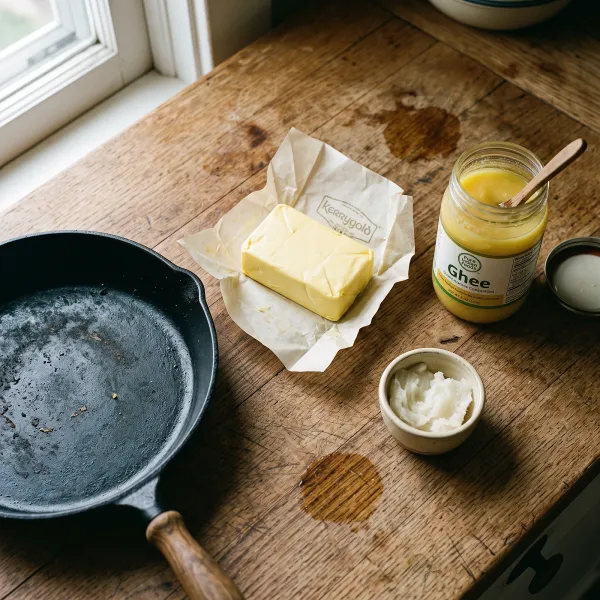
Use freely for cooking: Grass-fed butter, ghee, beef tallow, pastured lard, and unrefined coconut oil for lower-heat applications. These are stable, they've been used by humans for thousands of years, and the research supporting their demonization has serious methodological problems.
Use with intention: Extra-virgin olive oil is great for low to medium heat and for finishing and dressings. It's more stable than most people think but not the right call for a screaming-hot sear.
Use sparingly or avoid: Refined vegetable and seed oils, including canola, corn, soybean, sunflower (high-oleic is better), safflower, and cottonseed. Not because of their smoke points, but because of their high polyunsaturated fat content, their industrial processing, and their oxidative instability under heat. The fact that they dominate restaurant cooking and packaged food is a problem, not a recommendation.
This isn't about being extreme. It's about making a decision with actual information instead of a number on a label.
We were designed to eat real food. Fats that come from animals raised well and plants minimally processed have a track record that refined seed oils, invented in the 20th century, simply do not have. That matters to me, and I think it should matter to you too.
---
This article is for general informational purposes only and is not medical advice. Always consult a qualified healthcare professional before making changes to your diet or health routine.
Key Takeaways
- Smoke point measures when a fat starts to visibly smoke, not how chemically stable it is under heat. Those are two different things.
- Oxidative stability is the real indicator of a cooking fat's safety, and it is driven by the fat's structure, not its smoke point.
- Saturated fats have no double bonds and are highly resistant to oxidative breakdown under cooking heat.
- Polyunsaturated-fat-heavy seed oils can produce aldehydes and other oxidation byproducts before they ever visibly smoke.
- A major 2020 review in the Journal of the American College of Cardiology found no consistent evidence linking saturated fat intake to cardiovascular events.
- Replacing saturated fat with refined carbohydrates, the outcome of decades of low-fat guidance, was associated with worse metabolic outcomes.
- Grass-fed butter, ghee, tallow, lard, and coconut oil are chemically appropriate fats for real-food cooking.
- Refined seed oils (canola, corn, soybean, sunflower, safflower) are worth reducing, not because of their smoke points but because of their oxidative instability and industrial processing.
Frequently Asked Questions
Is saturated fat actually bad for your heart?
The evidence is far less clear than decades of dietary guidelines suggested. A 2020 systematic review published in the Journal of the American College of Cardiology found no consistent association between saturated fat intake and cardiovascular events or mortality. The review also noted that replacing saturated fat with refined carbohydrates, which became common practice during the low-fat movement, was linked to worse metabolic outcomes. This does not mean food quality and overall diet pattern don't matter, but the blanket claim that saturated fat causes heart disease is not well-supported by current evidence.
Does a high smoke point mean a cooking oil is safe?
No. Smoke point tells you when a fat begins to visibly smoke, not how chemically stable it is under heat. What matters for cooking safety is oxidative stability, which is determined by the fat's chemical structure. Refined seed oils with high smoke points can still produce harmful aldehydes and oxidation byproducts at cooking temperatures, because their high polyunsaturated fat content makes them vulnerable to oxidative breakdown. Fats higher in saturated and monounsaturated fatty acids tend to be more oxidatively stable.
What are the best fats to cook with on a paleo or real-food diet?
Grass-fed butter, ghee, beef tallow, pastured lard, and unrefined coconut oil are all solid choices for medium to high-heat cooking because of their high oxidative stability. Extra-virgin olive oil works well for low to medium heat and is excellent for dressings and finishing. Refined seed oils like canola, corn, soybean, and sunflower oil are worth minimizing, not because of their smoke points but because of their high polyunsaturated fat content and the industrial processing they undergo.
Why did doctors tell us to avoid saturated fat for so long?
The anti-saturated fat guidance traces back largely to researcher Ancel Keys and his Seven Countries Study from the 1950s and 60s, which drew a correlation between dietary saturated fat and heart disease. The problem is that the methodology has been heavily criticized: Keys had data from 22 countries and selected 7. Later analyses using all available country data found the correlation was far weaker than Keys claimed. Despite ongoing research challenging those original findings, the dietary guidelines built on Keys' work proved very difficult to change once they were embedded in public health policy.
Sources
- Acta Scientific Nutritional Health: Evaluation of Chemical and Physical Changes in Different Commercial Oils during Heating
- Journal of the American College of Cardiology: Saturated Fats and Health: A Reassessment and Proposal for Food-Based Recommendations
This article is for general informational purposes only and is not medical advice. Always consult a qualified healthcare professional before making changes to your diet or health routine.