

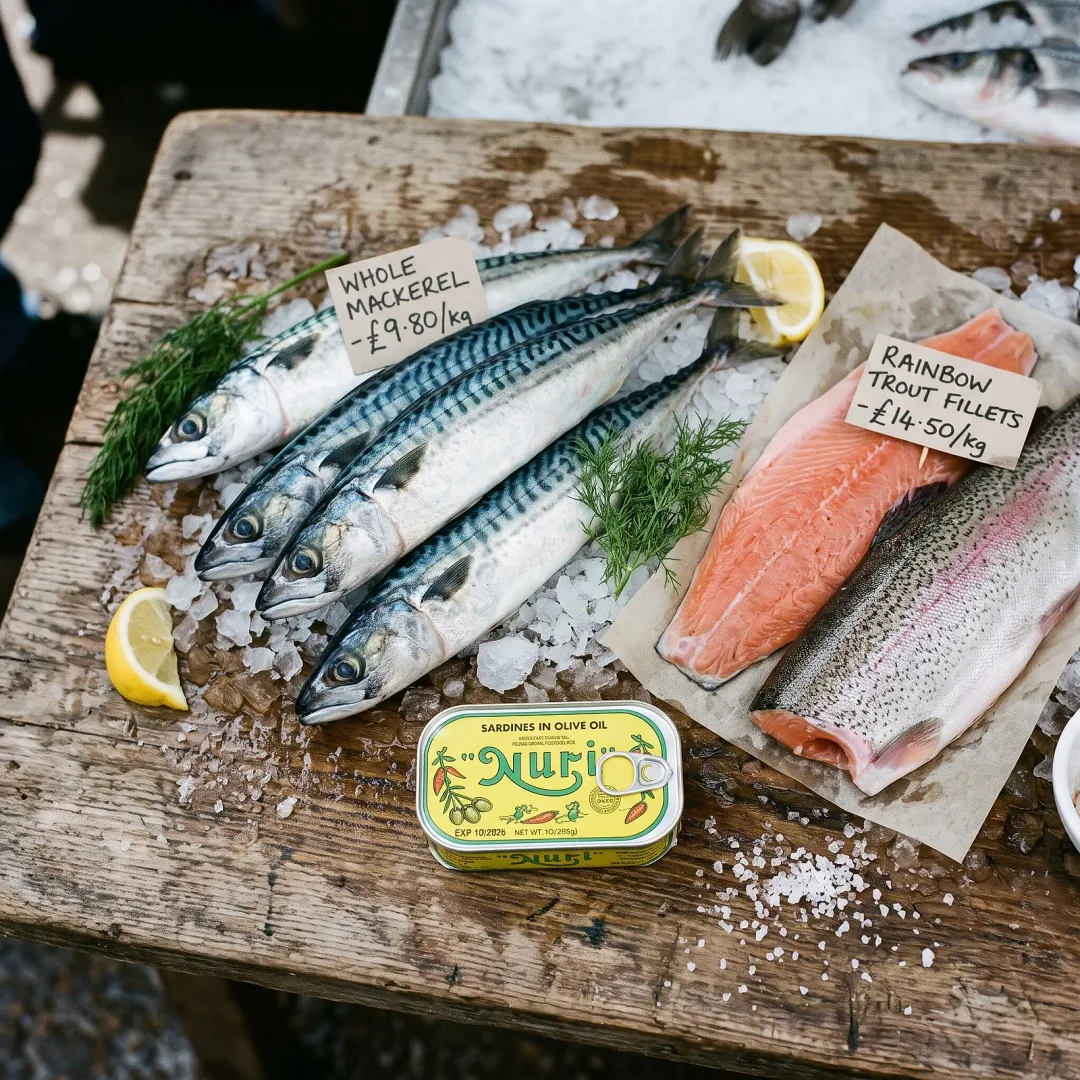

Most people grab a piece of fish at the store thinking they're making the smart, clean choice, and they are, mostly. But flip that package over and actually read it, and things get a little more complicated than you'd expect. Wild-caught, farmed, farm-raised, responsibly sourced, Atlantic, Pacific, the labels pile up fast and none of them come with a decoder ring. So let me give you one.
Why the Wild vs. Farmed Question Actually Matters
Fish is one of the most nutrient-dense foods you can put on your plate. Oily fish in particular, mackerel, sardines, rainbow trout, anchovies, are some of the richest dietary sources of omega-3 fatty acids, specifically EPA and DHA. The NIH Office of Dietary Supplements notes that these long-chain omega-3s may support cardiovascular health, brain function, and healthy inflammation response. That's the prize you're buying when you reach for a piece of fish.
The catch (yes, I went there) is that the nutritional profile of a fish is not fixed. It depends enormously on what that fish ate, where it lived, and how it was raised or caught. A wild mackerel that spent its life eating krill and small crustaceans in cold open water has a different fatty acid profile than a farmed fish that ate a pellet diet formulated in a factory. That difference matters, especially if fish is a cornerstone of how you eat.
What "Wild-Caught" Actually Means on a Label
Wild-caught means the fish was pulled from its natural habitat, ocean, river, or lake, rather than raised in an enclosed environment. That sounds simple, but the label alone doesn't tell you everything.
The U.S. requires that fish sold at retail be labeled with its country of origin and whether it's wild or farmed, under the COOL (Country of Origin Labeling) rules enforced by the USDA. So you do have a legal right to that information when you're buying whole fish or fillets at a fish counter or in a package.
What the label doesn't tell you: how far the boat traveled, how long the fish sat before it was frozen, or whether it was processed overseas before coming back to U.S. shelves. "Wild-caught" fish can be caught in Alaska, shipped to China for processing, and shipped back, all legally. The label won't flag that unless you read the fine print on country of origin.
For oily fish especially, freshness and cold-chain handling matter. The omega-3 fats in mackerel or sardines are polyunsaturated, meaning they can oxidize (go rancid) if handled poorly. Rancid fish fat is not doing you any favors nutritionally, and it tastes off too. Smell is your first quality check. Fresh fish smells like the ocean. It doesn't smell like fish.
What "Farmed" Actually Means, and Why It's Not Automatically Bad
Farmed fish has a reputation problem it doesn't entirely deserve. Aquaculture, the farming of fish and shellfish, varies wildly in quality depending on the species, the country, and the operation.
Here's what can be a problem with certain farmed operations: overcrowded conditions that increase disease pressure and require antibiotic use, the use of synthetic pigments (some farmed fish are dyed to look like their wild counterparts), and feed formulas that shift the fatty acid profile away from the omega-3s you're after. A 2005 study published in Environmental Science and Technology found elevated levels of PCBs and other contaminants in farmed Atlantic salmon compared to wild. That study specifically looked at salmon, which is why I'm not leaning on salmon as my example here, it's been talked to death, and the picture for other species looks different.
On the other hand, well-managed aquaculture operations, particularly for mussels, oysters, and rainbow trout raised in the U.S., can be clean, sustainable, and nutritionally solid. The Monterey Bay Aquarium Seafood Watch program rates specific fish and farm operations, and some farmed options earn a "Best Choice" rating. This is not a blanket condemnation of all farmed fish. It's a call to pay attention to which farmed fish and from where.
The Oily Fish Lineup: Where Wild vs. Farmed Actually Shows Up
Let me get specific, because the difference between species matters more than the general label.
Mackerel: Atlantic mackerel is almost entirely wild-caught and is one of the most affordable, nutrient-dense oily fish you can buy. It's high in EPA and DHA, and because it's small and fast-reproducing, it's also a lower-contamination choice. Canned mackerel is an underrated pantry staple. If you haven't tried it, start there.
Sardines: Almost always wild-caught. Canned sardines in olive oil or water are shelf-stable, affordable, and pack a serious nutritional punch, omega-3s, calcium (from the soft bones), vitamin D, and B12. The USDA FoodData Central database lists a 3.75-ounce can of sardines as providing over 1,300 mg of combined EPA and DHA. That's significant.
Rainbow Trout: One of the better-farmed stories in the U.S. American-farmed rainbow trout raised in freshwater raceways consistently earns high sustainability ratings from Seafood Watch, and the fatty acid profile holds up well because U.S. operations use better-formulated feed than many international ones. If you want a mild, affordable oily fish that isn't sardines or mackerel, U.S.-farmed rainbow trout is a solid pick.
Anchovies: Almost always wild-caught and tiny enough that contamination concerns are minimal. Packed with omega-3s and intensely flavored. Great in sauces, dressings, and braises even if you don't want to eat them straight.
Red Flags to Watch for When You're Shopping
These are the things that should make you pause before you put a package in your cart.
No country of origin listed. Under COOL rules, it should be there. If it isn't, that's a gap worth noting, it usually means the fish passed through enough processing steps that origin tracking was lost (or avoided).
Farmed fish from countries with weak aquaculture regulations. The FDA does inspect imported seafood, but their own data shows that only a small fraction of imported seafood is physically examined. Countries like Thailand, Vietnam, and China produce a lot of aquaculture product, and standards vary dramatically by operation. That doesn't make all of it bad, but it means the burden falls on you to look for third-party certifications.
Unusually low prices on "wild-caught" fish. Wild-caught fish costs more to produce. If a "wild-caught" fillet is priced the same as the farmed one next to it, ask questions.
Dyed fish or added sodium tripolyphosphate (STP). STP is added to some fish to retain water weight, which means you're buying water at fish prices. It shows up in ingredient lists as "sodium tripolyphosphate" or just "phosphates." Look for it, especially on frozen fillets.
What Is Actually Worth Paying More For
Here's my honest take, because I know real food costs money and not every budget has room for every upgrade.
Worth it every time: Wild-caught for any fatty fish you eat regularly. The omega-3 content, the cleaner fat profile, and the lower likelihood of dyes or antibiotic residue make the price difference meaningful. Mackerel and sardines make this easy because wild-caught is basically the only option and they're still affordable.
Worth it most of the time: Wild-caught for large, long-lived fish like tuna and swordfish. These accumulate more mercury over their lifespans, and wild-caught versions tend to be better documented for sourcing. Canned light tuna (not albacore) is lower in mercury than white albacore, per FDA guidance on fish consumption.
Okay to flex: U.S.-farmed rainbow trout, domestic mussels, domestic clams, and domestic oysters. These are cases where responsible aquaculture is genuinely well-regulated and the product is nutritionally solid. Spending extra for "wild" here doesn't always buy you more.
Not worth stressing over: The difference between wild and farmed canned sardines. Almost all commercial sardines are wild. Crack open a can, drizzle olive oil, eat over greens. Done.
The Seafood Watch app is free, it's on your phone, and it gives you real-time ratings by species and region. Use it. It's the simplest tool I know for making better choices at the fish counter without needing a marine biology degree.
A Quick Word on Certifications
Third-party certifications aren't perfect, but they're the best shorthand available when you don't have time to research every fish you buy.
Marine Stewardship Council (MSC): Blue label, wild fish. MSC certification means the fishery was independently audited for sustainable harvesting practices. It doesn't speak directly to nutritional quality, but it does mean the fishery is tracked and managed.
Aquaculture Stewardship Council (ASC): Green label, farmed fish. Similar independent audit process for aquaculture operations. An ASC-certified farmed operation is a meaningfully better choice than a randomly sourced farmed one.
Best Aquaculture Practices (BAP): Commonly seen on supermarket farmed shrimp and some fish. Four-star BAP is the most stringent tier. It's not as rigorous as ASC in my opinion, but it's better than no certification.
None of these labels are flawless, and there have been documented cases of certification bodies being slow to revoke status when problems arise. But they're a reasonable starting point when you're standing in a grocery store trying to make a fast decision.
The Bottom Line on Picking Your Fish
The goal is simple: get the fish that actually delivers the nutrition you're paying for, without a side of contaminants, synthetic additives, or a misleading label. Wild-caught oily fish, mackerel, sardines, anchovies, trout, hits that goal consistently and affordably. For everything else, knowing the species, the source country, and whether a third-party cert is on the package takes you 90% of the way there.
Fish is one of those foods where the real-food principle holds perfectly: closer to its natural state, the better. A mackerel that swam in cold open water and ate what mackerel are designed to eat is a fundamentally different food than a pellet-fed fish that never saw open water. Your body knows the difference, even if the label tries to blur it.
This article is for general informational purposes only and is not medical advice. Always consult a qualified healthcare professional before making changes to your diet or health routine.
Key Takeaways
- Wild-caught oily fish (mackerel, sardines, anchovies) consistently delivers a stronger omega-3 profile and cleaner sourcing than most farmed alternatives.
- "Wild-caught" on a label is a legal starting point, not the full story, country of origin and handling matter just as much.
- Some farmed fish (U.S. rainbow trout, domestic shellfish) are genuinely well-regulated and worth buying without guilt.
- Red flags to watch: missing country of origin, farmed fish from low-regulation countries, and added phosphates in frozen fillets.
- The free Seafood Watch app and MSC/ASC certifications are your best real-world tools at the fish counter.
- Canned mackerel and sardines are wild-caught by default, affordable, and among the most omega-3-dense foods you can buy.
Frequently Asked Questions
Is wild-caught fish always better than farmed?
Not always. Wild-caught is generally the better choice for oily fish like mackerel and sardines, where the natural diet produces a stronger omega-3 profile. But some farmed fish, particularly U.S.-farmed rainbow trout and domestic shellfish, are well-regulated and nutritionally solid. The species and the source country matter more than the wild vs. farmed label alone.
How can I tell if fish is really wild-caught at the store?
U.S. law requires that packaged fish sold at retail be labeled with its country of origin and whether it's wild or farm-raised, under USDA Country of Origin Labeling (COOL) rules. If that information is missing from a package, that's a red flag. Third-party certifications like the Marine Stewardship Council (MSC) blue label add another layer of verification for wild-caught claims.
What are the best oily fish to buy for omega-3s?
Mackerel, sardines, and anchovies are consistently among the highest in EPA and DHA omega-3 fatty acids, and they're almost always wild-caught commercially. U.S.-farmed rainbow trout is another strong option. The USDA FoodData Central database lists a standard can of sardines as providing over 1,300 mg of combined EPA and DHA, a meaningful amount from an affordable, shelf-stable source.
What does 'sodium tripolyphosphate' in fish mean?
Sodium tripolyphosphate (STP) is a food additive sometimes used in frozen fish fillets to help retain moisture, which means the fish holds extra water weight, and you're paying fish prices for water. It's legal and common, especially in imported frozen fillets. Check the ingredient list on any frozen fish you buy; a clean fillet should list nothing but the fish itself.
Sources
- NIH Office of Dietary Supplements: Omega-3 Fatty Acids: Fact Sheet for Health Professionals
- USDA Agricultural Marketing Service: Country of Origin Labeling (COOL)
- Environmental Science and Technology (ACS Publications): Global Assessment of Organic Contaminants in Farmed Salmon
- Monterey Bay Aquarium Seafood Watch: Seafood Watch Recommendations
- USDA FoodData Central: Sardines, canned in oil, drained, Nutrient Data
- U.S. Food and Drug Administration: Seafood Import Program
- U.S. Food and Drug Administration: Advice About Eating Fish
This article is for general informational purposes only and is not medical advice. Always consult a qualified healthcare professional before making changes to your diet or health routine.

Join the conversation
What do you think?
Free members can comment, reply and like. It takes ten seconds.