
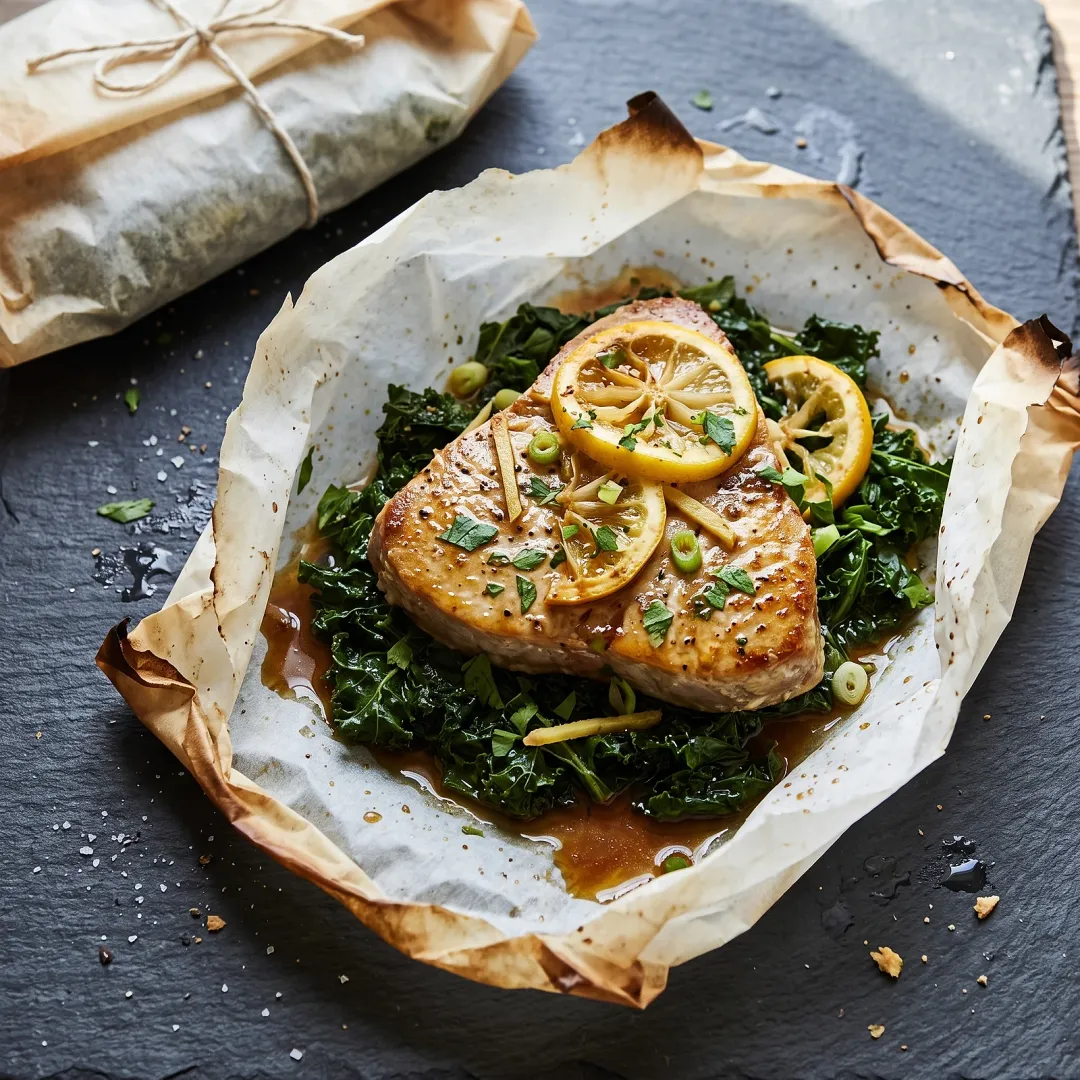

My oven has seen a lot of salmon. A lot of chicken thighs. The usual rotation. So when I finally put a tuna steak into a parchment parcel with a handful of pantry staples that lean Japanese, I stood at the counter eating straight out of the paper while the second portion was still cooling. That's the honest review. Fish en papillote sounds like a restaurant technique, and it is, but it's also one of the most forgiving things you can do on a weeknight. You fold up a piece of parchment, shove it in the oven, and the steam does everything. No pan to watch, no oil splatter, no overcooked fish. The parchment traps every drop of that ginger-coconut aminos-garlic liquid, and the kale below the tuna soaks all of it up while it wilts. What you get when you tear that parcel open is something that smells wild-good, looks intentional, and tastes like you spent way more time than you did. For anyone on the Autoimmune Protocol, this one is clean from top to bottom. No exceptions, no workarounds. Tuna, kale, real food, real flavor.
Nutritional Benefits
Wild-Caught Tuna
- One of the richest whole-food sources of protein available, with roughly 40 grams per steak to support muscle repair and immune function.
- Provides omega-3 fatty acids EPA and DHA, which research consistently links to lower levels of systemic inflammation, a central driver of autoimmune flares.
- Rich in selenium, a mineral that plays a direct role in thyroid hormone conversion, something especially relevant for anyone managing Hashimoto's or another thyroid-related autoimmune condition.
- A solid source of B12 and niacin, both critical for neurological function and energy metabolism.
Kale
- One of the most nutrient-dense leafy greens available, high in vitamins K, A, and C.
- Contains sulforaphane precursors and antioxidants that support the body's natural detoxification pathways.
- Provides calcium and magnesium without any dairy, important for bone health and muscle function on elimination diets.
- The brief steam inside the parcel softens the oxalates slightly, making the nutrients a bit more available.
Fresh Ginger
- Gingerols and shogaols, the active compounds in fresh ginger root, have well-documented anti-inflammatory properties.
- Supports healthy digestion and can reduce nausea, a benefit for anyone whose gut is still healing.
- Adds enormous flavor without any AIP-problematic spices, making it an anchor ingredient in elimination-phase cooking.
Coconut Aminos
- A soy-free, gluten-free alternative to soy sauce that delivers the same savory umami depth without any of the problematic compounds in soy.
- Naturally lower in sodium than conventional soy sauce.
- Made from fermented coconut sap, so it carries a gentle natural sweetness that balances the ginger and lemon perfectly.
Extra Virgin Olive Oil
- High in oleocanthal, a polyphenol with anti-inflammatory action that some researchers compare to ibuprofen at meaningful dietary doses.
- The fat in the olive oil helps your body absorb the fat-soluble vitamins A and K present in the kale.
- Cold-pressed and minimally processed, it is one of the few oils that is both AIP-compliant and backed by decades of research.
FAQs
Can I use frozen tuna steaks?
Yes, but thaw them completely in the refrigerator overnight and pat them very dry before assembling the parcels. Excess moisture from a poorly thawed steak will water down the sauce and throw off the cook time.
Can I swap the kale for another green?
Absolutely. Swiss chard or collard greens both work well here. Remove the thick stems either way. Collards will need the same bake time; chard is a little more tender and will be perfectly wilted at 16 minutes.
What if I only have one type of parchment and it seems small?
Use two overlapping sheets per parcel if your parchment is narrow. The seal is what matters, not the exact shape. You can also use foil if you are out of parchment, though you lose a little of the dramatic tearopen moment.
Does this recipe fit the AIP elimination phase?
Every ingredient here meets the AIP elimination phase guidelines as written. No grains, legumes, dairy, eggs, nuts, seeds, seed-based spices, nightshades, or alcohol. If you are unsure about your specific health situation, work with a practitioner who knows your history.
How do I know when the tuna is done without opening the parcel mid-cook?
For a one-inch steak at 400°F, 16 minutes gives you a center that is just barely pink and very moist. 18 minutes will be fully cooked through. If your steaks are thinner than an inch, check at 13 to 14 minutes by carefully peeling back one edge of the parcel. Better to peek than to overcook.
Can I make this ahead of time?
You can assemble the sealed parcels up to four hours ahead and keep them in the refrigerator. Pull them out 15 minutes before baking so the fish is not ice cold going into the oven, and add two minutes to the bake time to account for the chill.
If you made this one, I genuinely want to know how it landed. Drop a comment below and tell me if you went with kale, chard, or collards, and whether you let it rest the full two minutes or tore it open the second it came out of the oven (no judgment, I have done both). Save this to your AIP dinner board, share it with someone who thinks eating for autoimmune health has to be bland, and if you are newer here, check out the other AIP-tagged recipes. This is real food. It is supposed to taste good.
Tuna and Wilted Kale en Papillote with Ginger, Coconut Aminos, and Lemon
A thick tuna steak baked inside a sealed parchment parcel on a bed of fresh kale, steamed with fresh ginger, coconut aminos, garlic, olive oil, and bright lemon slices. Clean, fragrant, and hands-off, this Japanese-inspired AIP-friendly dinner is ready in under 30 minutes and arrives at the table in its own parcel.
Ingredients
- 2 tuna steaks (6 to 8 oz each, about 1 inch thick)
- 4 cups fresh kale, thick stems removed, leaves roughly torn
- 2 tablespoons coconut aminos
- 1 tablespoon extra virgin olive oil, plus more for brushing parchment
- 1 tablespoon fresh ginger, peeled and finely grated
- 3 cloves garlic, thinly sliced
- 1 lemon, half thinly sliced into rounds, half reserved for squeezing
- 1/4 teaspoon fine sea salt
- 2 scallions, trimmed and cut into 2-inch lengths
- 1 tablespoon fresh flat-leaf parsley, roughly chopped, for finishing
Instructions
- Preheat your oven to 400°F and cut two large sheets of parchment paper, each roughly 16 by 12 inches.
- Lightly brush the center of each parchment sheet with a small amount of extra virgin olive oil to prevent sticking.
- Divide the torn kale evenly between the two parchment sheets, piling it in the center of each. The kale will look like a lot, that is exactly right. It wilts down beautifully inside the parcel.
- In a small bowl, whisk together the coconut aminos, 1 tablespoon olive oil, grated ginger, and sliced garlic. Stir to combine.
- Lay the tuna steaks on top of each kale bed. Spoon the coconut aminos and ginger mixture evenly over each piece of tuna, letting it run down into the kale.
- Sprinkle sea salt over each tuna steak. Lay two or three lemon rounds on top of each steak and scatter the scallion pieces over the kale.
- To seal each parcel, bring the two long sides of parchment up over the tuna and fold them together tightly in small overlapping folds, working down toward the fish. Twist or fold the ends shut to trap the steam inside. The parcel should feel like a secure little package.
- Place both parcels on a rimmed baking sheet. Transfer to the preheated oven and bake for 16 to 18 minutes. At 16 minutes the tuna will be just slightly pink in the center (ideal for a thicker steak). At 18 minutes it will be cooked through and opaque.
- Remove the baking sheet from the oven. Let the parcels rest for 2 minutes, they hold heat well.
- Carefully cut or tear open each parcel (watch the steam). Squeeze the reserved lemon half lightly over each portion, scatter fresh parsley over the top, and serve the whole parcel on the plate so everyone gets the full moment of opening it themselves.
Nutrition per serving
- Calories: 310
- Total Fat: 11g
- Carbohydrates: 9g
- Protein: 42g
- Dietary Fiber: 2g
- Sugar: 3g
 That Paleo Chick
Real food that heals
RecipePaleoDinnerGluten-Free

Fits these needs
Checked ingredient by ingredient. Tap one to see every recipe that fits.
Ingredients
Instructions
Nutrition Facts Amount per serving
Estimated from the ingredients. Values vary with brands and portions.

Join the conversation
Made it? Tell us how it went.
Free members can comment, reply and like. It takes ten seconds.