


Most people who try a low-histamine diet quit too early or stay on it way too long. And either way, they end up with no real answers. That frustrates me, because histamine intolerance is one of those conditions where the elimination trial is basically the diagnostic tool. If you rush it or you drag it out indefinitely, you lose the data. You lose your chance to actually understand what is happening in your body.
What Histamine Intolerance Actually Is (And What It Isn't)
Histamine intolerance is not a food allergy. That distinction matters, and it changes everything about how you approach it. With a true IgE-mediated food allergy, your immune system is reacting to a specific protein. With histamine intolerance, the problem is more about a bucket overflowing. Your body takes in histamine from food, produces some of its own, and relies on enzymes, primarily diamine oxidase (DAO) and histamine N-methyltransferase (HNMT), to break it down. When that breakdown process is impaired, histamine accumulates and symptoms follow.
According to a 2021 review published in Nutrients, histamine intolerance is estimated to affect roughly one percent of the population, though researchers acknowledge it is likely underdiagnosed because its symptoms overlap so heavily with other conditions: migraines, skin flushing, nasal congestion, digestive upset, heart palpitations, anxiety, and fatigue. These symptoms look like a dozen other things, which is part of why so many people go years without a clear picture.
This is also why histamine intolerance is not something you diagnose yourself. Symptoms should always be discussed with a clinician who can rule out mast cell activation syndrome, allergies, small intestinal bacterial overgrowth, and other conditions that can look identical. A low-histamine trial is one tool in that process, not the final word.
Myth #1: Two Weeks Is Long Enough to Know If the Diet Is Working
This is probably the most common misfire I see. Someone commits to a low-histamine diet for two weeks, feels only marginally different, and assumes the diet is not helping. Or they feel significantly better, reintroduce a few foods too quickly, symptoms flare, and they're back to square one with no clarity about which foods triggered what.
Two weeks is not enough time for a meaningful low-histamine trial. Most functional-medicine practitioners and gastroenterology-oriented researchers recommend a minimum of four weeks, with some extending that to six to eight weeks for people who also have gut involvement, because it takes time for the gut lining to calm down, for histamine load to meaningfully drop, and for your symptom pattern to stabilize enough to be readable.
The Cleveland Clinic notes that a low-histamine elimination diet is the primary way clinicians and patients identify histamine intolerance, and that the process involves both a restriction phase and a structured reintroduction phase. You cannot assess what you did not complete. Four weeks at minimum for the restriction phase is not excessive. It is the point at which you start to have something worth evaluating.
For reference, most formal elimination diet protocols, including those used in food sensitivity research, use four to six weeks of strict elimination before any reintroduction begins. The reasoning is simple: some symptoms are slow to resolve even when the trigger is removed, especially when gut inflammation is part of the picture. Calling it too early just means you're drawing conclusions from incomplete data.
Myth #2: Strict Low-Histamine Forever Is the Goal
This one goes the other direction. Some people find partial relief on a low-histamine diet, get nervous about reintroducing anything, and end up on an extremely restrictive eating pattern for months or years. That approach has real costs: nutritional gaps, social isolation, a complicated relationship with food, and, ironically, a gut environment that may be getting worse rather than better because it's missing the diversity it needs.
The goal of a low-histamine elimination trial is not permanent restriction. It is information gathering. You are using a temporary, structured reduction in dietary histamine to determine whether histamine load is contributing to your symptoms, and then you work back toward the broadest possible diet your body can comfortably tolerate.
A 2019 review in the Journal of the Academy of Nutrition and Dietetics looked at food elimination diets broadly and emphasized that prolonged elimination without supervised reintroduction carries its own risks, including nutritional inadequacy and disordered eating patterns. The authors are clear that elimination is phase one, and reintroduction is not optional. It is how you get your life back.
For histamine intolerance specifically, the endpoint is not a permanent low-histamine diet for most people. It is an understanding of your personal threshold, which foods you tolerate well, which push you over the edge, and what other factors (stress, sleep, hormonal shifts, gut health) affect your bucket size.
Myth #3: Salmon Is Off the Table If You Have Histamine Intolerance
Fresh salmon confuses a lot of people because fish in general has a reputation as a high-histamine food. And that reputation is not wrong for fish that has been sitting around. Histamine forms in fish and other proteins through a process called bacterial decarboxylation: bacteria convert the amino acid histidine into histamine, and that process accelerates with time, temperature abuse, and improper storage. Canned, smoked, fermented, and older fish are legitimately high in histamine.
But fresh or properly frozen salmon is a different story. Research published in the journal Foods and cited by food safety bodies confirms that histamine levels in fresh fish are low and only rise significantly when fish is stored improperly or processed through smoking, fermenting, or canning. Fresh, wild-caught salmon that has been properly handled and kept cold, or that was flash-frozen immediately after catch, is generally considered appropriate during a low-histamine trial by most practitioners working in this space.
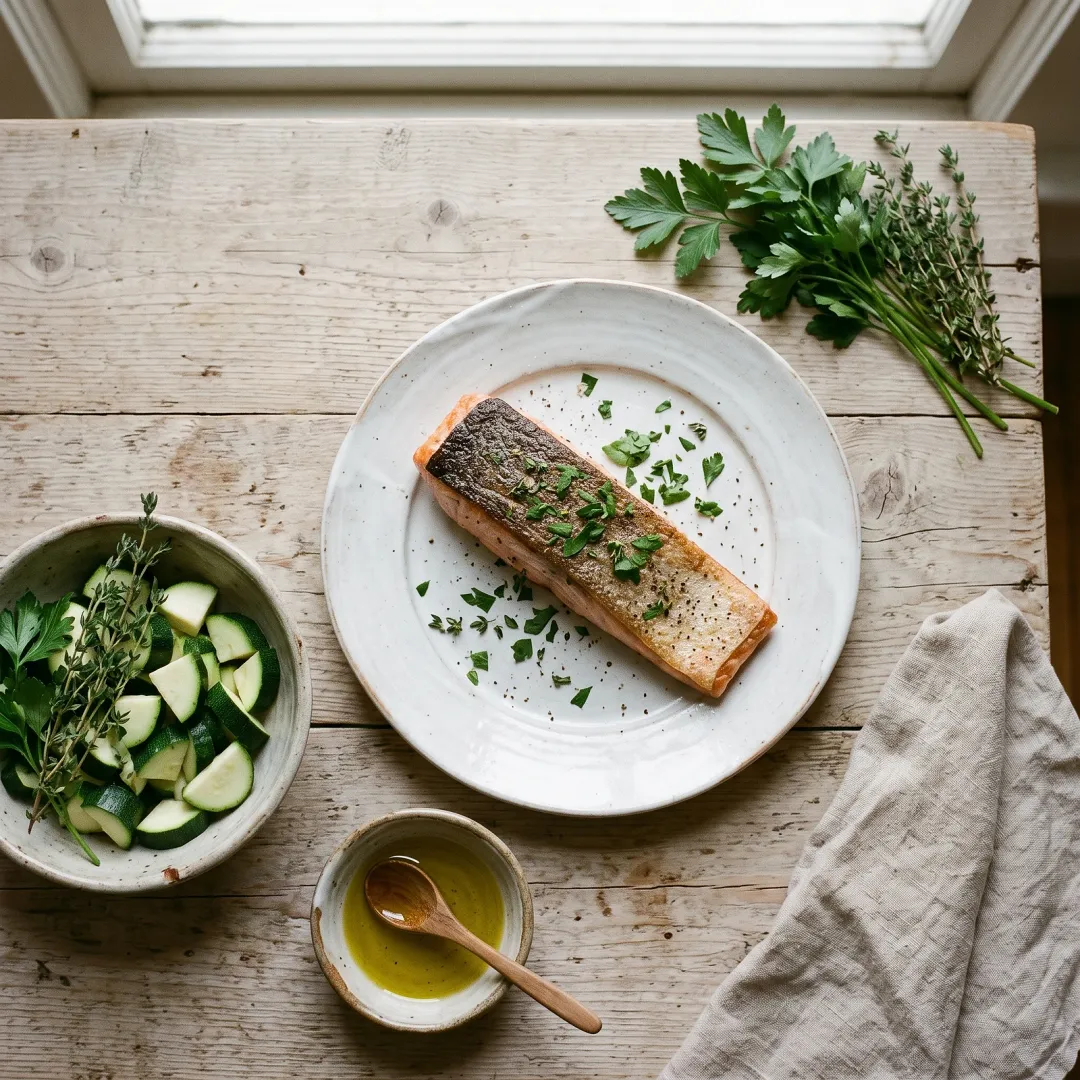
For practical purposes during your trial: buy fresh salmon the day you cook it, or use salmon that was commercially flash-frozen and has been in your freezer, not thawing and refreezing repeatedly. Cook it simply. Lemon is a histamine liberator for some people, so skip that for now and season with fresh herbs and olive oil. This matters because protein adequacy during an elimination trial is important. You do not want to accidentally under-eat protein because you've cut out too many sources based on an oversimplified list.
Myth #4: If Symptoms Don't Improve on a Low-Histamine Diet, Histamine Isn't the Problem
This myth is understandable but it's not the whole picture. A low-histamine trial that produces no symptom improvement could mean a few things, and "histamine isn't involved" is only one of them.
First, the trial may not have been strict enough. Histamine hides in a lot of places people don't expect: vinegars, fermented condiments, bone broth (which is high because of the long collagen-extraction cook time), leftover cooked meat, certain herbal teas, and even some food additives. If the trial wasn't comprehensive, the load may not have dropped enough to see a change.
Second, something else may be driving symptoms. Mast cell activation syndrome (MCAS), which involves dysregulated mast cell behavior beyond just histamine, can look almost identical to histamine intolerance and may not respond to dietary histamine restriction alone. The American Academy of Allergy, Asthma and Immunology outlines how MCAS differs from simpler histamine intolerance and why evaluation by an allergist or immunologist is important when a dietary trial is not producing expected results.
Third, the DAO enzyme deficiency that underlies many cases of histamine intolerance may itself have a root cause: gut permeability, gut dysbiosis, certain medications (including some commonly prescribed drugs that inhibit DAO activity), or nutritional deficiencies in the cofactors DAO needs to function, including vitamin B6, copper, and vitamin C. Addressing dietary histamine while the enzyme is still impaired for another reason may not produce the relief you expected. That is not a reason to give up. It is a reason to go deeper with a clinician.
Myth #5: Reintroduction Means Eating Whatever You Want and Seeing What Happens
Unstructured reintroduction is a waste of everything you just did. After four to six weeks of a careful elimination phase, your reintroduction needs to be methodical or you will not come out the other side with useful information.
The standard approach: introduce one higher-histamine food at a time, in a normal serving size, and wait two to three days before introducing anything else. Track your symptoms during that window. If you introduce three new foods in the same week and symptoms flare, you have no idea which one triggered the response.
This is also where working with a registered dietitian who is familiar with elimination protocols is genuinely useful. The Academy of Nutrition and Dietetics has resources on finding a registered dietitian who specializes in food sensitivities and elimination diets, and I'd encourage anyone navigating this to use that support rather than guessing their way through reintroduction alone.
The reintroduction phase typically takes another four to six weeks when done properly. So the total trial, elimination plus reintroduction, is often two to three months. That sounds like a long time. But it is far shorter than spending years symptomatic and confused because you never got clean data.
What to Track During Your Trial
A symptom diary is not optional here. Because histamine intolerance symptoms are so varied and because factors like stress, sleep, the hormonal cycle, and alcohol all affect your histamine bucket independently of food, you need a written record to see patterns that your memory will miss.
Track daily: what you ate, sleep quality, stress level, any symptoms and when they occurred, any medications or supplements taken. For women, tracking where you are in your cycle is also relevant. Research suggests that estrogen can stimulate histamine release and histamine can in turn affect estrogen levels, meaning some women experience their worst histamine symptoms in the days before menstruation when estrogen fluctuates. That pattern, if it shows up in your diary, is important clinical information for your doctor.
You are looking for two things: overall symptom burden going down during elimination, and specific triggers becoming identifiable during reintroduction. If you are not tracking in writing, you are essentially doing the trial in the dark.
The Bigger Picture: Histamine Is a Bucket, Not a Switch
The bucket model is the most useful mental framework for living with histamine intolerance long-term. Your bucket has a capacity. Everything that adds histamine, whether that is food, alcohol, stress, poor sleep, gut dysbiosis, or hormonal shifts, fills it. Symptoms appear when the bucket overflows. Your job is not to empty the bucket permanently by eating nothing with histamine. That's not realistic and it's not healthy. Your job is to understand your bucket's size and keep the total load below your personal threshold most of the time.
For most people, that means some combination of: keeping dietary histamine moderate (not zero), supporting DAO enzyme function through gut health and nutrition (ask your doctor or a registered dietitian about whether DAO-supporting nutrients are appropriate for you), managing the non-food contributors to the bucket (sleep, stress, alcohol), and knowing which high-histamine foods are worth it to you on occasion and which ones reliably push you over.
A 2021 narrative review in Nutrients specifically frames histamine intolerance management as a personalized, threshold-based approach rather than blanket avoidance, and that framing lines up with what functional medicine practitioners see in practice. You are not building a prison of food rules. You are building a map of your own body.
The low-histamine trial is how you start drawing that map. Four to six weeks of careful elimination, followed by four to six weeks of methodical reintroduction, with a symptom diary running the whole time, and a clinician involved to rule out other conditions and interpret the results. That is the process. It's not fast, but it works when it's done right.
Key Takeaways
- A low-histamine elimination trial should last a minimum of four weeks (many practitioners recommend four to six weeks) before you draw any conclusions about whether it is helping.
- The elimination phase is only half the protocol. Structured reintroduction, one food at a time with two to three days between each, is how you identify your personal triggers.
- Fresh, properly handled salmon is generally appropriate during a low-histamine trial. Histamine in fish accumulates through improper storage and processing, not because fish is inherently high-histamine.
- If the trial produces no improvement, consider whether it was strict enough, whether another condition like MCAS may be involved, or whether DAO enzyme function needs deeper investigation with a clinician.
- A symptom diary is not optional. Stress, sleep, hormonal shifts, and alcohol all affect your histamine bucket independently of food, and you need written data to see the full pattern.
- The goal is not permanent, strict restriction. It is understanding your personal threshold and maintaining the broadest diet your body can comfortably tolerate.
Frequently Asked Questions
How long should I follow a low-histamine diet before I see results?
Most practitioners recommend a minimum of four weeks for the elimination phase of a low-histamine trial, with some extending that to six weeks for people with significant gut involvement. Two weeks is generally not enough time for histamine load to drop meaningfully and for your symptom pattern to stabilize. After the elimination phase, a structured reintroduction period of another four to six weeks is needed to identify specific triggers. Always work with a clinician who can help interpret your results.
Can I eat salmon on a low-histamine diet?
Fresh or properly flash-frozen salmon is generally considered appropriate during a low-histamine elimination trial. Histamine in fish builds through bacterial activity during improper storage, smoking, fermenting, or canning. If you buy fresh salmon and cook it the same day, or use commercially flash-frozen salmon without repeated thawing and refreezing, histamine levels are typically low. Avoid canned, smoked, or leftover cooked fish during the elimination phase.
What happens if a low-histamine diet doesn't improve my symptoms?
A lack of improvement could mean the trial was not strict enough, that another condition such as mast cell activation syndrome is involved, or that an underlying issue like gut dysbiosis or a DAO enzyme deficiency is preventing improvement even with dietary restriction. If a carefully conducted low-histamine trial produces no change, that is important information to bring back to your doctor or an allergist for further evaluation.
Do I have to stay on a low-histamine diet forever?
No. The goal of a low-histamine elimination trial is information gathering, not permanent restriction. The aim is to identify your personal histamine threshold and which foods push you over it, so you can return to the broadest possible diet your body can comfortably tolerate. Most people land on a moderate, threshold-based approach rather than blanket avoidance. Prolonged strict restriction without supervised reintroduction carries its own nutritional and health risks, so working with a registered dietitian through the reintroduction phase is strongly recommended.
Sources
- Nutrients (MDPI): Histamine Intolerance: The Current State of the Art
- Cleveland Clinic: Histamine Intolerance
- Journal of the Academy of Nutrition and Dietetics (ScienceDirect): Elimination Diets and the Risks of Prolonged Restriction
- Foods (MDPI): Histamine Formation in Fish and Fishery Products
- American Academy of Allergy, Asthma and Immunology: Mast Cell Diseases
- PubMed Central (NIH): The Interplay Between Histamine and Estrogen
- Academy of Nutrition and Dietetics: Find a Registered Dietitian Nutritionist
Cook for it
Start with one of these Low-Histamine recipes:
- Provençal Braised Cod on Roasted Butternut Squash with Herbes de Provence and Garlic
- Herb-Scented Sole en Papillote over Zucchini with Garlic, Dill, and Roasted Red Onion
- Roasted Beets Stuffed with Herbed Ground Pork and Wilted Leeks
Browse every Low-Histamine recipe
This article is for general informational purposes only and is not medical advice. Always consult a qualified healthcare professional before making changes to your diet or health routine. Nothing here diagnoses, treats or cures any condition, and food is support alongside medical care, not a replacement for it. If you have, or think you may have, the condition discussed here, work with your doctor or a registered dietitian, and do not start, stop or change any medication without talking to them first.


Join the conversation
What do you think?
Free members can comment, reply and like. It takes ten seconds.